
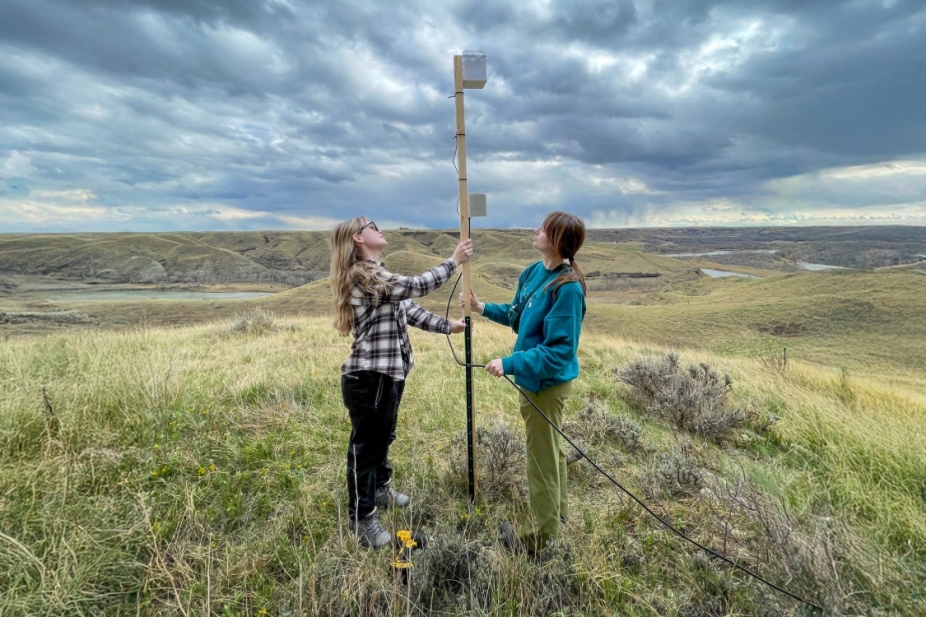
 Natalie Emerick and Madison Bygrove trekked across Canada installing 100 audio recorders. (Photo courtesy of Dan Mennill/University of Windsor)
By Sara Elliott
Every night during spring migration, millions of birds cross Canada in darkness, calling out to one another to stay together.
Until now, no one was listening.
A University of Windsor research team is changing that.
Motus Audio, a collaboration between UWindsor and Birds Canada, has deployed 100 acoustic recorders from Vancouver Island to Newfoundland — the first coast-to-coast network designed to capture the sounds of nocturnal bird migration across Canada.
Natalie Emerick (BIAS ’25) and Madison Bygrove (BSc ’25) are the master’s students behind what the team calls “an acoustic fence” along the southern Canadian border.
“This is altogether a new era of migration monitoring,” says Dr. Dan Mennill, project lead and ornithology professor in the Department of Biology.
“This technology gives us new ways to detect migrants – as long as they call out during spring and fall migration.”
While most people are asleep, microphones pointed at the night sky will record migrating birds calling to one another from sunset to sunrise. Researchers focus on nighttime recordings because birds migrate at night, when they can travel safely without the presence of daytime predators such as hawks.
“In the safety of darkness, they call out like cyclists riding through the fog during the Tour de France yelling navigation calls of ‘I’m over here,’” says Mennill.
The audio signals are transmitted to computers where specialized software decodes sounds to identify species. With thousands of detections each night, the recorders allow the researchers to estimate changes in bird populations. The long-term goal of Motus Audio is to create a clearer picture of which bird populations are thriving and which are in decline.
For Emerick and Bygrove, one of the project’s greatest advantages is that the data can be collected without disturbing birds.
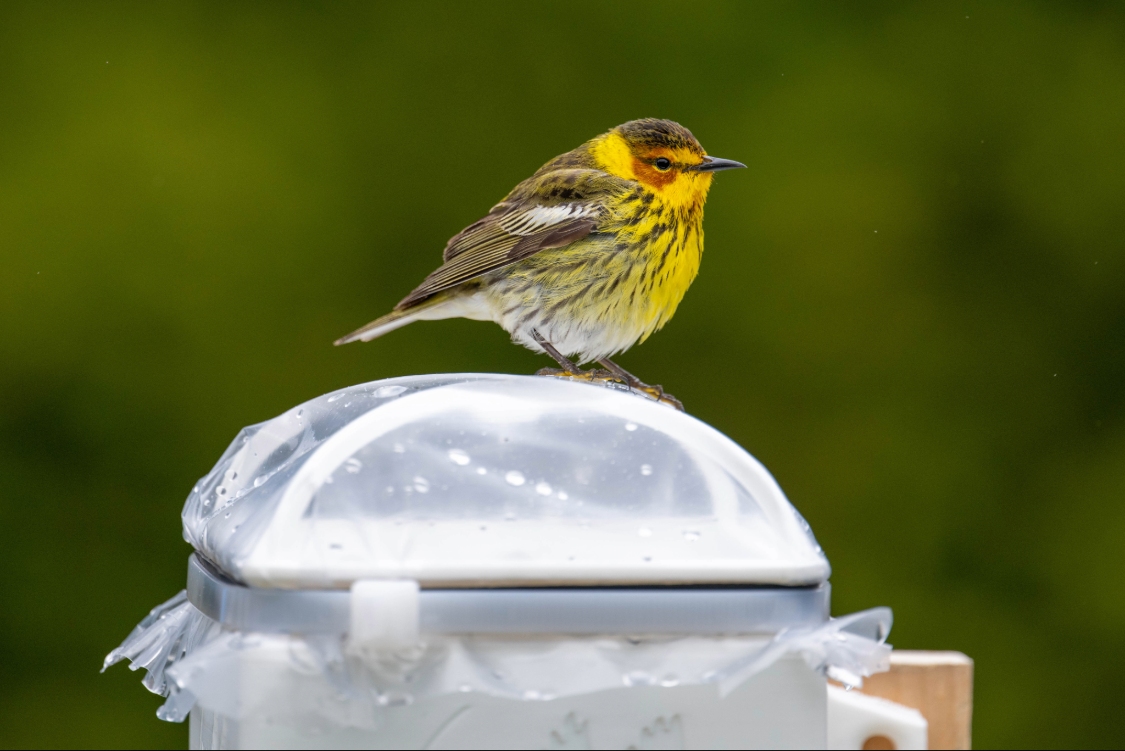
Cape May warbler perched on a Motus Audio recorder. (Photo by A. Desrochers/University of Windsor)
“Radiotracking technology relies on tagging and adding some sort of weight to migrating birds,” says Emerick. “While it gives us valuable data, it can be invasive.”
“What's cool about the Motus Audio project is that we’re using a Canada-wide monitoring system as a way of acoustically tracking bird populations without having to interfere with them.”
The birds, captured only by bioacoustics, will help pinpoint migration activity.
“We’re peeking into the window of overnight migration,” says Emerick.
This type of large-scale monitoring is the first of its kind. It promises to shed light on migratory behaviour that occurs under the cover of darkness.
“Unless people are taking point counts every night, which is quite hard when you're in the dark and the birds are flying high overhead and you're just listening for tiny little cheeps,” Bygrove says.
The team hopes the recordings will reveal where birds are travelling and when migration begins and how different species respond to various environmental conditions, including light pollution.
Previous Windsor-led research has shown artificial light can disorient birds during migration. Light pollution can set the birds off course, increase fatigue and contribute to deadly collisions with buildings.
“Our research team has found that birds make more nocturnal flight calls in areas with high light pollution as a way to maintain flock cohesion and orient themselves towards where they need to go,” says Emerick.
The Motus Audio system will allow researchers to compare how birds experience light differently in areas of high and low levels of artificial light across Canada. Similar studies have been conducted on smaller scales, but the researchers say no one has attempted a network of this size.
Preparation for the trip started months before they set out. The biggest challenge was developing the recording system and then assembling the recording kits which each consisted of two 3D printed items: a microphone box and a computer box.
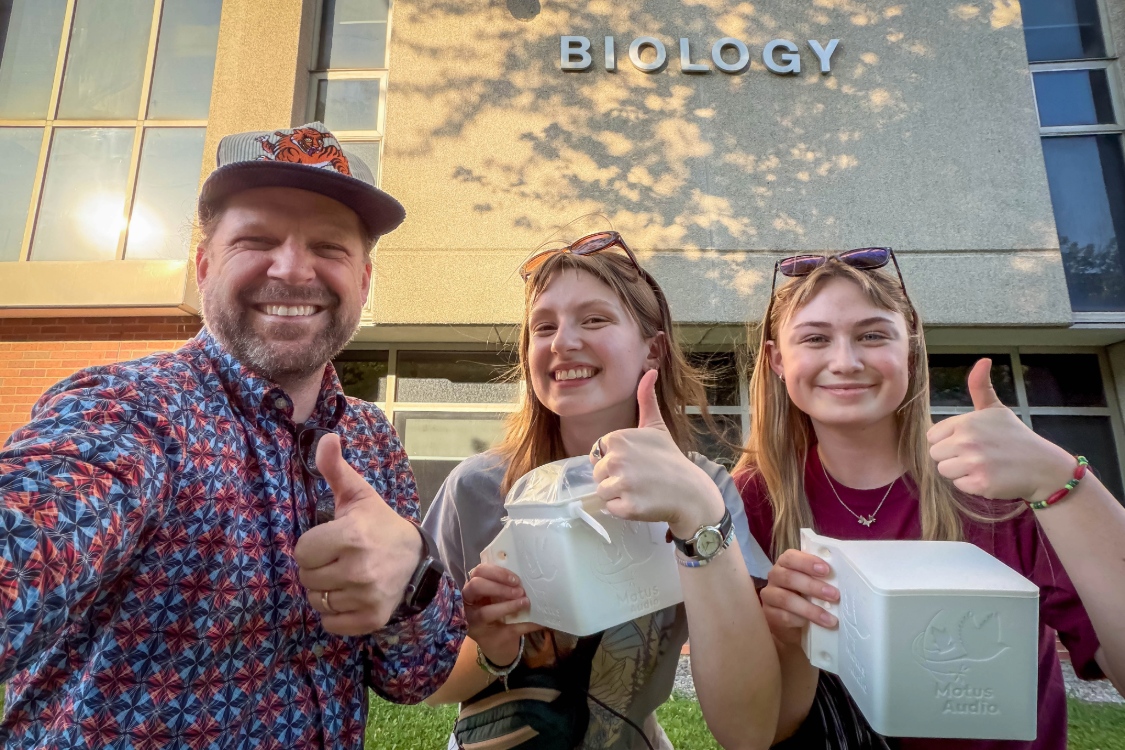
From left, Dan Mennill, Natalie Emerick and Madison Bygrove show off their recording kits on campus before the trip began. (Photo courtesy of Dan Mennill/University of Windsor)
Working with one of Mennill’s former graduate students, Lincoln Savi, they created a custom design using Savi’s 3D printing company, SaviMade.
“The 3D-printed recorder is so small and easy that you can put it up in people's backyards in an hour,” says Bygrove.
“I think a lot of people expect us to pull up with this giant van and we come out of a little minivan with two little boxes.”
The research team included an assembly line of undergraduate student researchers. Once completed, the first batch of kits was shipped out to Vancouver ahead of the students’ arrival.
In early April, Emerick and Bygrove flew to Vancouver, rented a Chrysler Pacifica minivan, and began installing recorders. Once on the road, they visited popular bird migration sites, including bird observatories, nature centres, parks and private backyards. The pair built a community of volunteers along the way.
“We have a really interesting connection of community science volunteers across Canada,” says Emerick. “Some of these people are ornithologists or they're bird lovers that we knew through birding communities.”
As a way to share their data and give back to the people who helped them along the way, the team created a public dashboard. Anyone can see which species have so far been detected by the recorders. This dashboard is available on the Motus Audio website.
“I think even the non-bird people have really enjoyed logging on and seeing their detections,” says Emerick.
“A friend of a friend was so excited to see different sparrows on the dashboard. It's been so fun talking to everybody and seeing everybody's different perspectives and how excited they are to watch our journey.”
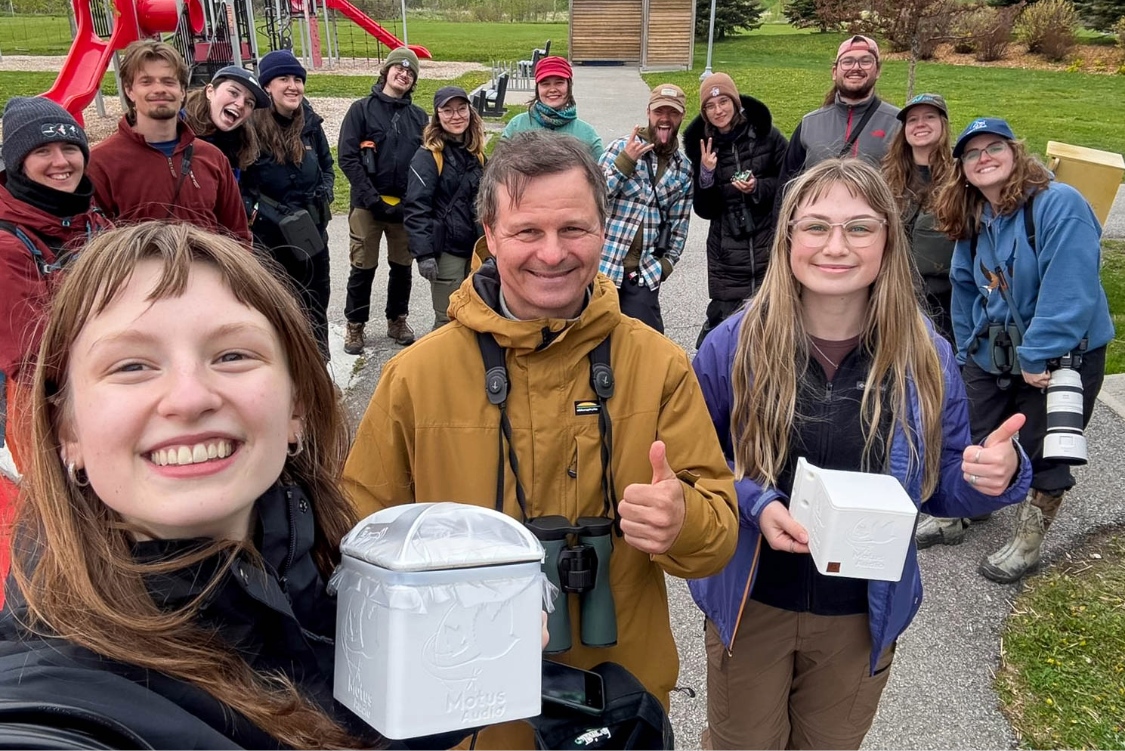
Natalie Emerick and Madison Bygrove befriended many birders as they made their way across Canada. (Photo courtesy of Dan Mennill/University of Windsor)
Beyond birds, the once-in-a-lifetime trip came with other perks. As they drove across the coountry, the students spotted harbour seals in British Columbia, a bear in Sault Ste. Marie, and a whale in Quebec.
“Nanaimo on Vancouver Island was another big highlight for us,” says Bygrove.
“We got to go to the raptor centre where they train tons of raptors, and they did a flying demonstration for us where they had birds flying over our heads and we saw baby barn owls – it was so special.”
The pair made a pact to complete a hike for every Motus Audio recorder they set up.
“We parked right at Lake Louise and walked on to the lake because it was frozen solid and it was beautiful,” says Emerick.
“We were also very excited about all the new bird species we observed. We saw mountain bluebirds, a California quail, a bunch of American avocets.”
People can also follow the two-month trip on Motus Audio Instagram channel.
Motus Audio is an offshoot of Birds Canada’s Motus Wildlife Tracking System. For the past 10 years Motus has used radio telemetry towers across North America to detect tagged birds in flight. Researchers hope the addition of bioacoustic monitoring, using Motus Audio recorders, will provide a more complete picture of bird migration.