
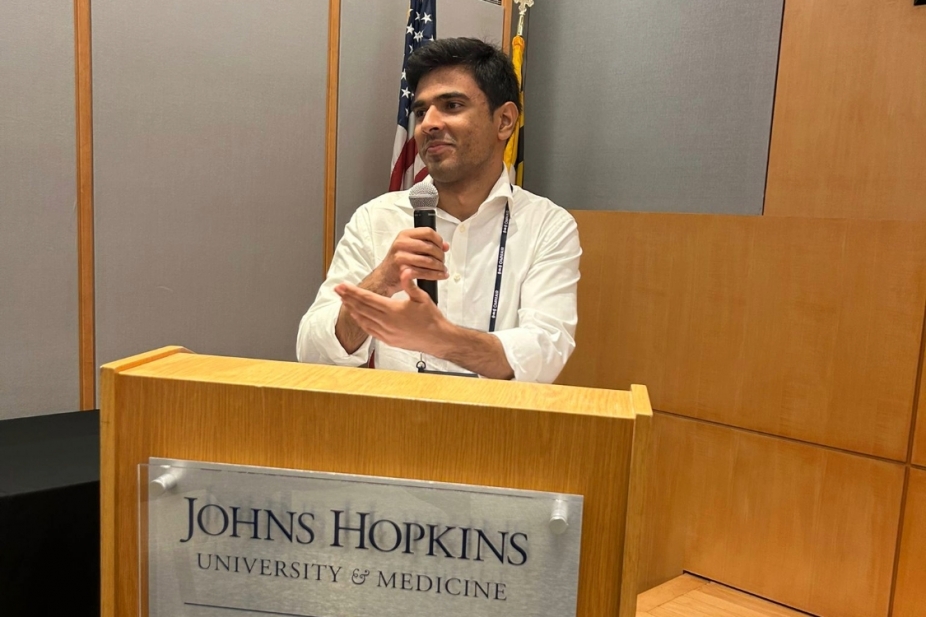
 Hashim Tayyab Shah presents at the inaugural OmniAir Hackathon held at Johns Hopkins University in Baltimore. (Courtesy of Hashim Tayyab Shah/University of Windsor)
By Sara Elliott
A future where vehicles communicate directly with one another is not so distant — but is the technology safe enough to deploy?
That question was at the centre of the inaugural OmniAir Hackathon held at Johns Hopkins University in Baltimore, where three University of Windsor graduate students earned first place for their research.
School of Computer Science master’s students Amitoj Birah, Hashim Tayyab Shah and Saumya Buch developed realistic scenarios challenging potential safety gaps in the emerging field of Vehicle-to-Everything (V2X) technology.
“They're sort of developing the tech and you're saying, ‘Hold on just a second, these scenarios could happen,’” says Shah.
The team’s winning concept focused on fraudulent emergency-braking messages transmitted through V2X communication networks.
“We had to create a misbehaviour scenario, show how it would impact people on the road and propose ways to mitigate it,” says Shah
In one scenario, the team suggested a roadside transmitter could falsely report that a vehicle was braking, causing nearby vehicles to slow down. The tactic could be used to slow traffic in front of a business, increasing visibility and potentially attracting customers.
In a more serious scenario, a fake braking message could trigger a chain reaction resulting in gridlock or even collisions.
“This could have a ripple effect and essentially lock the whole traffic system — a highway or even a city-wide blocking system,” says Birah.
“Vehicles that depend on V2X communications would receive this data which could potentially cause whole city gridlock.”
The team presented simulations demonstrating how false messages, whether malicious or accidental, could affect traffic flow.
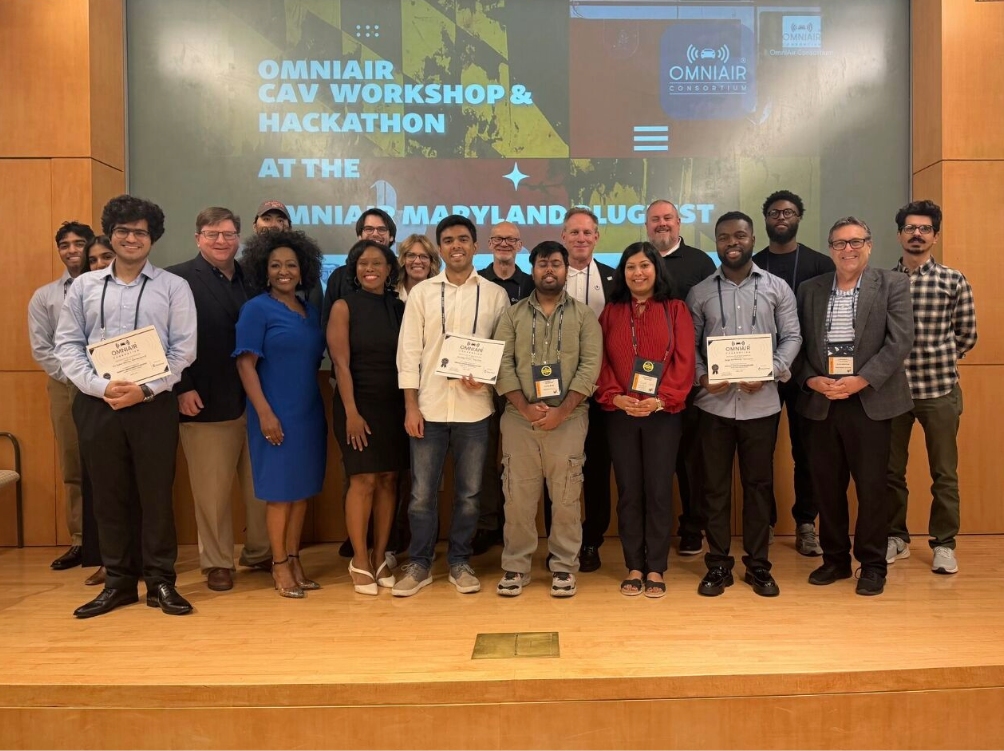
Competitors of the inaugural OmniAir Hackathon gather at Johns Hopkins University in Baltimore. (Courtesy of Hashim Tayyab Shah/University of Windsor)
“Amitoj created a simulation that was a great visualization tool to help others see the impact of these different attacks that could take place,” says Buch.
Hackathon participants were challenged to identify different types of misbehaviour as well as suggest methods of prevention or mitigation using V2X networks.
“Whether there is a sensor that's sending out faulty information, if it's accidentally sending out this false braking information, or if someone's purposefully sending out this braking information,” says Buch.
“The hackathon was on the concept of creating scenarios or finding scenarios where these misbehaviours could happen then also looking at generating solutions that could help counter these misbehaviours on the road.”
Organized by OmniAir, a wireless industry consortium focused on connected and automated vehicle technologies, the event brought students together with leading V2X testing, certification and security experts.
“It was exciting because the people sitting in front of us were the people who are actually creating these things that we are researching,” says Shah.
The team adds that the ultimate goal is to stop these issues from occurring.
“We're basically trying to mitigate any potential hurdles that may come up with V2X communication,” he says.
The emerging field of vehicular communication has the potential to significantly improve road safety, if implemented correctly.
“That's basically a network between vehicles used to avoid collision and reduce traffic congestion,” says Birah.
“Cars can talk with each other about their status, but the main point is to make the roads safer by allowing the cars to communicate and transfer more data to each other.”
Researchers and automakers are rapidly gaining interest in the emerging communications field.
“OmniAir is basically the forefront of this V2X or vehicle-to-vehicle technology,” says Shah.
“They are the people making the standards for how this technology should be implemented.”
Dr. Ikjot Saini, a professor in the School of Computer Science and the students’ supervisor, says the achievement is a testament to the dedication, curiosity, and teamwork of the students in her research lab.
“Over the past year, they have immersed themselves in V2X cybersecurity research, and it was incredibly rewarding to see them apply that knowledge to solve a real-world challenge alongside some of the brightest students from leading institutions,” says Saini.
“I couldn't be prouder of how they represented the University of Windsor.”