
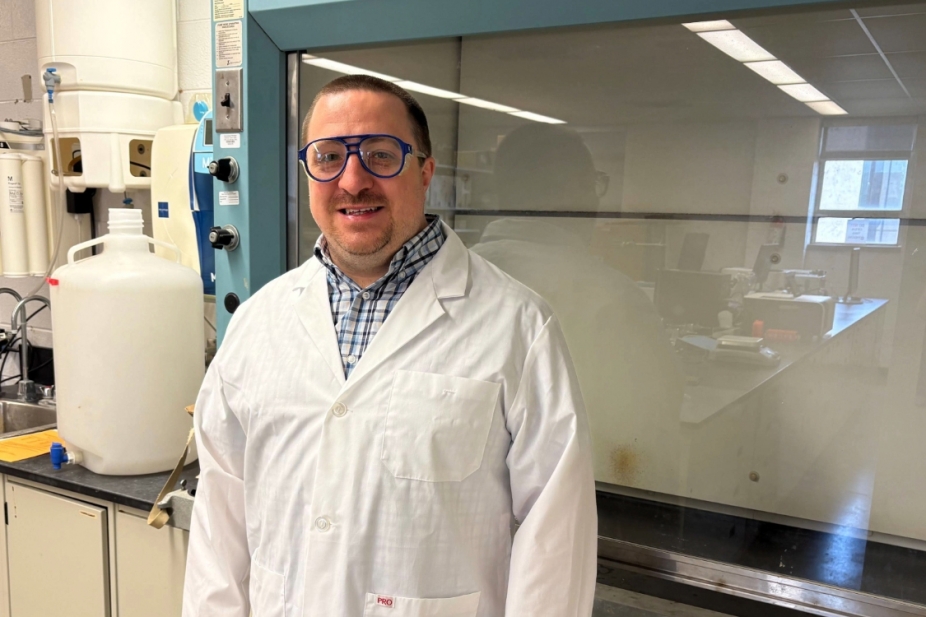
 Dr. Scott Harroun’s microscopy image, Nanoscale signaling, is a top 20 finalist in the Acfas La preuve par l'image photo contest. (SARA ELLIOTT/University of Windsor)
By Sara Elliott
The glittering gold and red image titled Nanoscale signaling is in striking contrast to the research behind it.
What appears to be a thing of beauty is, in fact, lung cancer cells studded with gold nanoparticles.
The image was captured by University of Windsor chemistry researcher Dr. Scott G. Harroun, along with his colleague and former advisor, Dr. Michel Meunier of Polytechnique Montréal, during Harroun’s post-doctoral work in an engineering physics lab.
“Each of these nanoparticles is chemically bound to antibodies, which allow them to attach to proteins expressed on the surface of the cells,” says Harroun.
“Because each type of antibody only attaches to one type of protein, by using different antibodies, in principle, we could determine the type of cancer cell involved and the best treatment to fight it.”
“Using this technique, called immunoplasmonics, we attach the antibody-nanoparticle bioconjugates onto the cells,” he says. “If the protein is there, they stick, and if it's not there, they'll rinse off.”
Harroun’s microscopy image is a top 20 finalist in the Acfas La preuve par l'image photo contest which is open to public voting.
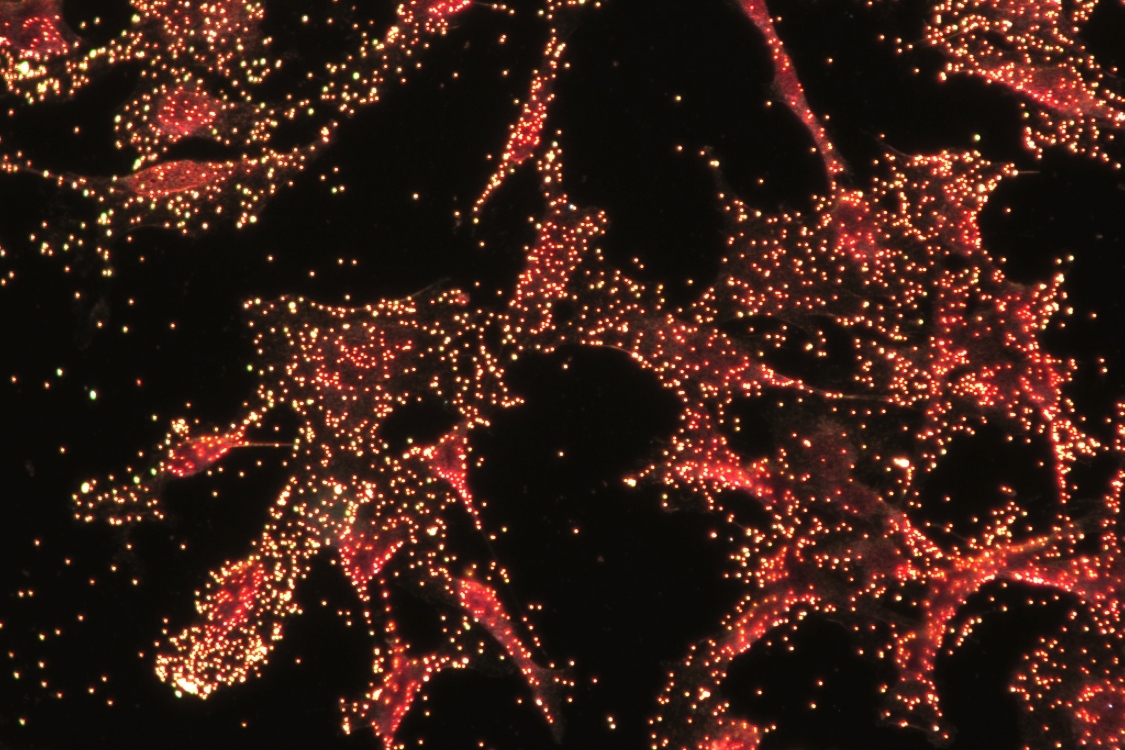
The glittering gold and red image titled Nanoscale signaling was captured by University of Windsor chemistry researcher Dr. Scott G. Harroun, along with his colleague and former advisor, Dr. Michel Meunier of Polytechnique Montréal. (Courtesy of Scott G. Harroun/University of Windsor)
“Cell lines express certain proteins, and that makes them a useful model because different types of cancer will also express different types of proteins,” says Harroun.
“But here's where it gets complicated. It's not just one protein that needs to be determined. It could be several and running a dozen different tests introduces challenges for the doctor.”
That is where Harroun comes into the process.
To make proteins detectable under a microscope, researchers attach gold or silver nanoparticles that scatter light.
“When the light hits the nanoparticles, it gets set off in a different direction and we can see it.”
The method, known as side-illumination dark-field microscopy, allows nanoparticles with different compositions, shapes and sizes to appear as different colours. Now researchers can see the cancer as well as determine protein levels by counting the nanoparticles.
“My role in the project was to work on the chemistry of how the antibody attaches to the nanoparticles.”
His co-authored research paper on the technique was published in Analysis & Sensing.
“The next stage could involve applying this chemistry, or similar chemistry, to other colours of nanoparticles so that one could run multiple tests simultaneously,” he says.
Computer software can then digitally count the number of dots of each colour, which could help inform a doctor which treatment to use.
“From the physician's point of view, if they see a particular protein being expressed on the cell, then it may respond to a certain treatment,” says Harroun.
“Or if it's not expressed, then it likely won’t respond to that treatment,” says Harroun.
A highlight of the project for Harroun was the interdisciplinary collaboration between chemists, physics engineers, biomedical engineers and people on the medical side.
Harroun’s Advanced Biosensing and Nanotechnology Lab is currently focusing on other forms of cancer-detection and creating nanoscale tools for biochemistry, including DNA-based sensors that employ fluorescence and Raman spectroscopy.
The French-language public photo competition is featured on Radio-Canada and the Acfas website. It is the French-language equivalent of the English-language "Science Exposed" competition held by the Natural Sciences and Engineering Research Council of Canada (NSERC).