
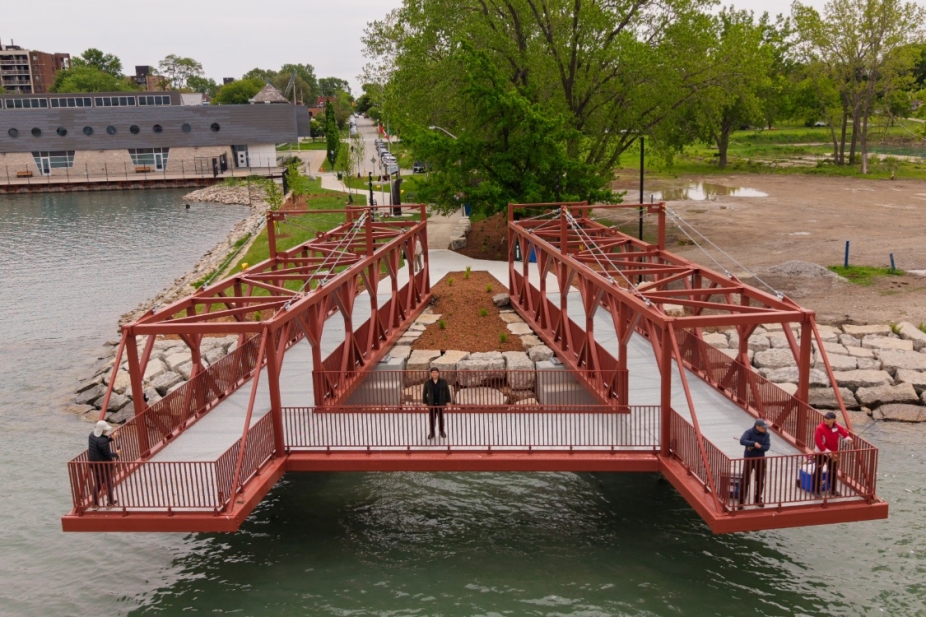
 University of Windsor Visual Arts and Built Environment program coordinator and architect Jasson Grossi standing at the front at the Queen's Dock Cultural Pier in Windsor, Ont. (PETER MARVAL/ University of Windsor)
By Lindsay Charlton
At the foot of Mill Street in Windsor’s Sandwich Town, a new pier is giving residents a fresh perspective on the Detroit River.
Within moments after the Bexhigoyaak Pier, also known as the Queen’s Dock Cultural Pier, opened this spring, people were casting lines into the water — something pier and park designer Jason Grossi was happy to see.
“It’s always great to see it come to life,” said Grossi, who is also a professor and coordinator of UWindsor’s Visual Arts and Built Environment program. “This is what the Port Authority wanted, to make sure people could always get to the water, and that the water would be part of the sustenance of life here in Sandwich.”
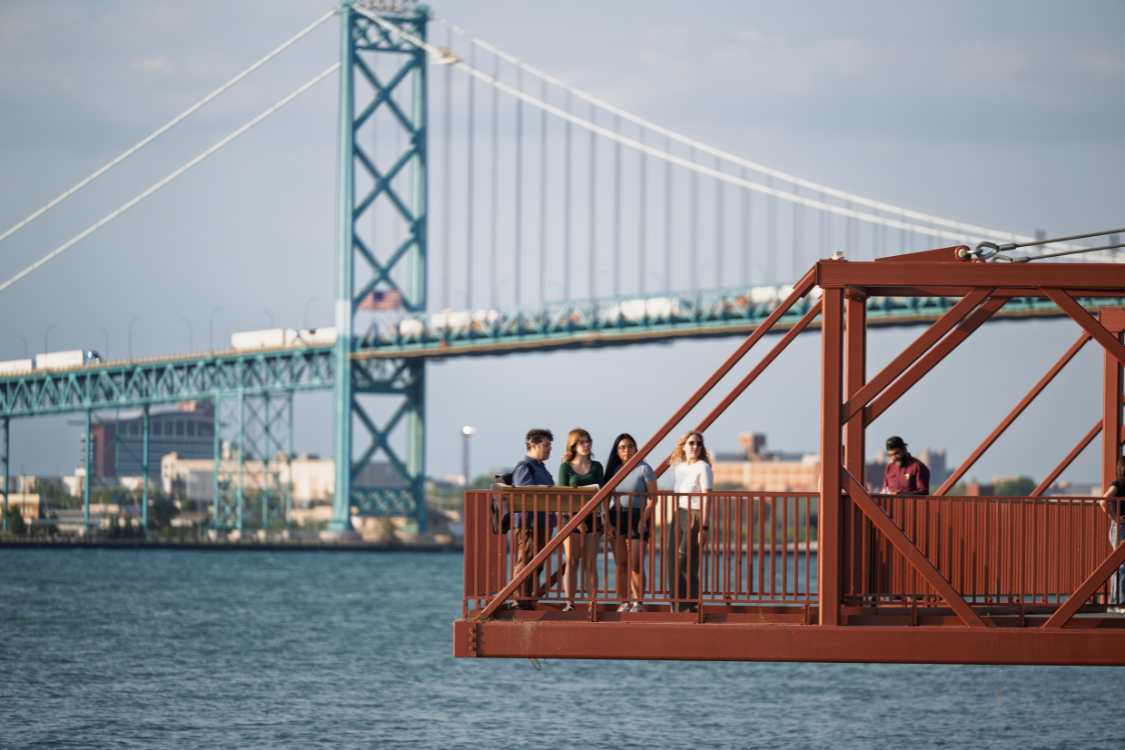
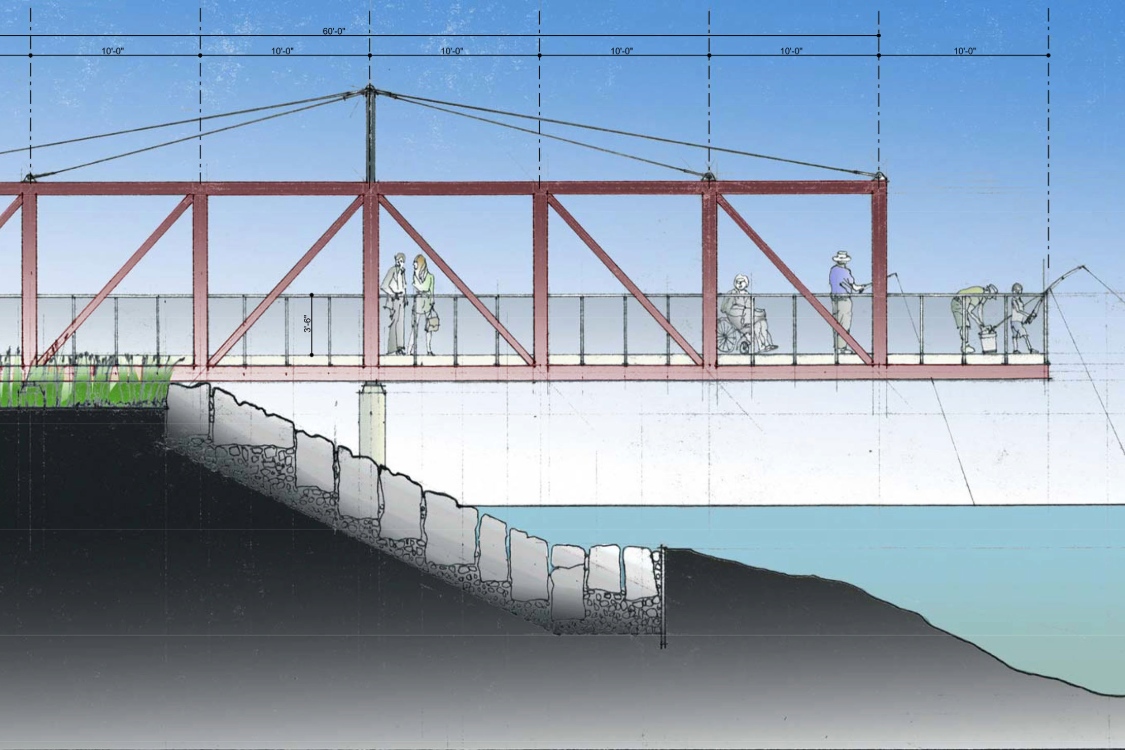
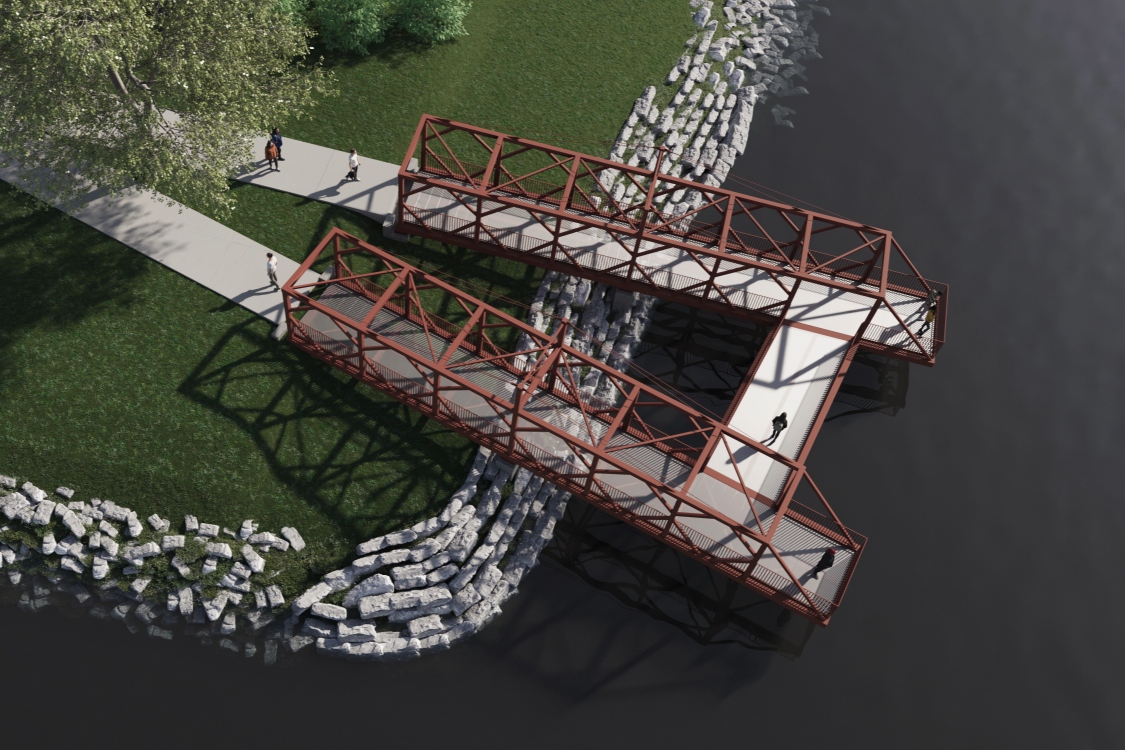
Located at Queen’s Dock Park within Port Windsor’s green space, the pier extends more than 40 feet over the Detroit River on cantilevered portal frames — a bridge between bridges offering novel views of the Gordie Howe International Bridge and the Ambassador Bridge.
“There is no such asset we have here,” Grossi said. “To stick out that far on the water, it presents a view to the river that is completely unique; one you can experience from a stationary point of view as opposed to being in the water.”
The pier was part of a $2.5-million project partly funded through the Gordie Howe International Bridge Community Benefits Plan.
Port Windsor and other partners also contributed to the project, which includes an expanded pedestrian pathway, interpretive signage with QR codes, Indigenous artwork and a ceremonial space curated by First Nations leaders.
“Projects of this magnitude just don’t happen in a vacuum. They are born from vision, fueled by collaboration, and built through unwavering partnership,” Harbour Master Peter Berry said at the pier’s opening in May.
Well before the pier was conceptualized, Russell Nahdee, a retired learning specialist with the Aboriginal Education Centre (Turtle Island), went to Berry with an idea.
“He said, ‘We need something to find our First Nations on the waterfront. There's nothing here,’” Berry recalled. “I told him we had some property at the park and asked if this was a good spot to start.”
When it was time for Grossi to pull together a team for a separate project surrounding the Ojibway Parie Complex, he included Nahdee, UWindsor sessional instructor Dr. Will Tape, as the structural engineer on the project and a thesis student. While that initiative ultimately fell through, he kept the same group in place for the cultural pier.
“When Peter (Berry) contacted the structural engineer and me to discuss the idea of a pier and the Queen's Dock Park. I told him that I had a strong team already in place for that project that would be perfect for this,” Grossi said.
“When Peter heard that Russell was on this team, he smiled and said, ‘I know Russell. Russell suggested that we do something with the water a long time ago. He definitely needs to be part of this.’”
Grossi said it was an interesting turn of events and a “serendipitous” way for the group to find themselves on the same project once again.
He said Nahdee was instrumental in bringing the pier to fruition.
“My main role is really bringing all the players who are doing the work together, connecting people,” Nahdee said.
Nahdee took Grossi and others involved to Walpole Island, where they learned about Indigenous traditions that would be honoured in the pier’s design.
“From the very conception of the design, it all worked out because Russell was on the team,” Grossi said.
“He explained how, when Indigenous peoples fish, they always come in from the east side and come together, then leave from the west side,” Grossi said. “We included that in the design while being able to circumambulate around.”
Nahdee, a Walpole Island resident who lived in Windsor’s west end while studying at the University of Windsor, said he is pleased to see new community spaces include Indigenous features.
“There are so many incredible stories there,” he said. “Now we have this, and the Herb Gray Parkway Trail, and some really important, spectacular things happening.”
Nahdee said federal projects require consent from local First Nations, and that considerations around land claims for the Bexhigoyaak Pier helped shape an important element of the design.
“The water between the United States and Canada, beyond the shore, is not ratified by any treaty because that all belongs to us, First Nations,” he said. “So that led to the idea behind the pier: Why don’t we put the stand over the water?”
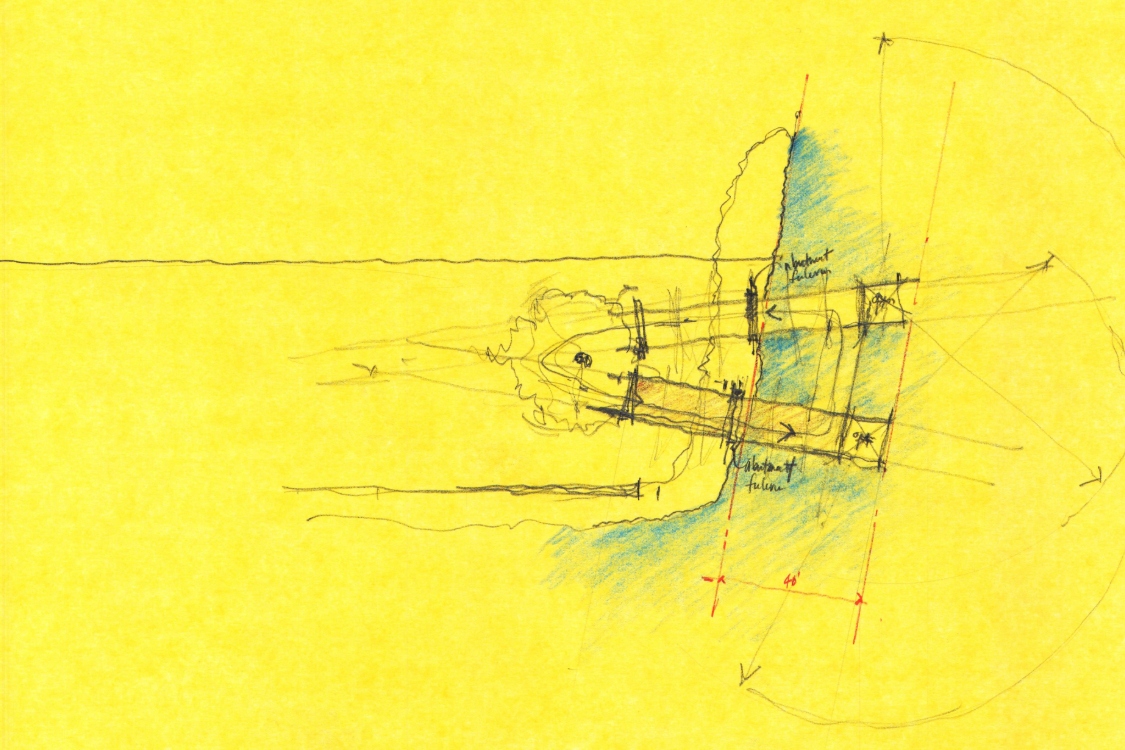
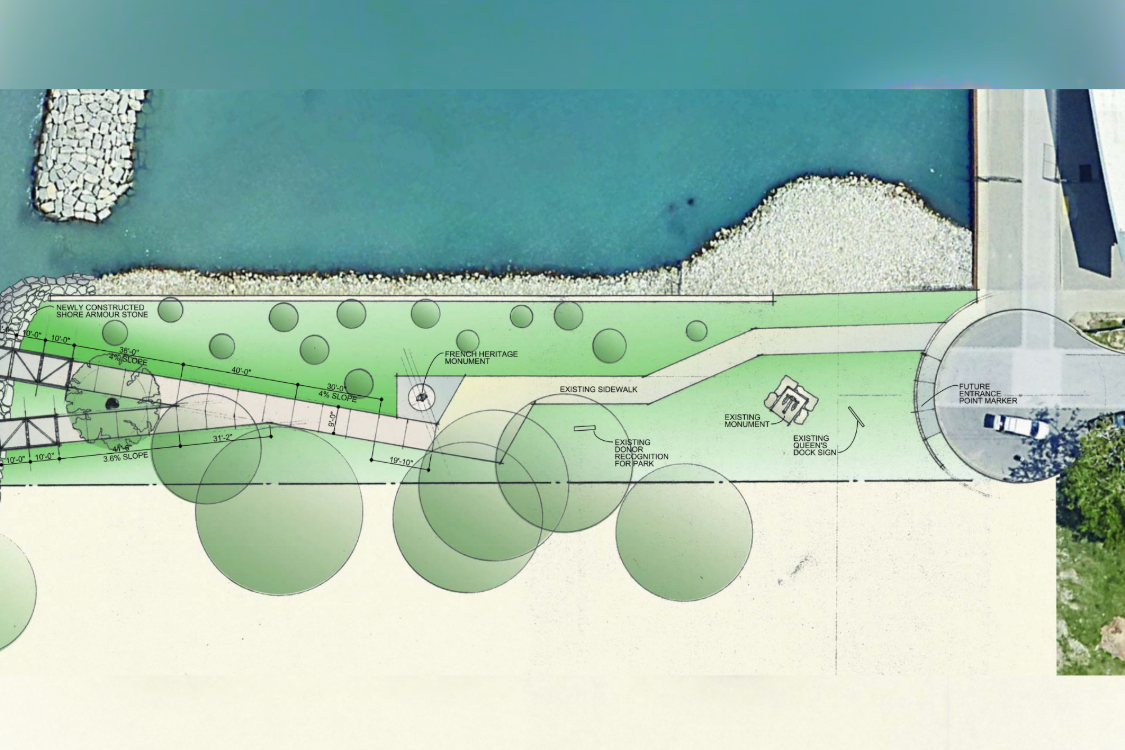
Rather than resting in the water, the pier reaches out over the Detroit River, supported by tubular frames that splay outward to form a bridge anchored deep in the bedrock.
“We already have the two bridges that are cable-supported, and we needed some sort of counterpoint in between them, so I took the concept of a tubular frame like in a high-rise building, but I just turned it so it would extend out,” Grossi explained.
Developing this concept took a lot of “back and forth” and weekend work, Tape noted.
“As I modelled it out, I’d change something, or Jason would ask for something, and this is where it landed with a lot of unique solutions.”
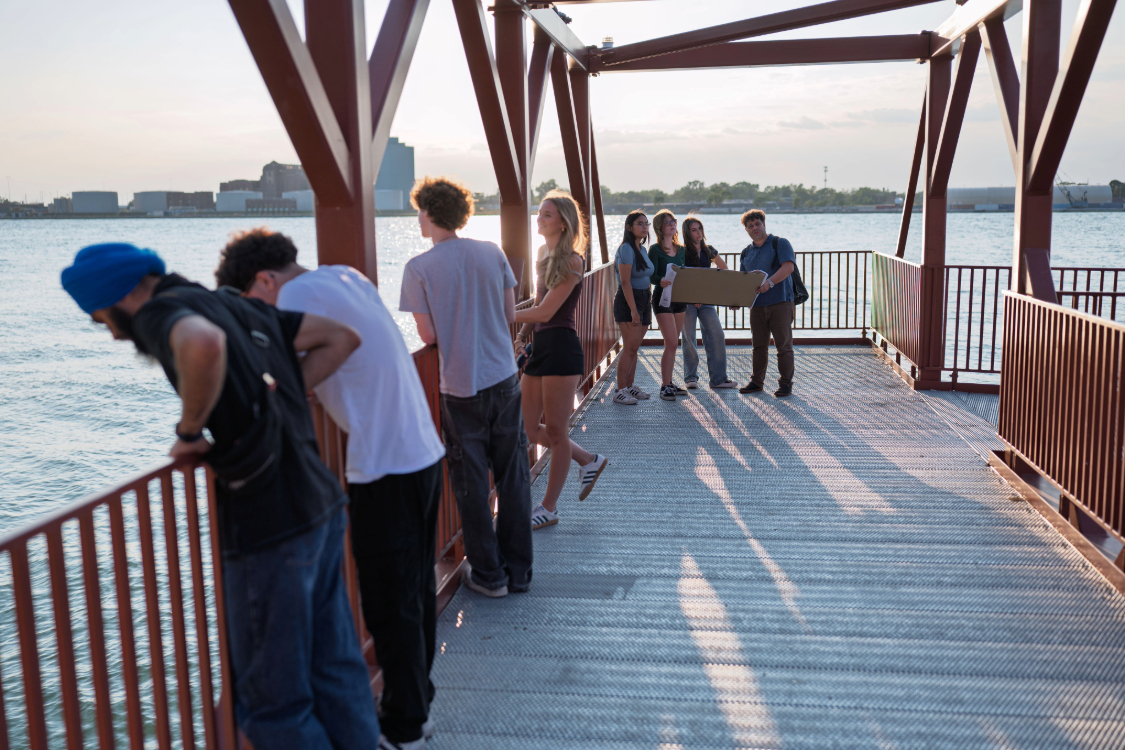
Organized by Tape, University of Windsor students also visited the site to observe the piles being driven into the bedrock.
“This became a chance for community involvement and learning simultaneously,” he said.
Tape said one of his students, Felicia Cranes, a graduate of the Civil and Environmental Engineering program, did her capstone on this project.
“One of the coolest things about working on it is just seeing how much the design changes from the original,” Cranes said. “It just shows how much planning and progress it takes to build something like this.”
The design also reflects the region’s industrial and port traditions, Grossi said.
“You can see the natural red oxide we always painted our structures with,” he said. “And, of course, when the boats go by, red oxide is the colour used to keep steel from rusting, so it was something that identified with the sort of things that were along the water’s edge.”
Grossi is pleased the project creates another way for people to connect with the historic neighbourhood and its waterfront.
“It's a great spot to start to talk about the history of our area, and specifically the history of Sandwich, which really is not talked about enough,” he said. “It's probably one of the most unique histories of any place in Canada, and it really should be celebrated and taught more, so that our next generation can learn it.”