
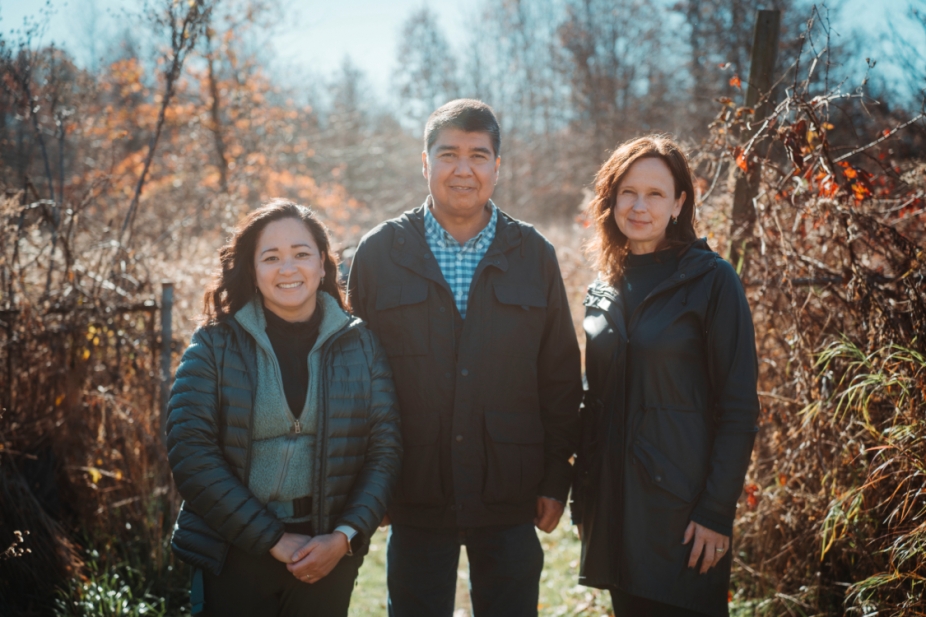
 Researchers Anneke Smit, director and founder of Centre for Cities, Clint Jacobs, senior advisor to the UWindsor president on Indigenous initiatives, and Catherine Febria Healthy Headwaters Lab director at Ojibway Prarie Complex in Windsor, Ont. on Thursday, Nov. 21, 2024. (MIKE WILKINS/The University of Windsor)
By Lindsay Charlton
WINDSOR, Ont. — Standing among the tall prairie grasses, feeling the wind move through the trees, and hearing the quiet rustle of leaves — these simple moments of connection to nature are at the heart of the vision for an urban national park in Windsor.
As efforts continue to shape the proposed Ojibway National Urban Park, University of Windsor researchers have been helping bring that vision to life through community partnerships, Indigenous knowledge, and ecological research — work that is already informing best practices for urban conservation in Windsor and beyond.
“This place has rich stories,” says Indigenous knowledge connector, UWindsor professor, and senior advisor to the president on Indigenous initiatives, Clint Jacobs.
Jacobs is a co-leader of the University of Windsor National Urban Park Hub (UW-NUPH), which was established in July 2023 by researchers Catherine Febria, Anneke Smit, and Jacobs to support community engagement, knowledge sharing, and collaborative planning toward the proposed designation of the Ojibway Prairie Complex, Ojibway Shores, and adjacent park areas as a National Urban Park.
“Connecting with the land happens through experience,” Jacobs explains. “You have to feel the wind, hear the leaves, witness the life here — that’s when the stories of this place truly come alive.”
One of the largest remnants of tallgrass prairie and oak savannah in Ontario, Ojibway is home to diverse species, including more than 160 provincially rare plants and animals, making it a truly unique habitat.
Parks Canada launched the National Urban Parks Program in 2021, with Windsor announced as one of the first cities in the program. The program focuses on three core objectives: conserving nature, connecting people with nature, and advancing reconciliation with Indigenous peoples.
In March 2025, prior to the federal election, the government reaffirmed plans and funding commitments toward establishing Windsor’s National Urban Park. However, with leadership transitions at the federal level, the park’s final status and timeline remain uncertain.
“I’m hoping that by having a national urban park in Windsor, people here, but everywhere really, start to value and understand how special and precious Nature is right here in this part of the Great Lakes area of Canada,” says Dr. Febria, Healthy Headwaters Lab director.

Catherine Febria, Healthy Headwaters Lab director at Ojibway Prarie Complex in Windsor, Ont., on Thursday, Nov. 21, 2024. (MIKE WILKINS/The University of Windsor)
Launched with an initial $1.2 million in funding from Parks Canada, matched by the University, the UW-NUPH has played a key role in contributing research, relationship building, and knowledge sharing that will support urban conservation in Windsor and provide a model for similar efforts elsewhere in Canada. The hub is a collaboration between three entities: the Indigenous Knowledge Table, the Healthy Headwaters Lab, and the Windsor Law Centre for Cities.
“Our three teams are working together to advance the objectives of the National Urban Parks Program through a collaborative, place-based approach,” Febria says. “We’re committed to building relationships and learning what this looks like in Windsor, and how it can inform efforts across Canada.”
Led by Febria, the Healthy Headwaters Lab guides the University’s scientific role, developing plans for ecological monitoring and mentorship of Indigenous youth as caretakers of Nature and science practitioners. The team continues to track biodiversity and water quality across the Ojibway Prairie Complex, the City of Windsor and the region.
“We have a responsibility to connect to and advance equitable access to Nature, support the training of the next generation, and do so in a way that honours the culture, spirit, and history of this place, without erasing its other rich histories,” she says.
Part of that access to nature includes research collaborations on environmental monitoring and the promotion of equitable and sustainable city-building, where the Centre for Cities (C4C), founded and directed by Dr. Smit, contributes expertise.
“The work that we’re doing is not only about the potential establishment of a national urban park but also about establishing processes, partnerships, and best practices that can guide urban conservation and stewardship efforts moving forward,” Smit says.
Ojibway’s proposed designation would make it Canada’s second national urban park and the first created under the federal government’s new National Urban Park policy and program.
“We’re thinking about what it means to connect and build urban parks in a very interdisciplinary and community-facing way,” Smit says. “Ensuring this effort truly increases access to nature for people in the city.”
That includes planning for active and public transportation connections and understanding how parks and green spaces are linked across the city.
“This area has some of the lowest remaining tree cover and natural spaces in the country,” Smit notes. “Over time, we’ve whittled away at it, prioritizing development that doesn’t centre Nature. As a result, we’re less healthy, less happy, and less connected — to each other and the land. Changing that doesn’t happen overnight. It is a long and careful process, but we’re excited to be a part of that.”

Researchers Anneke Smit, director and founder of Centre for Cities, Clint Jacobs, senior advisor to the UWindsor president on Indigenous initiatives, and Catherine Febria, Healthy Headwaters Lab director at Ojibway Prarie Complex in Windsor, Ont., on Thursday, Nov. 21, 2024. (MIKE WILKINS/The University of Windsor)
Smit sees this as an opportunity for both the community and the University to lead.
“We want to do things that are locally impactful and contribute to the community, and at the same time, this is an opportunity to test solutions and approaches that will have an impact across the country,” she says.
Central to these efforts is the Indigenous Knowledge Table, led by Jacobs.
“Our role is to help facilitate dialogue with the Indigenous population in the city — to bring forward their voices, interests, perceptions, and ideas,” he explains.
He emphasizes the importance of connecting Windsor-Essex’s Indigenous population to the vision for the park and the region’s ecological future.
“We call ourselves Great Lakes people, and that’s the scale we want to emphasize — not just a park in Windsor, but how we are connected to the ecosystem around the Great Lakes.”
Jacobs is also leading efforts to establish Elder and Youth Advisory Circles and discussions on the potential for an Indigenous Stewardship Centre, working alongside mentors, including Febria, to guide Indigenous youth.
“We’re helping them to get connected not just through their research and work, but in deeper ways too,” Jacobs says.
“That’s the only way this is going to continue — for this to be here into the future for another millennium — by having people on the land, going for walks, learning from nature, and feeling the love.”
While the future of Windsor’s National Urban Park remains uncertain, the work of the UW-NUPH is already creating lasting impact, building relationships, informing best practices, and helping shape how cities across Canada can reconnect people with nature in meaningful ways.