
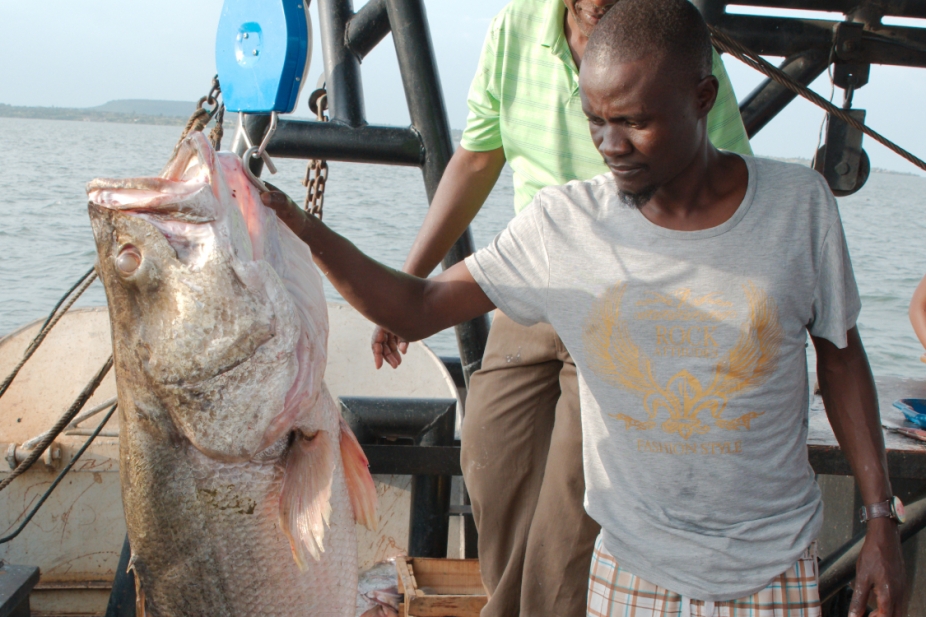
 PhD candidate Dennis Otieno’s research shows that some farmed fish would prefer consuming microscopic organisms to commercial fish food pellets. (Photo courtesy of Ken Drouillard/University of Windsor).
By Sara Elliott
Some farmed fish are snubbing commercial fish food pellets in favour of naturally and freely available microscopic organisms and invertebrates.
That is according to PhD candidate Dennis Otieno’s study which showed farmed tilapia in net-pen cages in Kenya were not significantly consuming the provisioned commercial fish feed – one of the highest costs of production.
This unexpected finding has major implications for cost-efficiency in aquaculture where there are high nutrient levels, or eutrophic conditions.
“The people are feeding the fish too much food currently and it’s not actually affecting the growth of fish,” says the School of the Environment graduate student.
“You could spend less and produce the same results.”
It is not just about waste. Feeding quantities could be scaled back without compromising fish growth. Reducing commercial feed could also lessen environmental degradation, as uneaten food sinks and contributes to the over-nutrification of lakebeds.
“The excess fish feed goes into the water, leading to nutrient enrichment, which essentially creates eutrophic microenvironments that can cause further problems,” he says.
“The results imply net-pen-reared fish receive little benefit from food provisioning, and aquaculture operators could realize economic gains while lowering their environmental impact by reducing feeding rates.”
Otieno’s previous research investigated mercury contamination in Winam Gulf, an embayment of Lake Victoria. The gulf is an important fishing ground and hosts aquaculture operations that support the dwindling wild fishery.
“My study assessed contaminant exposure risk in Winam Gulf and used that data to model the bioenergetics of some Lake Victoria fish species,” says Otieno.
The researcher designed a diagnostic tool using stable isotopes and mercury as tracers of consumption and growth.
Using this diagnostic tool, Otieno found the fish were relying on natural food sources such as biofilms and invertebrates growing on the netting within the cages in Lake Victoria.
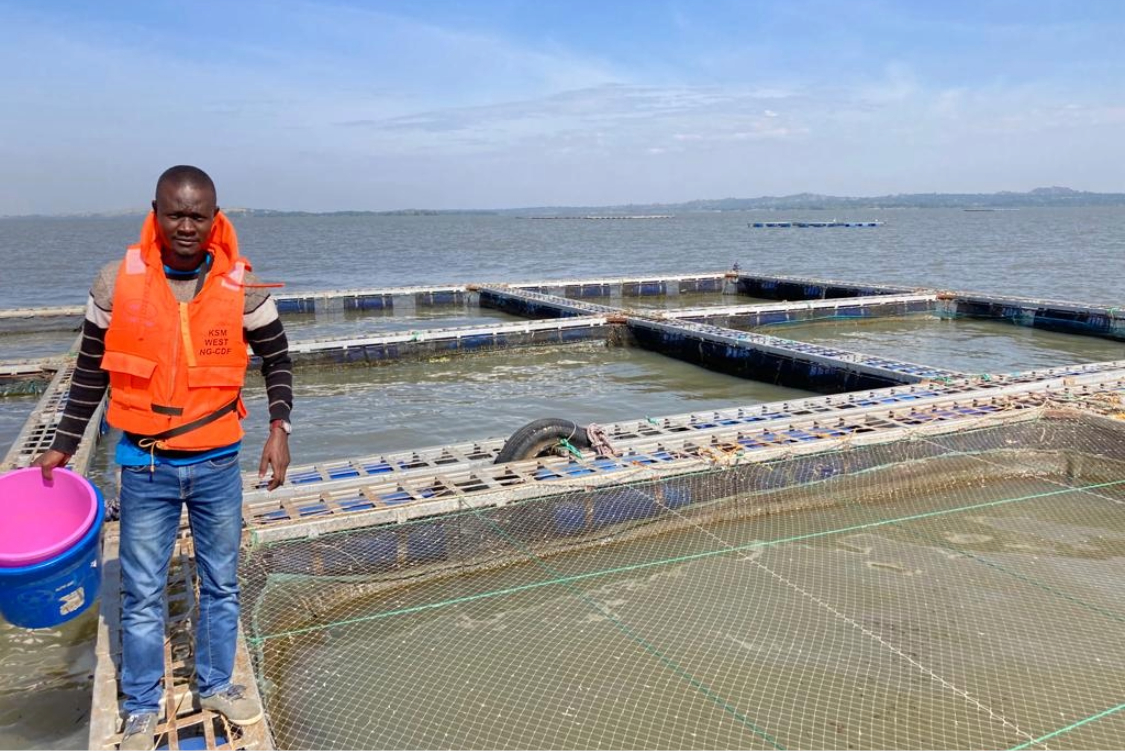
Dennis Otieno in the field in Kenya. (COURTESY OF DENNIS OTIENO/University of Windsor)
The study also established similarity in the mercury level between farmed and wild tilapia. Levels were below consumption restriction, making tilapia safe for consumption. However, continuous monitoring will be important due to dynamic processes of contaminants partitioning and transformation.
These surprising conclusions could significantly impact aquaculture sustainability in Lake Victoria - one of the most important fisheries in the world - but also in fish farms in other eutrophic areas like Lake Erie.
“Otieno’s research challenges long-standing assumptions about aquaculture feeding practices in Lake Victoria,” says Dr. Kenneth Drouillard, professor in the School of the Environment and the Great Lakes Institute for Environmental Research.
“His work informs policy on sustainable aquaculture across East Africa and supports global efforts toward environmentally responsible food production.”
The findings were published in the Journal of Great Lakes Research in a paper titled “Locally produced fish food pellets yield little evidence as a dietary substrate for net-pen-reared Nile tilapia in Lake Victoria, Kenya.”
This research was supported by fieldwork in Kenya as well as international collaborations including with NSF-IRES Lake Victoria Research Consortium.