
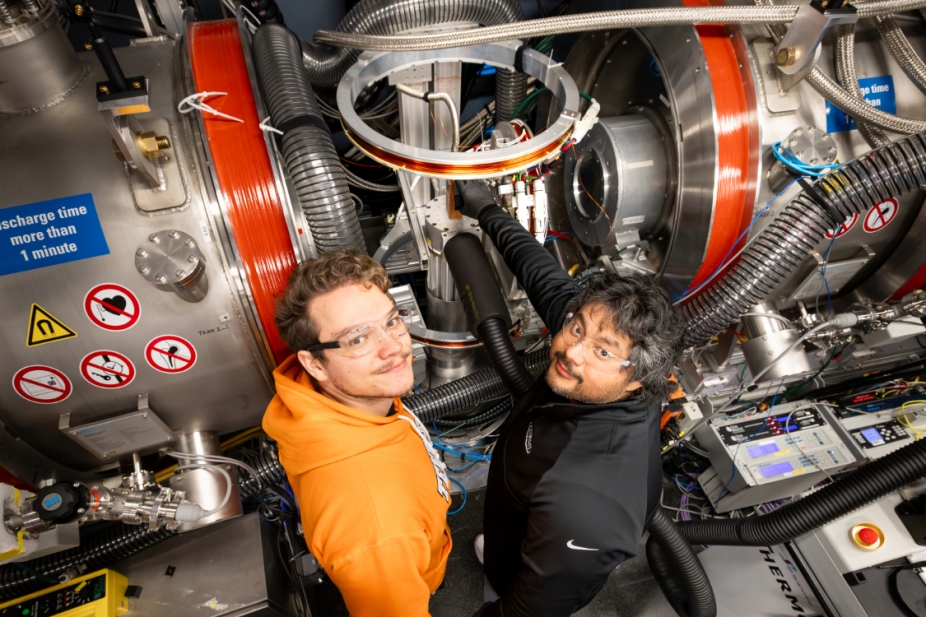
 Doctoral candidates Stuart Castillo and Maks Dziura stand beside the sample mount of the Neutron Spin Echo instrument at Oak Ridge National Laboratory’s Spallation Neutron Source. (GENEVIEVE MARTIN/University of Windsor)
By Sara Elliott
A University of Windsor researcher is one step closer to building a facility that could deliver cutting-edge cancer treatment, produce medical isotopes and anchor a new industry in Windsor — after securing nearly $2 million to design it.
Dr. Drew Marquardt, head of chemistry and biochemistry, has spent years advocating for a compact accelerator-based neutron source (CANS) in Windsor. The funding, announced March 13 as part of a $552-million federal infrastructure investment through the Canadian Foundation for Innovation (CFI), will support a full scientific and technical design for a prototype facility.
“Building this facility would anchor a new industry in Windsor, create high-skill, high-paying jobs, and deliver a level of healthcare infrastructure the region has never had,” says Marquardt, who also serves as president of the Canadian Institute for Neutron Scattering (CINS).
A CANS facility produces neutron beams using a particle accelerator rather than a nuclear reactor. Neutron beams give scientists a powerful way to examine the internal structure of materials down to the atomic scale — revealing details that other tools cannot detect.
The medical applications are significant. The facility would produce critically needed medical isotopes, including short-lived isotopes for PET scanners used in cancer diagnosis and longer-lived isotopes that could be used in cancer therapy and distributed internationally.
“It has the potential to bring a unique hospital-based cancer therapy that has been successful in Japan,” says Marquardt. “This would be the first of its kind in Canada and possibly North America.”
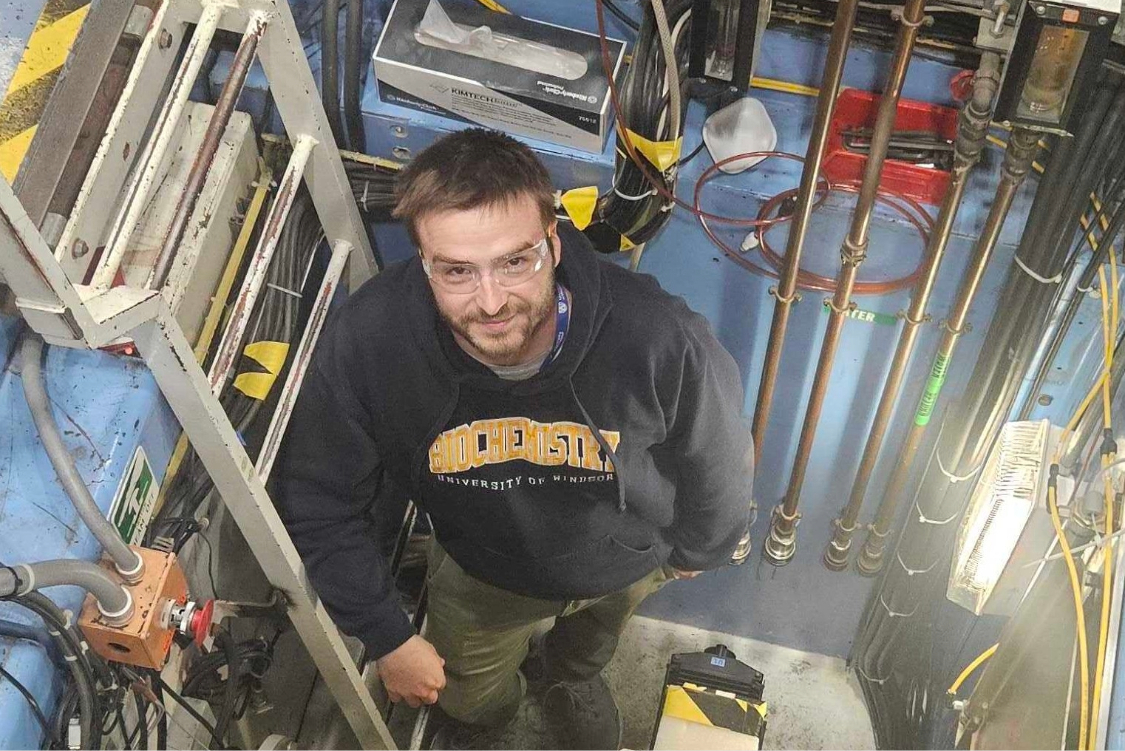
Dr. Drew Marqurdt at the ISIS Neutron and Muon Source, a world-leading centre for research in the United Kingdom. (MAKS DZIURA/University of Windsor)
The research applications are equally significant.
“If built, this prototype CANS could be bright enough for neutron spectroscopy, which is a primary technique in quantum materials research,” says Marquardt.
The UWindsor design project is part of a larger multi-institution effort, Building a Future for Canadian Neutron Scattering, Part 2, led by McMaster University. The initiative received a total of $13.5 million through the CFI 2025 Innovation Fund competition. UWindsor’s share — $1.6 million from CFI and $332,000 from TRIUMF, Canada’s particle accelerator centre based in British Columbia — will fund the design work.
“TRIUMF will do the heavy lifting on the design as they are the particle accelerator experts,” says Marquardt.
Currently, the Neutron and Positron Beam Laboratory at the McMaster Nuclear Reactor is the only facility in Canada that provides access to neutron beams. Marquardt estimates the prototype CANS described in the conceptual design report would cost approximately $50 million to build.
“Ideally, we would be building a full neutron facility with a particle accelerator that will produce neutrons and medical isotopes,” he says. “This is a big win for the University of Windsor and for the region as well.”
Dr. Shanthi Johnson is the vice-president, research and innovation.
“Projects like this demonstrate how the University of Windsor can drive both scientific discovery and economic development,” says Johnson.
“By supporting the design of this facility, we are laying the groundwork for new health technologies, high-skilled jobs and a research capability that could place Windsor at the forefront of neutron science in Canada.”