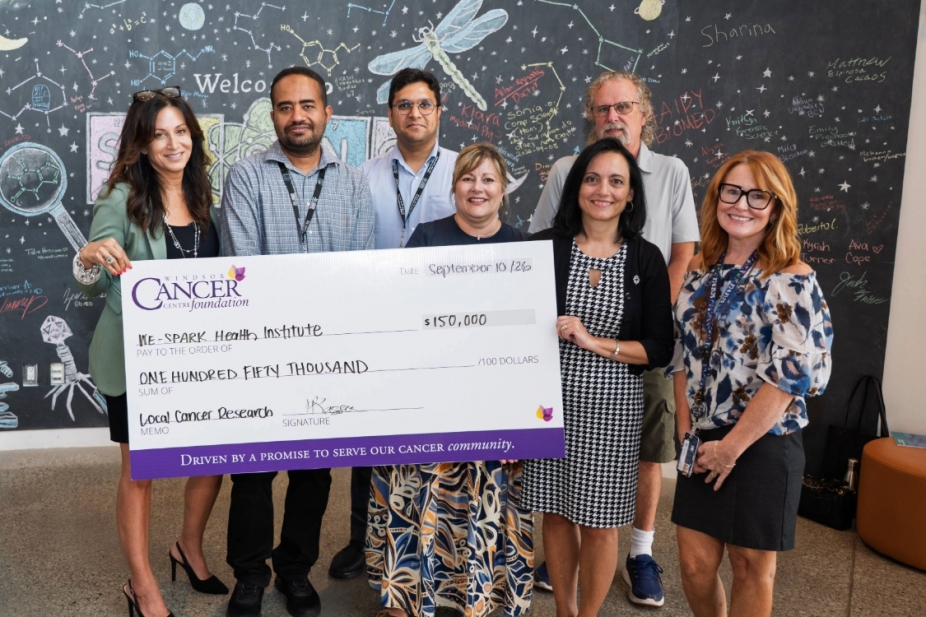
 WE-SPARK Health Institute received $150,000 to help advance research focused on cancer prevention, cancer risk, survivorship and youth engagement in cancer care. Pictured from left to right: Houida Kassem, Dr. Ayman Sayyed, Dr. Vikas Garg, Dr. Kathy Pfaff, Dr. Dora Cavallo-Medved, Dr. Lisa Porter and Dr. John Hudson. (PETER MARVAL/University of Windsor)
By Sara Elliott
Five WE-SPARK Health Institute members are receiving funding from the Windsor Cancer Centre Foundation to advance research focused on cancer prevention, cancer risk, survivorship and youth engagement in cancer care.
The investment, provided through the Dr. Hakam Abu-Zahra Research Fund, is part of a $150,000 commitment to support locally led projects selected through WE-SPARK Health Institute's 2026 Igniting Discovery Grants competition.
— Published on Sep 18th, 2026
 The top three winners in the 2026 University of Windsor Three Minute Thesis (3MT®) competition are (from left) Alex Stoinescu, Dora Strelkova and Isabelle Hinch. (DAVE GAUTHIER/University of Windsor)
Biology PhD candidate Isabelle Hinch earned first place at the 2026 University of Windsor Three Minute Thesis (3MT®) competition with a three-minute pitch on breastfeeding and breast cancer risk.
Judged on comprehension, communication and engagement, Hinch took the top prize at the April 1 final. In addition to a $1,000 cash prize, she will represent UWindsor at the provincial competition hosted by Brock University in St. Catharines, Ont., on May 6, 2026.
— Published on Apr 9th, 2026
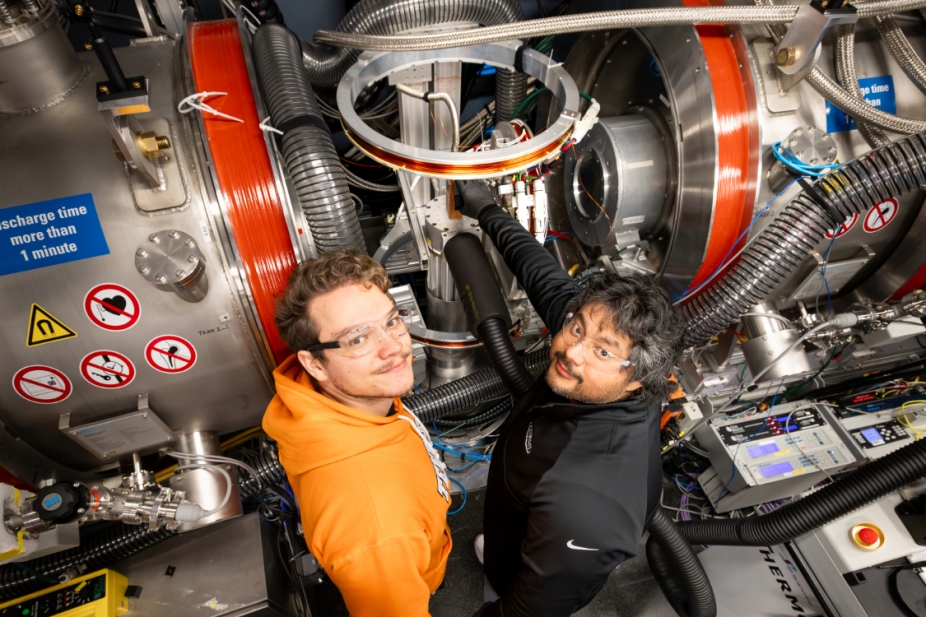 Doctoral candidates Stuart Castillo and Maks Dziura stand beside the sample mount of the Neutron Spin Echo instrument at Oak Ridge National Laboratory’s Spallation Neutron Source. (GENEVIEVE MARTIN/University of Windsor)
By Sara Elliott
A University of Windsor researcher is one step closer to building a facility that could deliver cutting-edge cancer treatment, produce medical isotopes and anchor a new industry in Windsor — after securing nearly $2 million to design it.
Dr. Drew Marquardt, head of chemistry and biochemistry, has spent years advocating for a compact accelerator-based neutron source (CANS) in Windsor. The funding, announced March 13 as part of a $552-million federal infrastructure investment through the Canadian Foundation for Innovation (CFI), will support a full scientific and technical design for a prototype facility.
— Published on Mar 26th, 2026
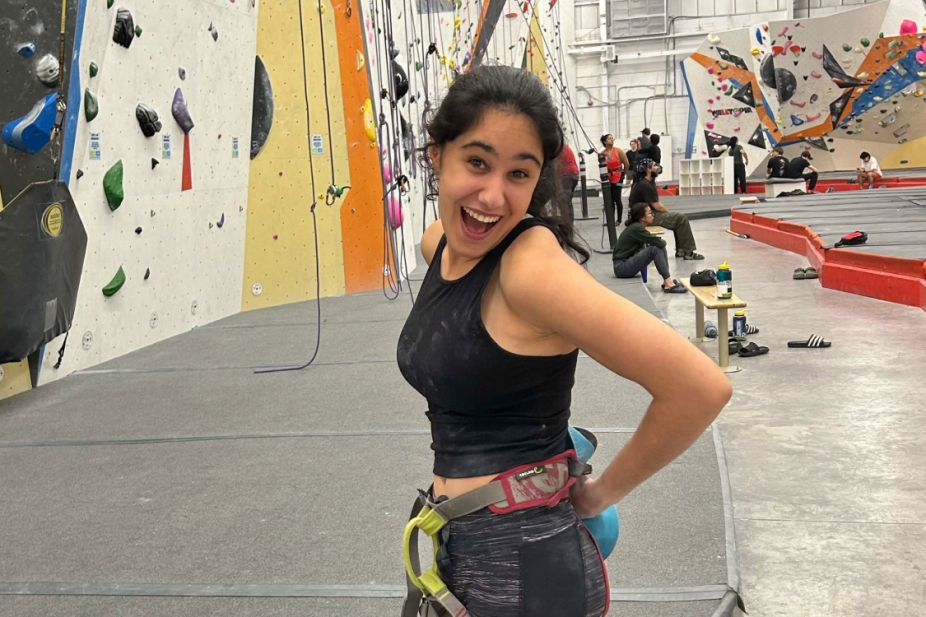 Mina Pairawan at the rock-climbing gym. (Photo courtesy of Mina Pairawan)
By Sara Elliott
Mina Pairawan’s brain rarely takes a break, even when she is relaxing.
During her scarce downtime, the biomedical science major goes bouldering at a local rock-climbing gym with her friends.
— Published on Dec 10th, 2025
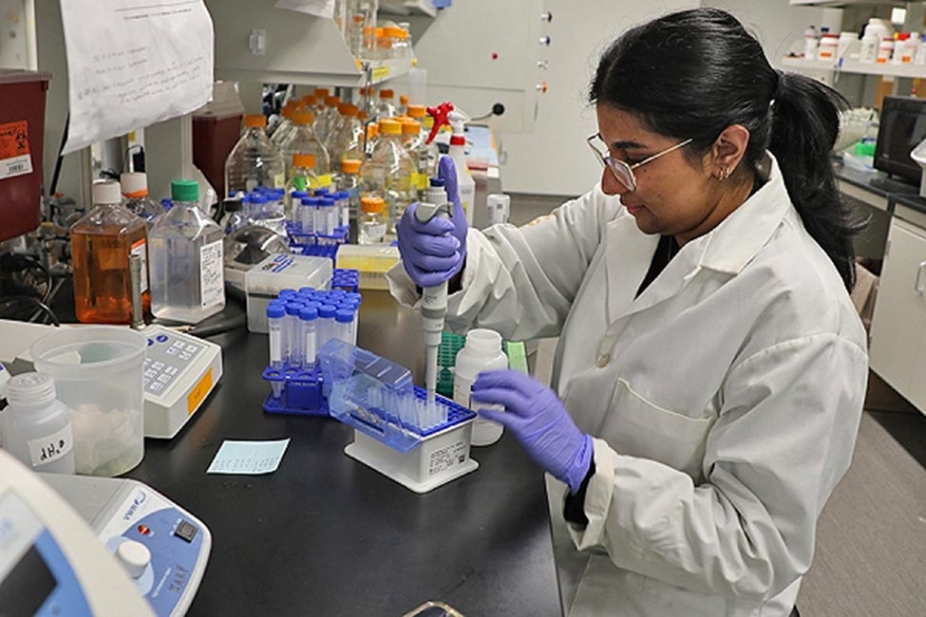 Graduate student Rachna Patel is working with the research team in professor Phillip Karpowicz’s lab to determine how eating patterns that conflict with circadian rhythms may contribute to development of colorectal cancers.
Your eating patterns could be throwing off your circadian rhythms. Biomedical sciences professor Phillip Karpowicz says this negatively affects your health — specifically your gut health — which could result in an increased risk of colorectal cancer.
Circadian rhythms are 24-hour physiological changes that include sleep-wake cycles, metabolic changes, hormone oscillations, and cycles of feeding-fasting. These are driven by the circadian clock, a molecular timer that enables our cells to anticipate daily events.
— Published on Jun 16th, 2025

 WE-SPARK Health Institute received $150,000 to help advance research focused on cancer prevention, cancer risk, survivorship and youth engagement in cancer care. Pictured from left to right: Houida Kassem, Dr. Ayman Sayyed, Dr. Vikas Garg, Dr. Kathy Pfaff, Dr. Dora Cavallo-Medved, Dr. Lisa Porter and Dr. John Hudson. (PETER MARVAL/University of Windsor)

