
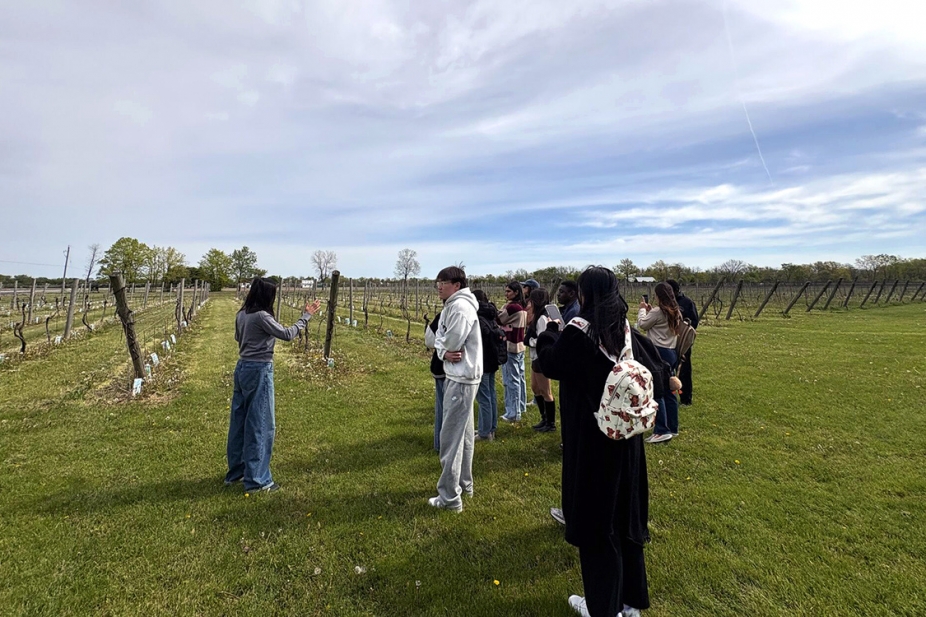
 Master of Management program students listen as Vivace Estate Winery owner and winemaker Jean Qian (left) explains the winery’s operations, grape production and quality practices during a tour that connected classroom learning with real-world business operations. (LAURA DUCHARME/University of Windsor)
By Victor Romao
A visit to Vivace Estate Winery gave University of Windsor Master of Management students an opportunity to see how business concepts taught in the classroom are applied in a real-world setting.
Twelve graduate students from the University’s Master of Management program toured the Amherstburg-area winery, gaining firsthand insight into operations, quality management and customer experience in the hospitality and agricultural sectors.
The group included students specializing in international accounting and finance, logistics and supply chain management, human resources management and business data analytics.
Led by owner and winemaker Jean Qian, the tour took students through the vineyard, tasting rooms and cellar, where they learned about grape production, quality assurance practices and the day-to-day operations required to run a successful winery. Vivace staff member Liz Bennet helped facilitate the visit.
The experience highlighted the connection between operational efficiency, quality control and strategic leadership — key concepts students study throughout the Master of Management program. Students also sampled the winery’s signature icewine while learning how product consistency and quality are maintained.
“Visits to organizations like Vivace Estate Winery help students understand how concepts and principles taught in the classroom can be used to build and sustain vibrant businesses,” said Dr. Brent Furneaux, director of the Master of Management program. “Seeing how supply chain management processes, marketing plans and other business practices are implemented reinforces classroom learning and better prepares students to apply this learning throughout their business careers.”
For Gabriela Cardozo Malagon, an Odette School of Business graduate student, one of the most valuable takeaways was seeing how a company’s identity can become a competitive advantage.
“The biggest lesson I learned was how important it is to embrace a company’s identity,” said Cardozo Malagon. “I liked that Vivace is proud to be a local Ontario winery and that the owner supports and works with other local businesses.”
She said the winery’s approach to customer engagement also stood out.
“I enjoyed that customers can see part of the winemaking process, which makes the experience more personal,” she said. “It showed me that being proud of your identity while always learning can help a business grow.”
Cardozo Malagon noted that the visit reinforced the importance of storytelling and communication in building strong customer relationships.
“I could see how sharing the story behind the winery creates a better customer experience by making customers feel part of the whole process,” she said. “Even though my background is in finance, I really appreciated seeing the importance of other areas of the business, such as product creation, operations and distribution.”
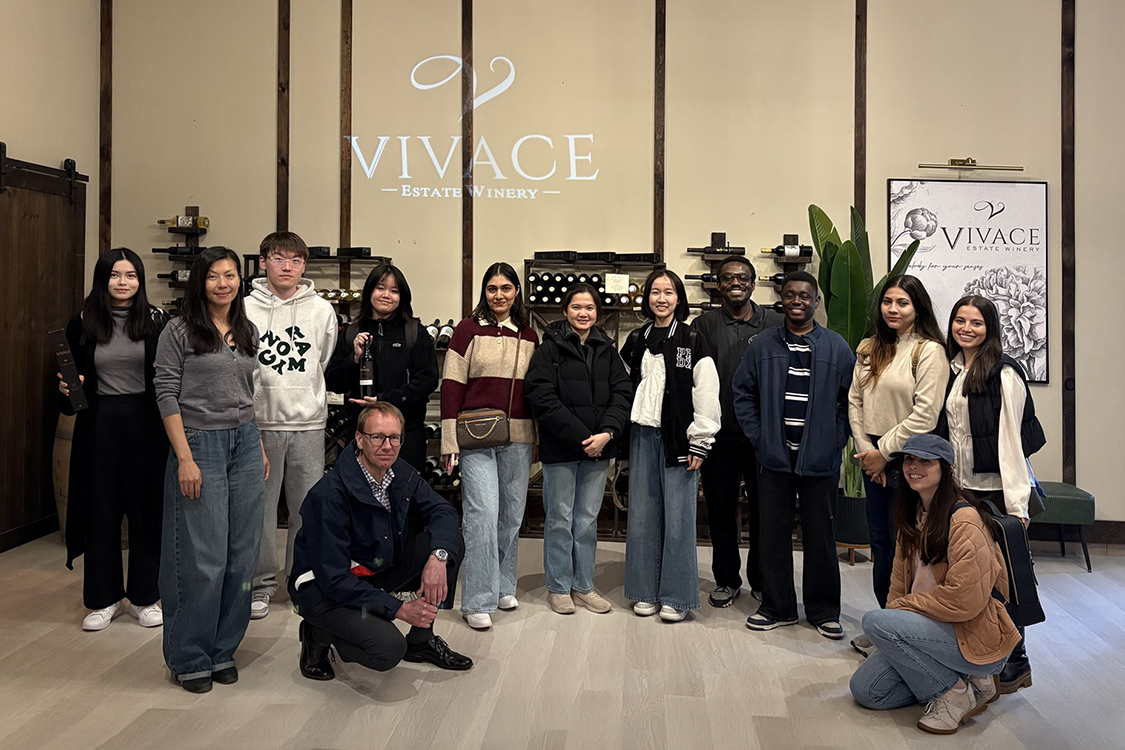
For fellow student Moslima Akter, the tour provided a practical example of concepts discussed in the Master of Management program.
“The most important business lesson I learned from visiting Vivace Estate Winery was the importance of building a strong brand identity and customer experience,” said Akter.
She said the experience reinforced lessons from her coursework on strategy and business development.
“Through my studies, we discuss areas such as strategic positioning, market development, financial sustainability and customer relationship management,” she said. “Seeing Vivace’s operations firsthand demonstrated how these concepts are applied by businesses to build long-term value and remain competitive.”
Akter also gained a deeper appreciation for both the opportunities and challenges facing Ontario’s wine industry.
“Ontario’s wine industry has significant growth potential through wine tourism, local branding and innovation in cool-climate wine production,” said Akter. “At the same time, the industry faces challenges, including competition from internationally recognized wine regions, changing consumer preferences, climate-related risks and production costs. The visit showed me that successful businesses are not only focused on selling a product; they understand their customers, adapt to market changes and create experiences that build lasting relationships.”