
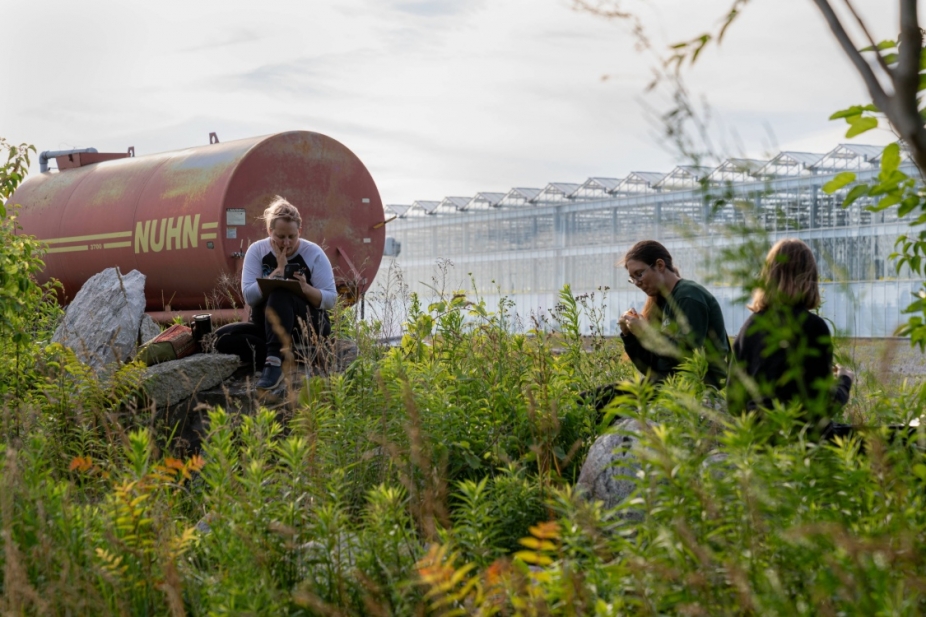
 Participants in a 2024 Creative Ecologies SMArt Masterclass sketch outside a Leamington-area greenhouse. (Cri Kosti/University of Windsor)
By Sara Elliott
Science students are learning to create original works of art to explain scientific research.
In a new University of Windsor research-creation project, undergraduate students will explore how sculpting, painting and drawing can be used to convey research.
The two-part project starts with visual artists teaching UWindsor students in the fall semester.
“Art absolutely communicates knowledge,” says project lead Dr. Jaclyn Meloche.
“It’s not an aesthetic object that we just hang on the wall if it’s a painting. It is doing something. It is articulating information, just through a different language.”
Meloche, an artist and art historian from the School of Creative Arts, will lead the UWindsor workshops. In winter 2027, she will teach students at the University of Waterloo and Western University.
This fall, workshops at Windsor will involve students from courses in psychology, arts and science and an Assumption University course.
“The students will be responding to research questions centred on scientific inquiry,” she says.
“The goal is to really communicate that research question visually.
The $66,000 project, titled Picturing the “A=Art” in STEAM: Piloting Research-Creation as a Methodology for the Democratization of Science Communication, is supported by a Social Sciences and Humanities Research Council (SSHRC) Insight Development Grant as well as contributions from UWindsor’s Faculty of Science and Faculty of Arts, Humanities and Social Sciences.
The term STEM stands for science, technology, engineering and mathematics. The project’s interdisciplinary group of professors would like to add the arts to make it STEAM.
“With this collaboration, we are building a research-creation network between art and science in Southwestern Ontario,” says Meloche.
The Faculty of Science already hosts Science Meets Art (SMArt), a group of science students who come together to create works of art with a science theme. The SSHRC-funded project expands opportunities for science communication through art.
Part two of the project launches in 2028 with a travelling exhibition that will showcase the work of potentially several hundred students at three venues: the Earth Sciences Museum at the University of Waterloo, Western University’s Library, and the Leamington Arts Centre in Essex County.
“We are excited to expand our SMArt Communications program and include other science and engineering students from our partner universities hence further demonstrating the effectiveness of collaboration in translating research,” says co-applicant Dr. Dora Cavallo-Medved, associate dean, faculty and student engagement in the Faculty of Science.
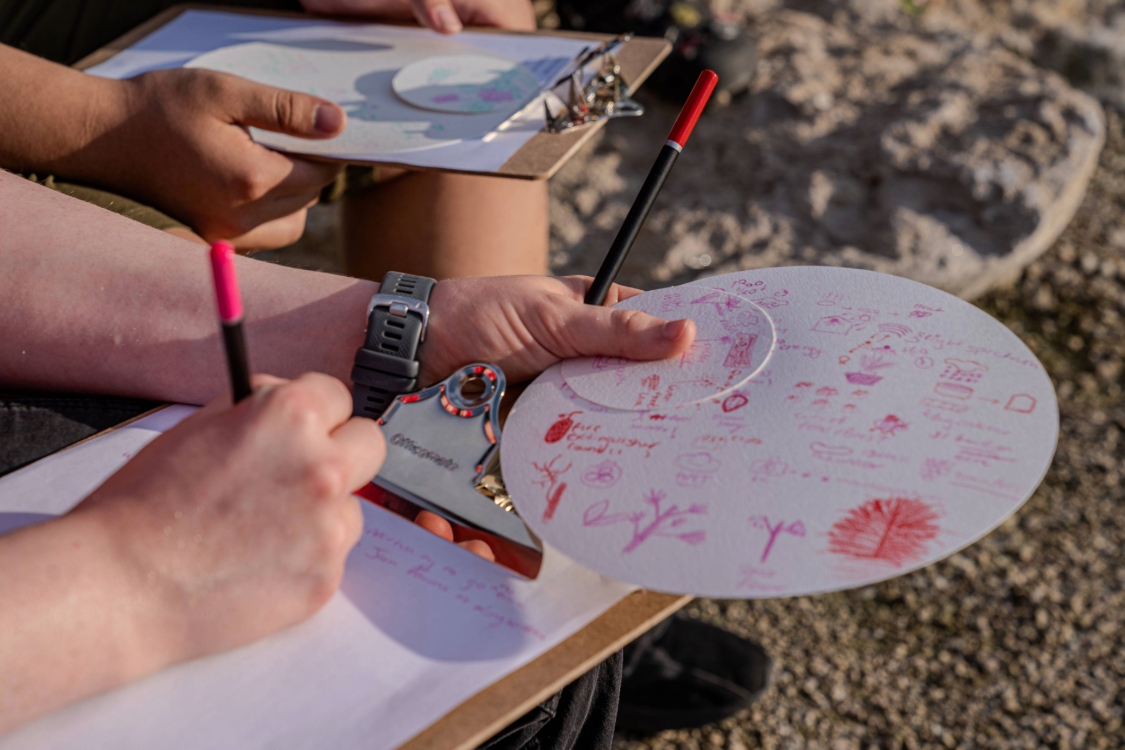
In a new University of Windsor research-creation project, undergraduate students will explore how sculpting, painting and drawing can be used to convey research. (Photo by Cri Kosti/University of Windsor)
Meloche says the three very different spaces will attract different audiences.
The Earth Sciences Museum has a science, archaeology and astronomy focus, Western University’s Library will enhance the inherent research capabilities of art on campus, and the Leamington Arts Centre is a municipal art centre.
The project brings together artists, curators, scientists, engineers and students from the University of Windsor, Western University and the University of Waterloo.
“I see this as an opportunity to really spearhead a research-creation network across Southwestern Ontario,” says Meloche.
“We’ve got two really strong partners in neighbouring institutions, and I think that’s one of the really special parts of this grant — that a group of like-minded scholars at Western and the University of Waterloo are here to champion SMArt communications.”
In addition to the co-applicants, the project has seven collaborators: Dr. Jennifer Willet, Lisa Salfi and Michelle Bondy from the University of Windsor; Dr. Chris Houser and Karina McDonald from the University of Waterloo; Dr. Helen Gregory from Western University; and Chad Riley from the Leamington Arts Centre.
“We are introducing science students to creative methodologies with the goal that new creative knowledge will help them imagine new ways for translating and communicating scientific research,” says Meloche.
“And by changing and reinventing how we circulate and put science research out into the world, we’re recognizing that our audiences are diverse and will be all over.”