
 Members of Enactus Windsor celebrate their national achievements at the Enactus Canada National Exposition in Montreal, where the team earned multiple honours and a place among the country’s top programs. (ANITA JAFARI/University of Windsor)
By Victor Romao
The moment the Enactus Windsor team heard their name echo across the competition hall at regionals, something shifted.
Months of work, late nights, early mornings and relentless iteration had finally produced results.
What began as a set of student-driven ideas was gaining national traction, and the team knew the journey was far from over.
That turning point came at the Enactus Canada Central Canada Regional Exposition, where the University of Windsor’s student-led entrepreneurship team distinguished itself as one of only three institutions nationwide to place in all four Impact Challenges — and the only one in Central Canada to do so.
The results propelled Enactus Windsor forward, carrying both validation and expectation as the team prepared for the next stage: the 2026 Enactus Canada National Exposition in Montreal.
At regionals, Enactus Windsor’s success was both broad and deep.
The team captured first place in the Canadian Tire Environmental Sustainability Challenge with its 100% Fish initiative and earned another first-place finish in the Desjardins Community Empowerment Challenge with REEDify.
Those two flagship projects would go on to represent Windsor at nationals.
“I am incredibly proud of our team of over 100 dedicated students spanning every faculty across campus,” said Enactus Windsor team president Andrew Booth. “The work they put into these award-winning projects was exceptional.”
That pride was shared across a team built on cross-disciplinary collaboration — with more than 70 per cent of members coming from the Odette School of Business, but drawing talent from across the university.
For many, the regional competition was more than a proving ground. It was a wake-up call that pushed the team to reassess, refine and elevate every aspect of their work.
“Regionals was my first time competing at that level and seeing the calibre of teams genuinely took me by surprise,” said team member Alberto Gertrudiz-Flores. “It raised the standard for all of us and made me even more eager to see what nationals would look like.”
With regionals behind them, the team shifted its focus from celebration to recalibration.
“After winning two first-place finishes and placing in all four Impact Challenges, we felt a surge of confidence and urgency,” said Booth.
That urgency translated into a more refined approach. The team intensified its preparation, shifting from broad storytelling to precise, evidence-driven presentations.
“We doubled down on in-depth practice sessions, shifted our storytelling to highlight depth of impact over raw numbers, and stress-tested every slide and Q&A scenario,” said Booth.
Judges’ feedback from regionals became a blueprint for improvement. Weaknesses were systematically addressed, and every detail, from messaging to delivery, was sharpened.
At the core of Enactus Windsor’s success are the projects themselves — initiatives grounded in real-world challenges and designed with measurable outcomes.
The 100% Fish project tackles waste in the fish-processing industry by transforming byproducts into dog treats, applying circular economy principles to reduce landfill waste and emissions while generating economic value.
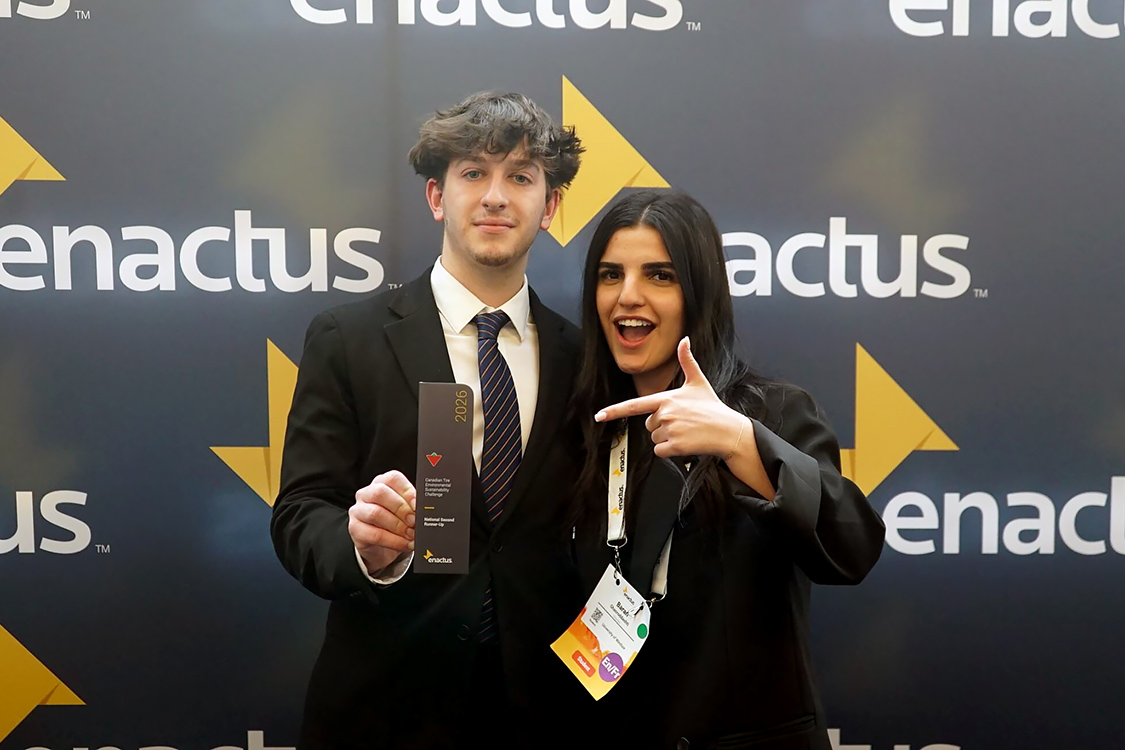
“What makes this initiative especially impactful is its alignment with circular economy principles,” said project manager Amal Jose. “Not only are we diverting waste from landfills, but we are also creating a value-added product that contributes to a more sustainable and responsible supply chain.”
For team members like Rana Hammoud, the project’s significance goes beyond its technical innovation.
“100% Fish was built by a group of University of Windsor students who care about environmental sustainability, but even more than that, care about Windsor-Essex,” she said. “Watching something that started as an idea grow … to the national level has honestly been surreal.”
Similarly, REEDify addresses invasive phragmites in Ontario wetlands by converting the plant into usable products such as straws, livestock silage and bug repellent.
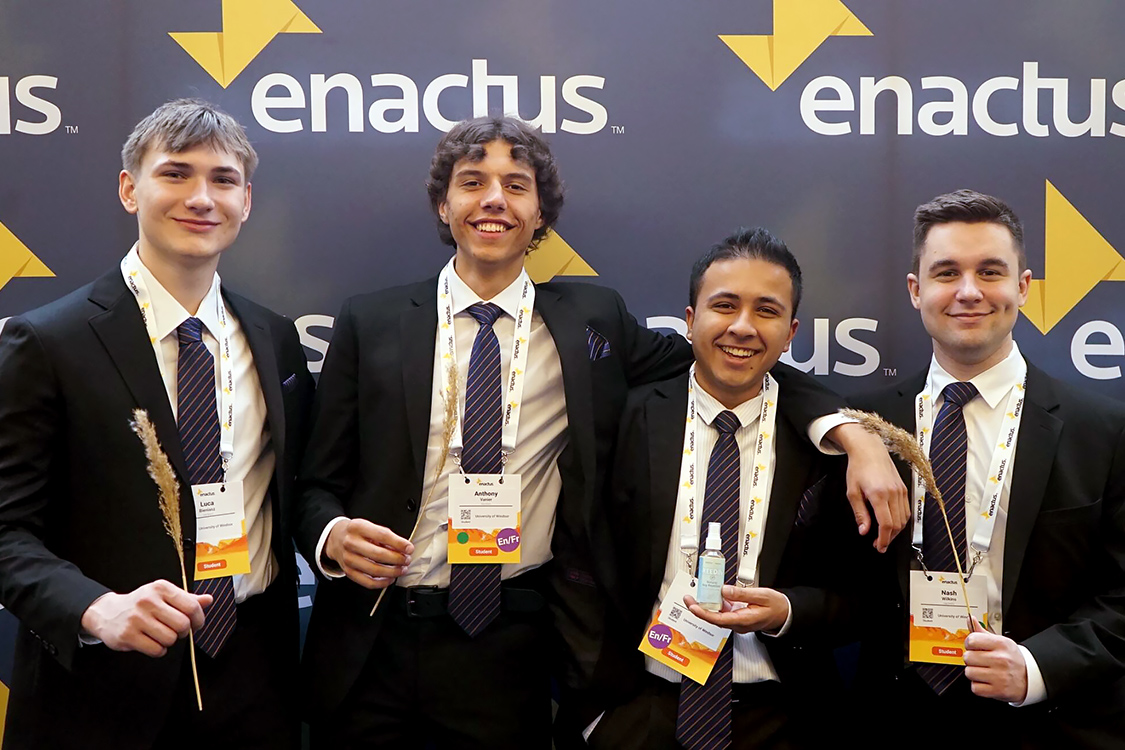
Together, the projects reflect a shared philosophy: environmental responsibility and economic viability are not mutually exclusive.
“Environmental sustainability and economic benefit aren’t opposites. You can do genuine good and create real opportunity at the same time,” said Gertrudiz-Flores.
When Enactus Windsor arrived in Montreal for the national exposition, the stakes, and the competition, were higher.
Competing against 49 institutions from across Canada, the team advanced to the semifinal stage, placing among the country’s top programs.
The 100% Fish project earned national second runner-up honours, while REEDify also competed at the national level.
Yet one of the team’s most meaningful achievements extended beyond rankings.
Enactus Windsor was awarded the Spirit of Enactus Award — a distinction given to a single team nationally that exemplifies excellence in student engagement, cross-faculty collaboration, leadership development and team culture.
“Personally, it validated my belief that a small chapter could compete with the best in Canada,” said Booth. “As a team, the Spirit award meant even more than the placement because it showed that our culture was just as strong as our results.”
For Gertrudiz-Flores, the recognition reinforced something the team already knew.
“The awards were public recognition of something we’d already felt internally,” he said. “And if anything, it made us hungrier.”
Looking back, team members point to lessons that extend beyond competition.
“The biggest lesson I learned is that consistency and hard work pay off,” said Booth, reflecting on the months of preparation leading up to regionals.
At nationals, that lesson evolved.
“Judges value credible, measurable impact over big, vague numbers,” said Booth. “A calm, well-rehearsed team will always outperform a frantic one.”
For many students, the experience also reshaped their understanding of what is possible.
“We shouldn’t underestimate ourselves because of our age or our stage in life,” said Gertrudiz-Flores. “We are fully capable of creating real impact in our communities.”
Even with national recognition secured, Enactus Windsor is not slowing down.
The team is already setting its sights on deeper impact, stronger partnerships and, ultimately, a path to the Enactus World Cup.
“We need a venture with proven global scalability, deeper corporate partnerships and a rigorous year-round development pipeline,” said Booth.
From regional success to national recognition, Enactus Windsor’s journey is more than a competition story. It is a testament to what happens when students are given the tools, trust and opportunity to lead.
And as their trajectory suggests, the journey is only just beginning.