
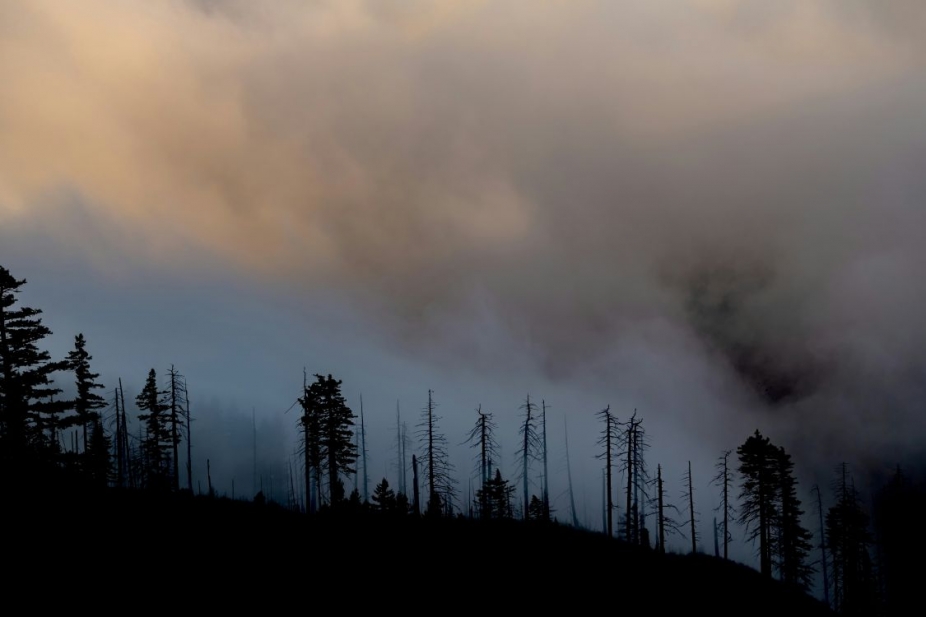
 Better understanding the timing of forest fire season means better preparation for Ontario (CHRIS LEBOUTILLIER via Unsplash/University of Windsor)
By Kate Hargreaves
With smoke from fires hundreds of kilometres away blanketing the region and wreaking havoc on air quality, Ontario's fire season has become increasingly relevant in the lives of Windsorites.
At the same time, a UWindsor statistician has been crunching the numbers to help Ontario better prepare.
"Understanding changes in the timing and length of the fire season is beneficial for the planning of staffing decisions and expenses related to fire suppression and management, such as when to contract seasonal firefighters and firefighting equipment," explains Dr. Kevin Granville of the Department of Mathematics and Statistics.
"Identifying where the season may be starting earlier or ending later in a given year could also be helpful when making regional deployment decisions."
In a recent study published in the International Journal of Wildland Fire, Granville and his co-authors present a new algorithm to better understand changes in the timing of wildfire season across Ontario.
"Definitions of the fire season are often based on either weather or observed fires," says Granville, explaining that these are referred to as the potential or observed fire seasons, respectively.
Past studies of changes in the potential fire season used weather models or other spatial estimates of weather values based on data observed at weather stations. This type of data enables high-resolution studies to identify where, and by how much, the fire season is changing over time.
However, because they require large amounts of fire data for each area to calculate commonly used definitions of the observed fire season’s start and end dates, studies of the observed fire season generally analyze broad geographic regions, such as western or eastern Ontario, rather than at a finer regional scale.
"Our study's algorithm helps bridge the gap by enabling higher-resolution studies based on observed fire data," Granville explains.
"It does this by regionally identifying fires with notably early or late recorded times they were known to be burning and smoothing this information across the study region, operating under the assumption that a fire in one location implies conditions were also favourable for burning nearby."
This approach allows the researchers to analyze and identify trends in how fire seasons are changing across the province over time.
While Granville's initial scholarly path did not lead him to forest-fire research, he says the importance of wildland fire science and climate research has only increased over the years.
After a PhD in statistics, focusing on queuing theory, Granville brought his longstanding interest in meteorology to a postdoctoral role examining forest fires.
"Although this represented a major change from the topic of my PhD research, the opportunity to do research on environmental data was still very appealing to me," he says.
Now conducting his research at UWindsor, Granville says that a natural extension of the provincial study would be to adapt the algorithm for use across Canada.
"The updated algorithm will enable more abrupt changes in the fire season over smaller distances, which will be relevant for parts of Canada outside of Ontario, such as across mountains," he explains.
At the same time, analyzing changes to the fire season over time itself is only the first aspect of this problem.
"I also have plans for a future investigation into how to best model and forecast fire season start and end dates," says Granville.
"I look forward to continuing to research and train students in these areas going forward."
Read the full study in the International Journal of Wildland Fire.