
 Alphonse Aquash, a traditional knowledge holder from Aamjiwnaang First Nation, opened the gathering during the Bill C-92 initiative announcement on Thursday, Sept. 27. (DAVE GAUTHIER/University of Windsor)
By Victor Romao
On Thursday, Sept. 27, the University of Windsor Faculty of Law unveiled an important initiative designed to protect and uplift Indigenous children across Ontario.
By enhancing legal representation in child welfare cases, the project aims to keep children safely within their families and communities—allowing them to grow up surrounded by their culture, identity and support networks.
Fuelled by a $425,000 grant from the Law Foundation of Ontario, the multi-year initiative will deliver culturally informed legal education and advocacy. It tackles the long-standing overrepresentation of Indigenous children in foster care, working toward fairer, community-driven outcomes that honour Indigenous rights and traditions.
The initiative brings together Legal Aid Ontario’s Indigenous Services, the University of Saskatchewan College of Law and the Federation of Sovereign Indigenous Nations, to close systemic gaps in representation and promote equitable outcomes in child welfare proceedings.
“This project provides an opportunity to build meaningful and reciprocal relationships between First Nations, law schools and Legal Aid Ontario,” said Jamie Holmes, a graduate and articling student with Indigenous Services Department (ISD), Legal Aid Ontario (LAO). “Our shared goal is to ensure Indigenous children and families receive competent and culturally intelligent legal representation.”
The initiative is grounded in the principles of An Act Respecting First Nations, Inuit and Métis children, youth and families (Bill C-92), which recognizes the inherent right of Indigenous communities to exercise jurisdiction over child and family services.
“An Act Respecting First Nations, Inuit and Métis children, youth and families affirms the inherent right that Indigenous people have over child and family services and supports a community's ability to implement their own laws and solutions,” said Fallon Melander, associate vice president of Indigenous Services at Legal Aid Ontario.
“It is an important piece of legislation that has a significant impact on how child protection issues are addressed. We are looking forward to working with the various Nations, the University of Windsor and other justice partners in southwestern Ontario to ensure the best possible outcomes for Indigenous children and families.”
The event featured remarks from project partners, a presentation outlining the initiative’s goals, and a spotlight on Holmes’ work in the field. Holmes emphasized the project’s potential to challenge systemic discrimination and reshape colonial institutions from within.
“The project will focus on educating lawyers and law students about the Act, while also developing collaborative models to improve legal services for Indigenous families,” said Gemma Smyth, professor and externship director at the Faculty of Law.
“The project partners are reaching out to local Nations, researchers, lawyers and law schools to increase both the number and competence of lawyers working in child protection and wellbeing.”
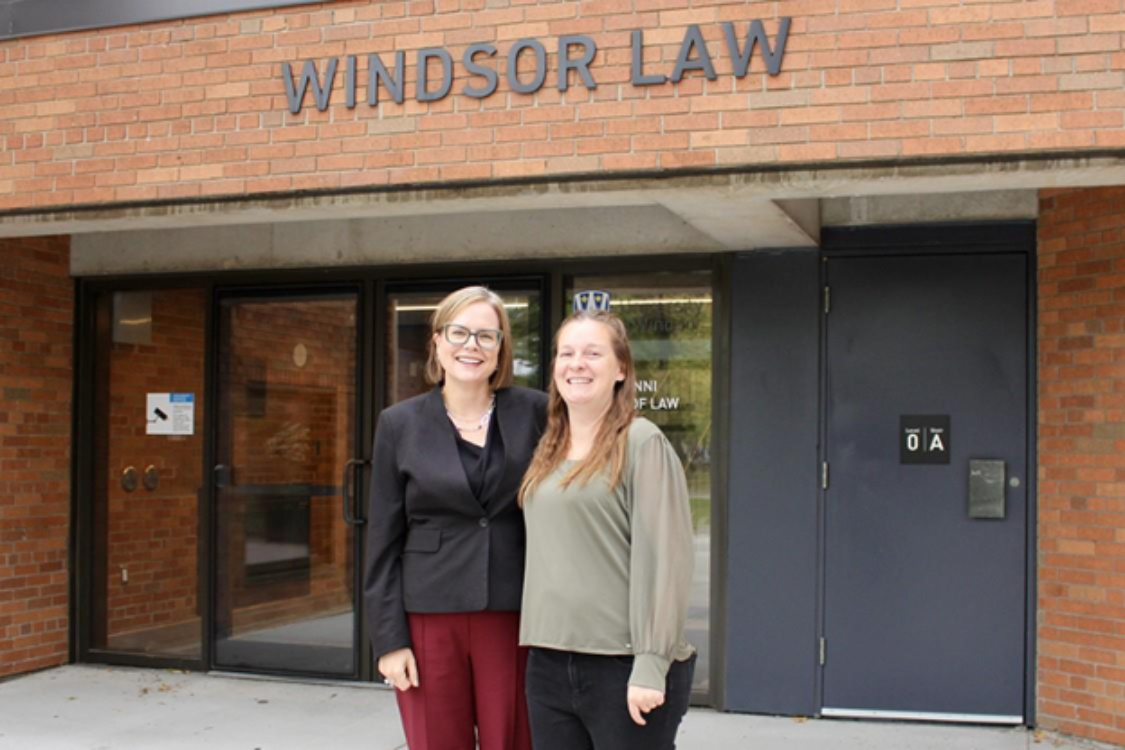
Gemma Smyth, professor and externship director (Law) left, and Jamie Holmes, Windsor Law graduate and articling student with Indigenous Services Department (ISD), Legal Aid Ontario LAO), will play important roles in the seminal Indigenous child research and education initiative. (ANGELA KHARBOUTLI/University of Windsor)