
 Aya Abu-Libdeh is a research and development engineer at the Centre for Hybrid Automotive Research and Green Energy (CHARGE) Lab. (MIKE WILKINS/University of Windsor)
By Sara Elliott
University of Windsor graduate students are positioned to benefit from new funding designed to help Ontario-based electric vehicle companies tackle real-world industry challenges through academic collaboration.
UWindsor has joined the new academic-industry initiative — Electric Vehicle Innovation Ontario (EVIO) — a $7.9 million federal and industry-backed partnership led by the University of Toronto.
“This is a significant opportunity to advance electric vehicle technology by helping solve problems in a scientific way,” says Dr. Narayan Kar, director of the Centre for Hybrid Automotive Research and Green Energy (CHARGE) lab. Kar serves on the EVIO Innovation Management Committee.
As one of eight partner institutions, UWindsor researchers are eligible to access EVIO funding, which supports the training of graduate students and postdoctoral fellows in developing next-generation electric vehicle and automotive mobility technologies.
By embedding students within companies across the electric vehicle supply chain, the program connects research talent directly with industry.
“Graduate students and postdoctoral fellows would be working full-time on the projects,” says Kar.
“Industry gains access to the intellectual capacity that we bring, while trainees are mentored by academic and industry supervisors.”
Projects may focus on battery chemistry, charging reliability, power electronics, mobility software, cold-weather performance and advanced manufacturing.
“Industry formulates the problem, researchers put forward a proposal to address it, then EVIO complements the industry’s investment with additional funding,” he says.
Projects run eight to 16 months and would place graduate students and postdoctoral fellows on site with industry partners.
“These results are implementable and not just theoretical research – this is practical relevance that industry can use,” says Kar.
In addition to advancing technology, the initiative advances intellectual property development. Kar says the companies benefit by having access to university research facilities and highly trained personnel.
The program provides students with hands-on experience solving complex challenges.
“This is a new and rapidly evolving field without many experts,” he says.
“Training the next generation is central to this project and it is our students who are the ones walking the walk and advancing the knowledge. This initiative makes it possible to create new experts in this area, which is essential to making the technology sustainable.”
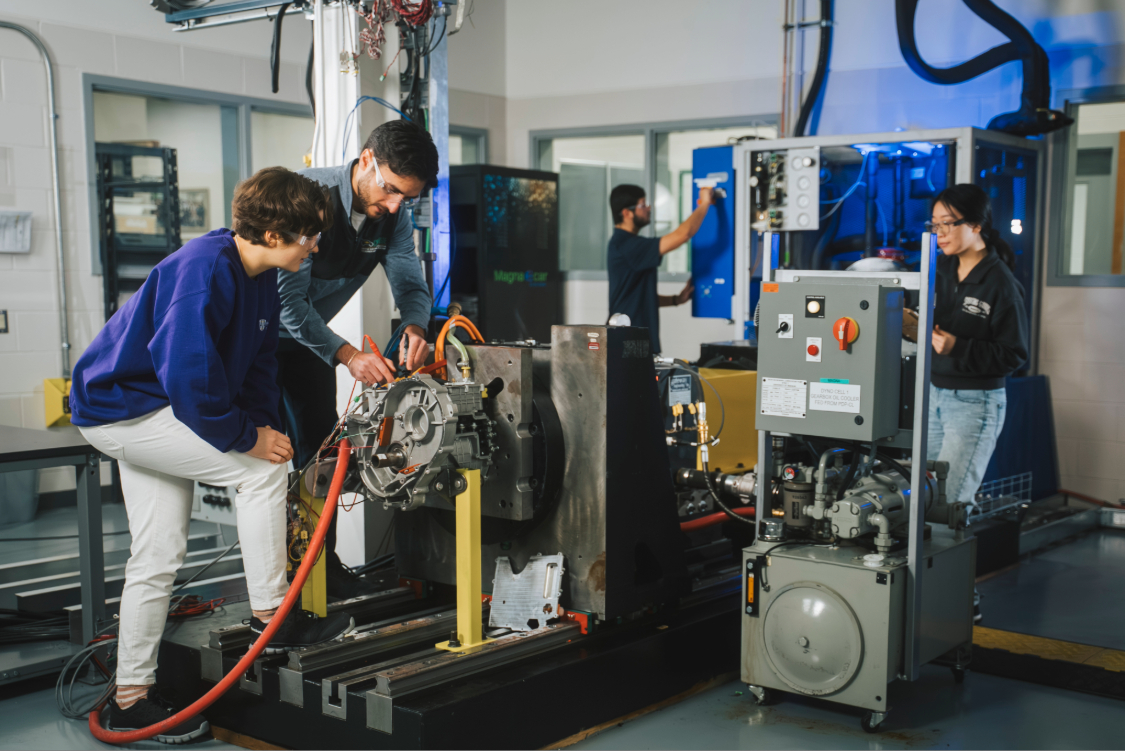
Researchers at the Centre for Hybrid Automotive Research and Green Energy (CHARGE) Lab in the Faculty of Engineering. (MIKE WILKINS/University of Windsor)
Kar says that Windsor has a long-standing role in Canada’s automotive sector and this makes UWindsor well positioned to lead in electric vehicle research.
“We want Windsor’s name to be linked to electric vehicles,” he says.
“Through EVIO by collaborating with industry, we can create new knowledge, advance intellectual property and develop new technology that will have real-life impact.”
Faculty interested in applying for project funding or who want to learn more about eligibility can visit the EVIO website for details.
“If you have capacity to deal with real industry problems it is a great opportunity,” says Kar.
“This funding model empowers us to expand our research community, strengthen our infrastructure, and tackle the complex challenges that matter most to our society and economy.”
Dr. Shanthi Johnson is the vice-president, research and innovation.
“This initiative gives our graduate students and postdoctoral fellows meaningful opportunities to collaborate with industry partners and apply their expertise to solving real-world challenges,” says Johnson.
“We’re proud to partner with the University of Toronto on this important initiative. Collaborations like this bring together academic expertise and industry insight, creating new opportunities for our researchers and trainees to work side by side with partners to address real-world challenges.”