
 Archivist and librarian Sarah Glassford and educator Walter Cassidy with items from the physical collection of Queer Life in Windsor and Essex County: A Living History at the University of Windsor’s Leddy Library on Tuesday, Aug 5, 2025. (PETER MARVAL/The University of Windsor)
By Lindsay Charlton
“Once we have knowledge of history, there is that concept of belonging and empathy,” says Walter Cassidy (B.Ed. 2000).
That belief has driven Cassidy’s work as an educator and advocate and inspired his efforts to uncover and preserve the stories of 2SLGBTQIA+ people in Windsor-Essex.
“I think a lot of the difficulties we’re facing today come from misinformation and a lack of historical knowledge,” he says. “This archive offers that knowledge.”
Now, that work lives on in a new digital archive: Queer Life in Windsor and Essex County: A Living History.
The collection includes relevant newspaper articles and advertisements for events around the city’s local bars, dating back to 1952, when Adrian Ames, a popular female impersonator, frequently performed in Detroit and at White’s Elbow Room in Windsor.
Photographs from past Pride parades and images of local activists are also featured, such as Harold Desmarais, a prominent Windsor-based activist who became a notable leader in gay activism across Canada, and Jim Davies, a local activist who ran a queer community phone line out of his apartment.
Both were founding members of Windsor Gay Unity (WGU), a support group launched in 1972 to connect and empower queer people in the region. Recognizing a lack of safe spaces for 2SLGBTQIA+ individuals, the group began hosting social events, including its first public gathering — a dance held at the University of Windsor.
“That group happened through the University of Windsor, and the actual first public event in Windsor history was a dance there,” Cassidy, chair of the Windsor/Essex Rainbow Alliance (WERA), says. “Of course, there were other events before that, but this was the first time they were open about it.”

Archivist and librarian Sarah Glassford and educator Walter Cassidy with items from the physical collection of Queer Life in Windsor and Essex County: A Living History at the University of Windsor’s Leddy Library on Tuesday, Aug 5, 2025. (PETER MARVAL/The University of Windsor)
Cassidy has been building this collection for years. Along with teaching at Walkerville Collegiate High School, he served as educator in residence for the Canadian Museum for Human Rights and teaches the Faculty of Education AQ course How to Teach LGBTQ Students.
While teaching that course, he wanted to include local history but found most Canadian-focused material concentrated on larger cities like Toronto, Vancouver and Montreal.
“I started to think how much I would love to look at local stuff, so I started a deep dive, and there really wasn’t anything, not at the university, not at the local museums. So, when COVID hit, I was bored and started to research,” he explains.
With help from archivists across North America, Cassidy collected materials and uncovered little-known Windsor connections.
“I found these important historical moments. An example, and what’s in the portal, is about Bill Kovinsky. He was the first person reported to have died of AIDS in Canada. He was from Windsor but was never named,” Cassidy says.
Through a “rollercoaster” of research, he pieced together Kovinsky’s story using obituaries, medical reports and documents, eventually connecting with his sister to shine a light on him years later in an article for Xtra magazine.
“She’s been so happy,” he shares. “One of the things she said was, ‘Before the article, no one would talk about my brother. It was kind of taboo, and now everyone’s talking about him again.’”
Cassidy notes a few similar examples of national history with unknown Windsor ties. The first bathhouse raid in Canadian history took place in Windsor, and a landmark Superior Court ruling that extended marriage rights to same-sex couples, Halpern v Canada, involved a lesbian couple with roots in Windsor.
He says he had a lot of support pulling the information together. Many knew some resources had been overlooked or didn’t exist, but recognized the value of unearthing this history, which eventually led him to connect with Leddy Library.
Librarian and archivist Sarah Glassford says when Cassidy reached out, there was already a website created by university students through various courses that highlighted local queer organizations and activism. She saw it as the perfect starting point — something that could be built on to include all the additional information Cassidy had found.
The WERA group approached the Office of the President, which provided funding to hire a student to help further develop the digital archive. Now, after years of research and collaboration with students, community organizations and UWindsor staff, Queer Life in Windsor and Essex County: A Living History is available online.
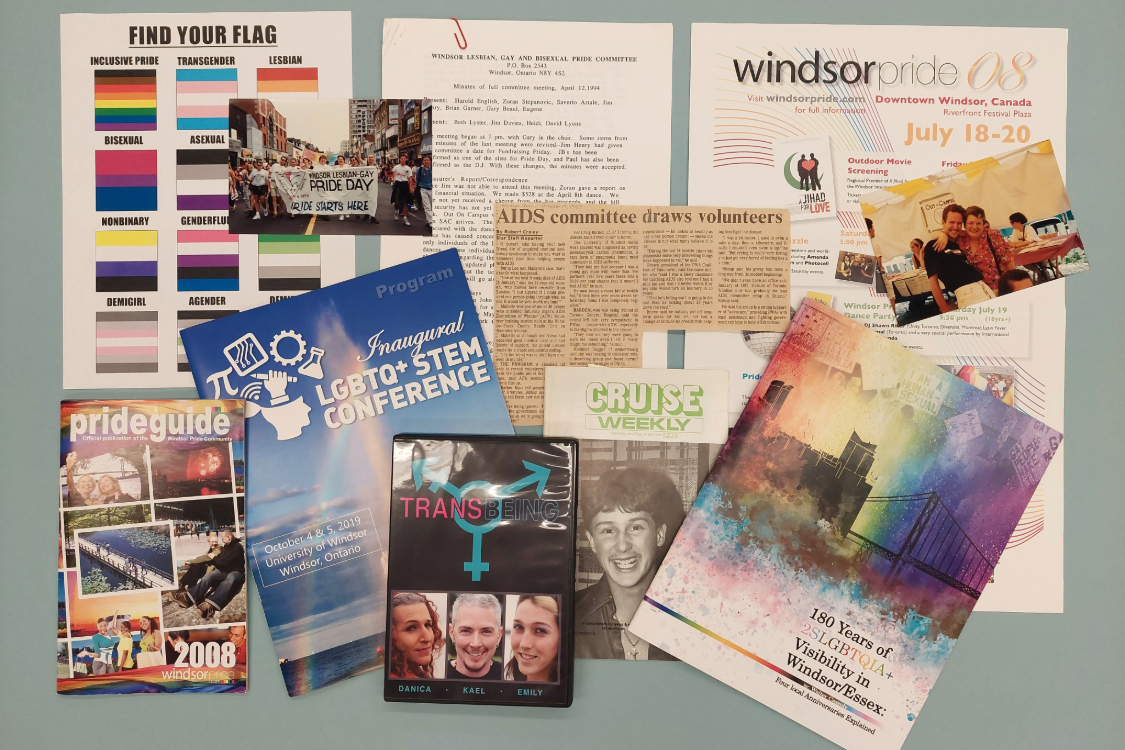
Items collected for the Queer Life in Windsor and Essex County: A Living History physical archive housed in Leddy Library. People are invited to visit the collection and share their own items by contacting archive@uwindsor.ca or 519-253-3000 ext. 3851. (Courtesy Sarah Glassford)
“If you go to our acknowledgements page, it’s huge, because we’re trying to explain where this all came from,” Dr. Glassford notes. “And we’re calling it a digital portal because it’s meant to be kind of an entryway rather than the final word.”
Bringing that history together in one place has created an important resource designed to inspire and support further exploration. It includes images, stories, suggested readings such as essays and research materials, information about local organizations and activism, and a map highlighting key locations across the region that have shaped its queer history.
Sites featured include Etna’s Steam Bath, the location of Canada’s first bathhouse raid; the first AIDS Committee of Windsor office; the John Damien protest, which the WGU held in support of a local man who was discriminated against due to his sexuality; and prominent queer hangouts like the West Side Hotel and the Ritz Hotel, Windsor’s first official gay bar.
Current events and locations are also noted, such as Windsor-Essex Pride Fest, the Campus Pride Centre, Run for Rocky, Trans Wellness Ontario, among others.
“I hope this encourages people to learn more, and maybe contribute to recovering some of this history,” Glassford says. “There’s plenty of space for research projects for people to use this archival collection, write more stories and bring them to life.”
She also hopes people may turn to the portal as a means for community connection.
“We would love for people to come across this and not only see the history but also see themselves in the story of Windsor. There’s a lot of history within Essex County, but what we often see feels very narrow. It’s so much richer, more colourful and more diverse than we realize. It’s been fun working with Walter and some of the students to bring that alive,” Glassford says.
She highlights that the “living” aspect of Queer Life in Windsor and Essex County: A Living History is key, as Cassidy continues to collect and discover, hoping to build more of the physical collection and update and expand the site.
Visitors are welcome to explore the digital portal online, but there’s even more to discover in the physical collection housed at Leddy Library. To consult the full archive in person, appointments can be made by contacting archive@uwindsor.ca or 519-253-3000 ext. 3851.