
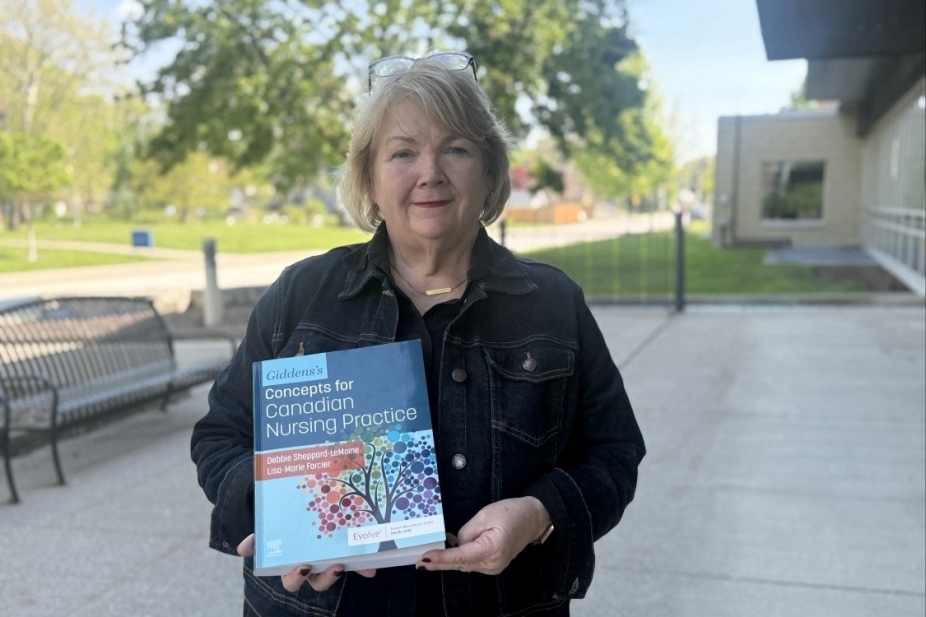
 Dean Debbie Sheppard-LeMoine co-edited Giddens’s Concepts for Canadian Nursing Practice, a new national textbook featuring contributions from experts across the country, including several UWindsor nursing faculty. (RONAK DOOWD/University of Windsor)
By Sara Meikle
At the University of Windsor Faculty of Nursing, classroom concepts have moved into print.
A new national publication featuring several faculty contributors is doing more than filling a gap in academic literature — it’s helping define how future nurses across Canada will learn, think and practise.
Co-edited by Dean Debbie Sheppard-LeMoine, Giddens’s Concepts for Canadian Nursing Practice marks the first Canadian edition of a widely used concept-based nursing text.
But the story behind the book is less about a single editor and more about the collective strength of a faculty — and a leader who recognized how to bring that strength forward.
Dr. Sheppard-LeMoine didn’t initially set out to take on the project.
With longstanding ties to the publisher and deep experience in concept-based curriculum, she instead saw an opportunity to connect experts across the country and create something distinctly Canadian.
“I realized I knew the people and their areas of expertise,” she said. “It became a way to bring the right voices together and to create space for our faculty to contribute.”
That instinct to lead by connecting others shaped the book from the ground up.
While she guided the overall vision along with her co-editor, Sheppard-LeMoine worked to ensure strong representation from the Faculty of Nursing at UWindsor, with faculty contributing to more than 20 chapters — an important milestone in many of their academic careers.
“It was exciting to see faculty members recognize their work in print,” she said. “That’s what I was hoping for, that sense of pride and contribution.”
Among those contributors is Amanda McEwen (BSN ‘07, MSN ‘17), a professor and learning specialist in simulation-based education, who saw the project as both professionally and personally meaningful.
“Being part of this resource allowed me to engage more deeply with how foundational nursing concepts are taught, particularly in ensuring that Canadian context is accurately reflected,” McEwen said. “It reinforces how important it is that our teaching aligns with what students will encounter in practice.”
That connection between theory and practice is central to the book’s concept-based approach, which emphasizes clinical reasoning over memorization. Through case-based learning, digital supports and interactive elements, the text is designed to help students apply knowledge in real-world scenarios.
For Dr. Kelly Kennedy (BSN ‘13, MSN ‘17), whose work focuses on pediatric and adolescent health, that approach is critical.
“Concept-based resources help students move beyond task-focused care toward a more holistic, patient-centred approach,” Kennedy said. “They encourage learners to consider the whole person, their health, context and lived experience, which is essential in Canadian healthcare settings.”
What distinguishes this edition further is the Canadian lens Sheppard-LeMoine championed throughout the process.
Recognizing gaps in the original American text, she pushed for the inclusion of three new chapters focused on Indigenous perspectives, racism and gender diversity — topics she saw as essential to nursing education in Canada.
“That was important to me,” she said. “If this was going to be a Canadian edition, it needed to reflect who we are and how we practise.”
The result is a 64-chapter resource that brings together contributors from across the country while highlighting the expertise within the University of Windsor. It’s also a reflection of the Faculty of Nursing’s broader commitment to advancing education, research and inclusive practice.
“This project showcases the depth of knowledge within our faculty,” Sheppard-LeMoine said. “It demonstrates their willingness to contribute, to share expertise and to help shape how nursing is taught.”
That spirit of collaboration and innovation aligns closely with the faculty’s strategic priorities — strengthening research impact, enhancing teaching excellence and preparing graduates to meet the evolving needs of healthcare systems.
By elevating faculty voices on a national stage, the book also helps position the University of Windsor as a leader in nursing education.
“I wanted people to see what our faculty can do,” Sheppard-LeMoine said. “This was a way to give them that presence and to show the role we’re playing in nursing education and practice.”
For contributors like Kennedy, that collective impact is what makes the project especially meaningful.
“There’s a real sense of shared purpose,” she said. “We’re contributing to something that will influence how students learn and how care is delivered across Canada. I’m proud to be part of that collective effort.”
In that sense, the book is more than an academic achievement.
It’s a reflection of leadership that brings people together, a faculty committed to advancing its field and a shared vision for nursing grounded in knowledge, inclusivity and real-world experience.