
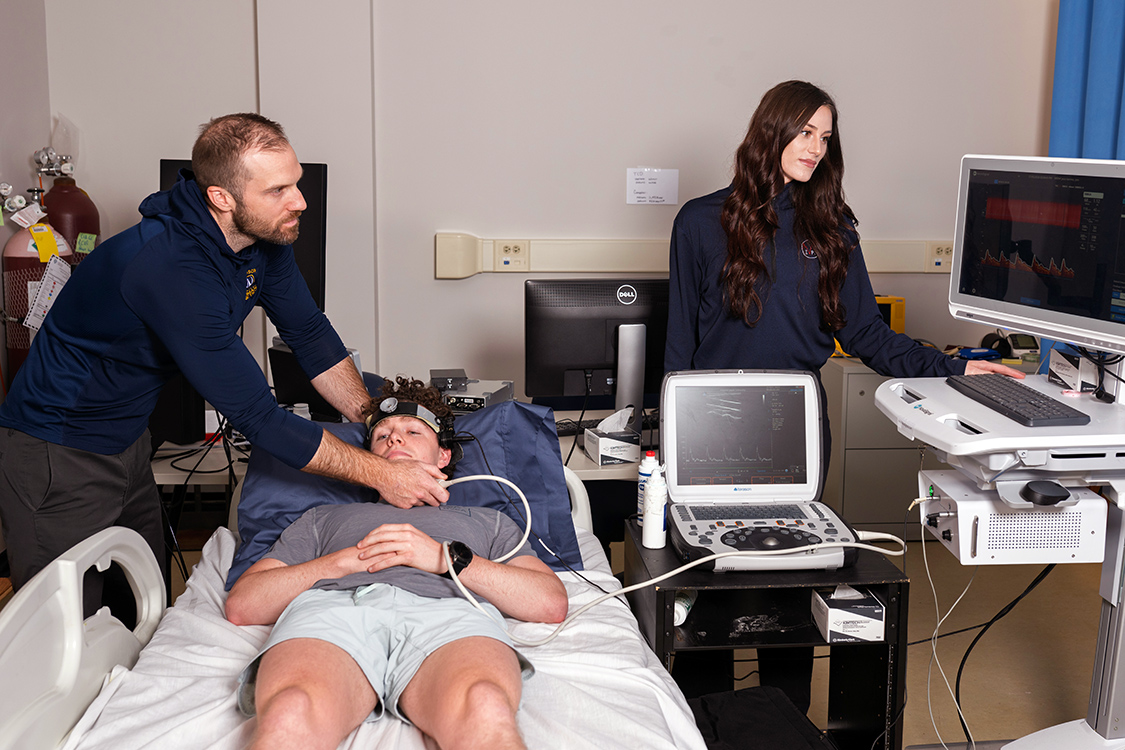
 Brooke Shepley, a PhD candidate in kinesiology at the University of Windsor, is studying the effects of near-infrared light therapy on Parkinson’s disease. (PETER MARVAL/University of Windsor)
By Victor Romao
By studying how near‑infrared light affects the brain, a University of Windsor PhD candidate is exploring a potential new approach to managing symptoms of Parkinson’s disease.
Brooke Shepley (MHK ’21, BHK ’19), a kinesiology researcher specializing in cerebrovascular physiology and vascular biology, is studying an approach known as photobiomodulation (PBM).
The treatment uses near-infrared light — a form of invisible electromagnetic radiation just beyond the red end of the visible spectrum — to stimulate brain activity and may influence cells involved in dopamine production, a key factor in Parkinson’s disease.
Rather than measuring dopamine levels directly, Shepley and her team are examining how the therapy influences brain blood vessel function, motor skills and cognitive performance.
“We assess potential benefits by looking at how the brain and body function change,” said Shepley. “That gives us a more complete picture of whether this therapy could have meaningful effects.”
Parkinson’s disease is a progressive neurological disorder that affects movement and cognition. Its prevalence has increased in recent years, driven largely by an aging population as well as environmental factors such as pesticide exposure and air pollution.
Against that backdrop, researchers are increasingly looking for treatments that can complement existing therapies.
“Photobiomodulation has shown promise in early studies on neurodegenerative diseases, but its impact on Parkinson’s remains largely unexplored,” said Shepley.
Her work is based in the Integrative Vascular Physiology Lab at the University of Windsor, where the primary research focus is on cerebrovascular function — how blood vessels in the brain respond to internal and external stimuli.
By combining vascular, cognitive and motor assessments, the study aims to better understand how Parkinson’s affects multiple systems in the body, and whether light therapy could help address those changes.
“We wanted to look beyond a single outcome,” said Shepley. “Parkinson’s affects movement, cognition and underlying brain function, so it’s important to measure all three.”
The project involves collaboration among faculty members, clinical partners and an industry partner that developed the light therapy devices used in the study.
Dr. Anthony Bain, Shepley’s PhD supervisor, said the research could serve as a foundation for a larger clinical trial.
“We intend to use the current study as pilot data for a multi-site trial investigating the therapeutic potential of photobiomodulation in Parkinson’s disease,” said Bain.
He added that the lab’s work is particularly focused on whether improvements in brain blood flow could play a role in reducing symptoms.
While Shepley’s volunteer work with a local boxing program for people with Parkinson’s is not part of the formal study, she said it has shaped her understanding of the disease.
“Connecting with individuals living with Parkinson’s disease helped me better understand their experiences,” she said. “That perspective is essential when designing research that aims to improve quality of life.”
Shepley also observed that regular exercise appeared to help participants manage symptoms, reinforcing existing evidence that physical activity can be beneficial for people with Parkinson’s.
Looking ahead, Shepley said she hopes to continue research that bridges scientific discovery and real-world impact.
“As I approach completing my PhD in 2026, I am exploring opportunities that will allow me to continue bridging research and real-world impact,” she said.
“I am currently pursuing postdoctoral and research scientist opportunities, with a particular interest in collaborative, interdisciplinary research environments. Ultimately, I would like to contribute to research that deepens our understanding of human health and disease and translates into meaningful improvements in function and quality of life.”
She added that the future of Parkinson’s research is especially promising as new approaches expand beyond traditional treatments.
“What excites me most about the future of this research is the growing recognition that exercise and other adjunct therapies can play an important role alongside traditional medical treatments for Parkinson’s disease,” said Shepley. “These approaches provide additional opportunities to improve function and independence, which improves the quality of life for people living with this condition.”