
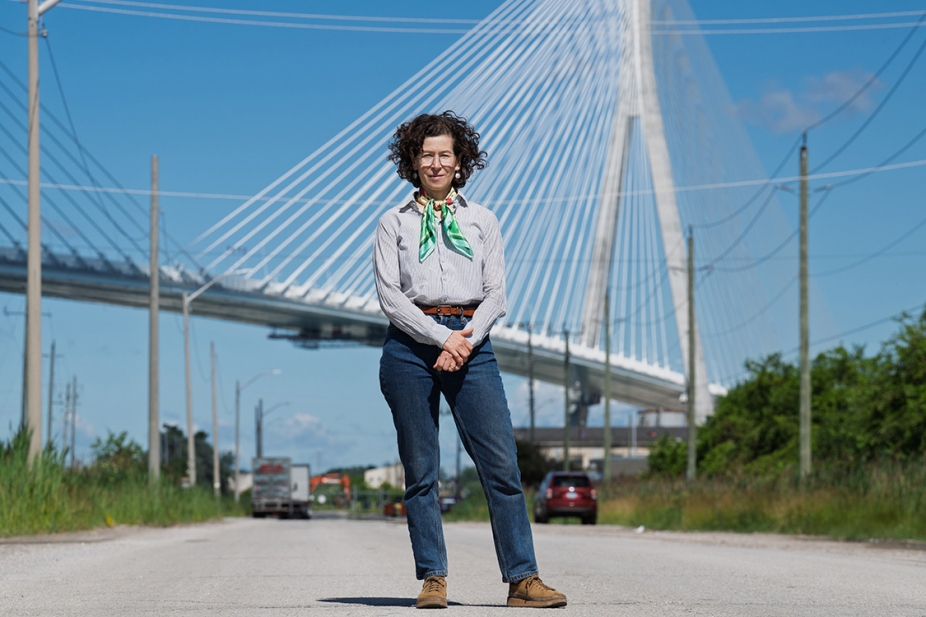
 University of Windsor professor Lee Rodney stands near the Gordie Howe International Bridge in Windsor, Ont., a project she says could reshape cross-border identity between Windsor and Detroit. (PETER MARVAL/University of Windsor)
By Victor Romao
The Gordie Howe International Bridge is rising at a time when the line between Windsor and Detroit can feel more fixed than fluid.
Tighter border controls, post-pandemic disruptions and political friction between Canada and the United States have made that divide more visible in recent years.
For decades, the Detroit River has been less a barrier than a seam, stitching together two cities whose economies, cultures and daily rhythms have long overlapped.
Yet in recent years, that sense of a shared region has been tested, as crossing the border has grown more complex and the idea of cross-border community more fragile.
The new bridge, set to join Highway 401 directly with Interstate 75, is widely understood as a solution to congestion and trade inefficiencies.
But as it takes shape on the skyline, some observers see something more, an opportunity to rethink how Windsor and Detroit relate to one another, not just as trading partners but as neighbours.
At the University of Windsor, urban ecologies scholar Dr. Lee Rodney is among those examining the bridge through that wider lens. A research affiliate with the Windsor Law Centre for Cities, Rodney studies border relationships and says infrastructure alone cannot define life in a region where identity has always extended across the river.
“We’re quite familiar with the numbers around trade volumes … but that doesn’t meaningfully describe the experience of living here,” she says. “The bridge is a vital symbol of the historic connection within the region.”
Historically, that connection has been anchored at the river’s narrowest point, where ferry routes, the Detroit–Windsor Tunnel and the Ambassador Bridge linked the downtown cores of both cities.
The Gordie Howe bridge marks a departure.
Located farther downriver, it connects highway systems rather than urban centres, a functional shift that could reshape how residents experience the border.
“It’s long overdue but fundamentally necessary,” says Rodney, pointing to decades-old gaps in regional highway planning.
At the same time, she argues, the project reflects a different approach to infrastructure, one that places greater emphasis on cultural meaning and community impact.
A public art program embedded in the bridge’s design highlights Indigenous and Black histories, making those narratives visible in the built environment.
“This puts those histories at the centre of how we understand connection in the region,” Rodney says, noting that such considerations were largely absent from earlier crossings.
Rodney says the bridge’s influence may also be felt in more immediate, everyday ways.
By diverting transport trucks from city streets, particularly near the University of Windsor, it could help reduce congestion, noise and air pollution in west Windsor neighbourhoods.
“Returning the streets to the people that live here is vital,” says Rodney, describing the potential for improvements in safety, health and social interaction.
Still, she cautions against viewing the project as an unqualified benefit.
Communities closest to the crossing, including Sandwich in Windsor and Delray in Detroit, have long been shaped by industrial traffic and environmental pressures.
“Mega-projects like this are generally not great for the communities immediately adjacent to them,” she says, while noting that the bridge’s long-term impact will depend on continued monitoring, consultation and investment.
Efforts to mitigate those impacts are built into the project, including improved connections to parks and trails and a multi-use pathway intended to support active transportation.
Rodney sees that feature as particularly significant in reimagining the border as a shared civic space rather than simply a checkpoint.
“Extremely important,” she says of pedestrian and cycling access.
That perspective aligns with broader cross-border initiatives involving the University of Windsor, including the Detroit–Windsor United Nations Regional Centre of Expertise on Education for Sustainable Development. Co-directed by UWindsor law professor Anneke Smit and Wayne State University’s Donna Kashian, the centre focuses on regional challenges such as climate action, water systems and urban sustainability.
Rodney, who has helped steer the RCE over the past year, was also among the original team members who helped field the cross-border application between the University of Windsor and Wayne State University in 2021.
For her, such collaborations reflect a deeper way of understanding the region, not as two separate jurisdictions but as part of a shared ecological system.
“The idea of a bioregion that isn’t separated by the border is well understood by Indigenous Peoples here,” she says, referencing the Anishinaabemowin concept of Wawiiatanong, or “where the river bends.”
Whether the bridge ultimately strengthens that sense of connection remains uncertain. Since the COVID-19 pandemic, Rodney says, cross-border collaboration has become more difficult, straining relationships that once felt routine.
Still, she believes the region’s history offers reason for optimism.
“We need to keep the channels of communication open,” she says, arguing that local engagement can counter broader political divisions.
In that context, the Gordie Howe International Bridge may come to represent more than infrastructure. Its success, Rodney suggests, will depend on whether it helps residents see the Detroit River not as a dividing line but as a shared space, one that continues to shape a common identity on both sides of the border.
“The main story is trade,” she says. “But the backstory is what this river has connected over centuries, and how we choose to understand that moving forward.”
Listen: Lee Rodney discusses the Gordie Howe International Bridge in a recent interview on Detroit public radio station WDET.