
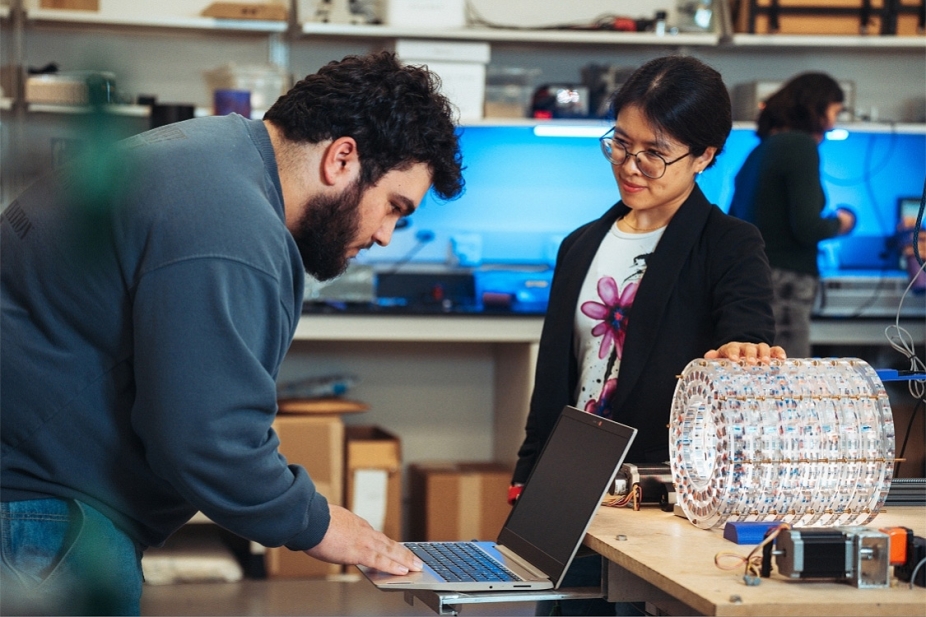
 Dr. Dan Xiao (right) is designing a low-cost magnetic resonance imaging device. (University of Windsor)
Ten University of Windsor researchers are turning their work into ventures as members of the inaugural Innovation Fellowship cohort.
The fellows aim to bring research-based business ideas to market, from a cybersecurity training program to a low-cost magnetic resonance imaging (MRI) device.
The 14-week venture development program supports early-stage founders, creators and researchers through mentorship, advising, networking and hands-on workshops.
“The Innovation Fellowship reflects our commitment to helping University of Windsor researchers translate bold ideas and discoveries into solutions that create meaningful economic and social impact,” said Dr. Shanthi Johnson, vice-president, research and innovation.
“By combining early-stage funding with mentorship, business expertise and connections to the regional innovation ecosystem, we are giving our fellows the tools and confidence to move promising research closer to market.”
Ten fellows from various disciplines across campus were selected from nearly 70 applications.
To kick off the program, the five faculty members, four PhD students and one postdoctoral fellow each received $10,000 in seed funding from Intellectual Property Ontario (IPON).
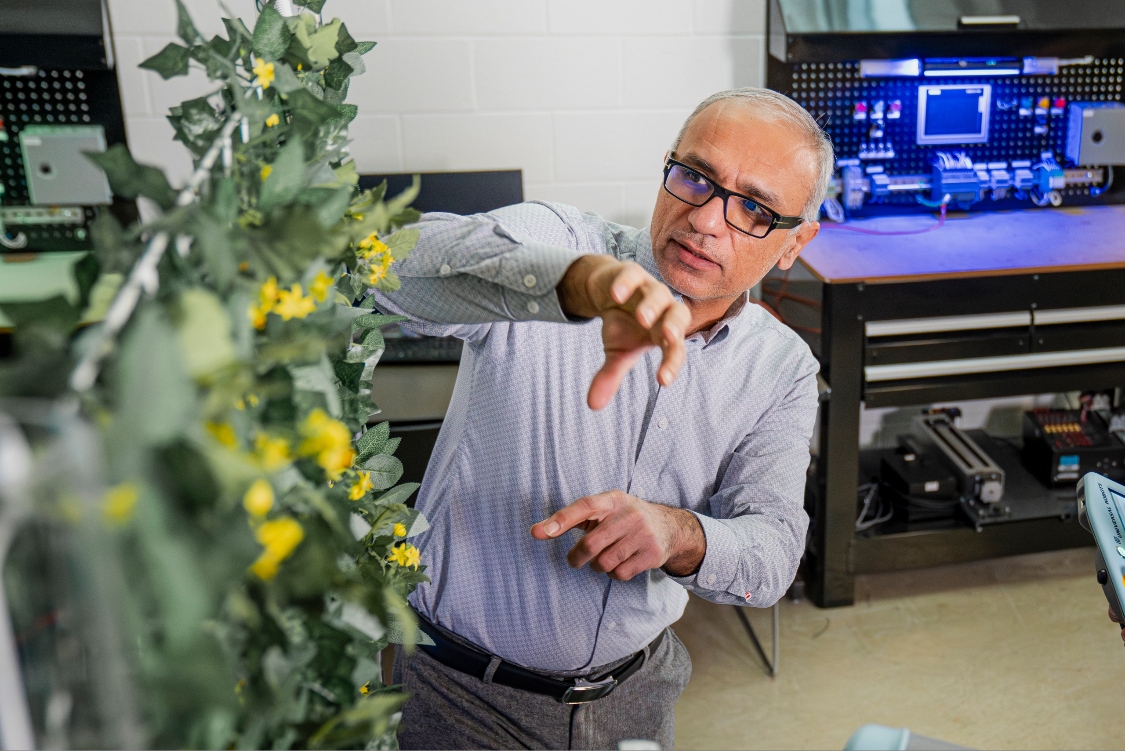
Dr. Shahpour Alirezaee is developing an artificial intelligence framework that enables mobile robots to understand natural language instructions and navigate complex environments. (MIKE WILKINS/University of Windsor)
The inaugural Innovation Fellowship cohort of lead applicants includes:
Faculty members
- Dr. Shahpour Alirezaee, Department of Mechanical, Automotive and Materials Engineering — developing an artificial intelligence (AI) framework that enables mobile robots to understand natural language instructions and navigate complex environments such as warehouses, campuses and disaster response scenarios.
- Dr. Maddie Brockbank, School of Social Work — developing an evidence-based framework to engage men in gender-based and sexual violence prevention through education, peer discussion and community action.
- Dr. Brian DeVeale, Department of Biomedical Sciences — using pooled tumour samples to improve the accuracy of cancer therapy testing while reducing the number of animals needed for research.
- Dr. Ziad Kobti, School of Computer Science — developing a cybersecurity training program that helps small and medium-sized businesses prepare for and respond to cyberattacks.
- Dr. Dan Xiao, Department of Physics — designing a low-cost magnetic resonance imaging device for small-scale hatcheries to determine the sex of chicken embryos early in development.
Postdoctoral fellow
- Dr. Haleh Nazemi, Department of Electrical and Computer Engineering — developing a smart greenhouse system that combines real-time environmental monitoring with early pest detection to improve crop production and sustainability.
PhD students
- Eunice Ajayi, Department of Civil Engineering — building an AI platform called FieldNote that helps structural engineers quickly create accurate field reports while preserving institutional knowledge.
- Nathan Drouillard, Department of Physics — developing a novel method for amplifying weak optical signals to improve sensing technologies used in medical diagnostics, security screening and materials analysis.
- Maksymilian Dziura, Department of Chemistry and Biochemistry — creating a strategy to support medical isotope production in Windsor-Essex to help strengthen cancer diagnosis and treatment in the region.
- Sooraj Sunil, Department of Electrical Engineering — developing an AI-powered system that predicts the remaining useful life of retired electric vehicle batteries for reuse in energy storage applications.
Throughout the program, Windsor-area business leader Shane Kilpatrick is mentoring the cohort as the entrepreneur-in-residence, while program delivery partner WEtech Alliance provides advisory services and support.
Since the program launched in May 2026, fellows have taken part in regular mini-pitch sessions. After learning business development strategies, they deliver fresh pitches using those techniques, with the winner receiving a $500 prize.
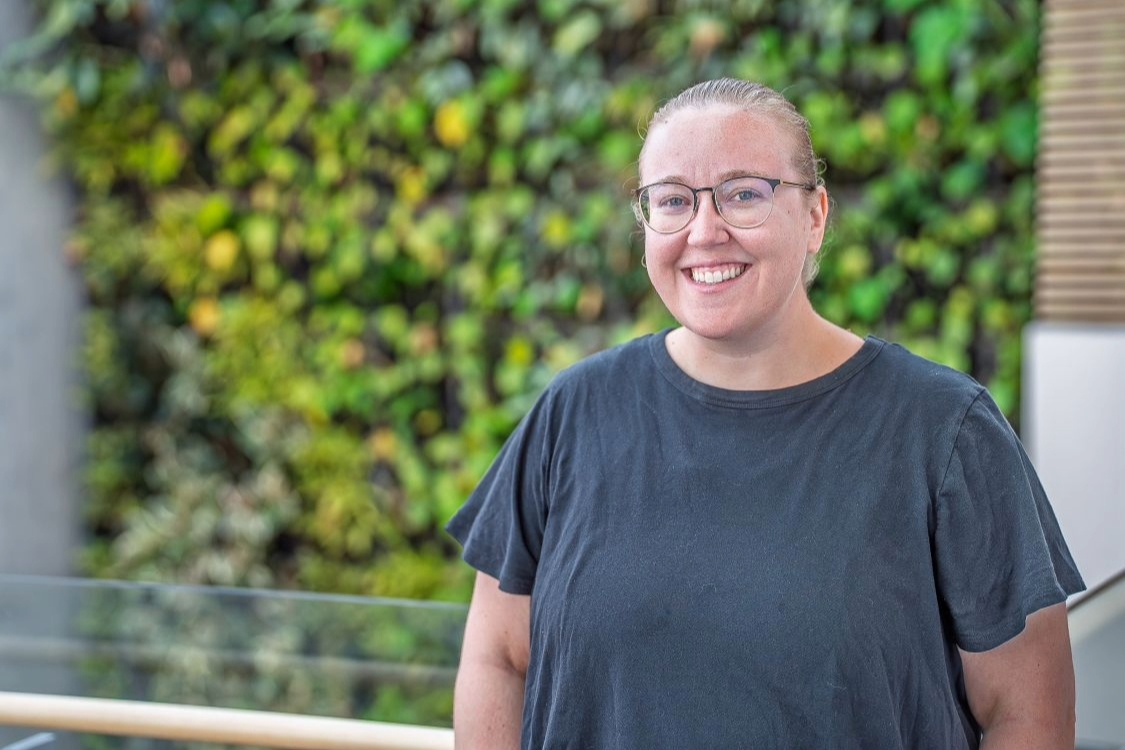
Dr. Maddie Brockbank is developing an evidence-based framework to engage men in gender-based and sexual violence prevention through education, peer discussion and community action. (KYLE ARCHIBALD/University of Windsor)
After a little more than three months of exploring market validation, intellectual property protection strategies and commercialization planning, the fellows will compete in a final pitch showcase before a panel of investors, government partners and business leaders.
The showcase will take place Aug. 21, 2026.
The winning venture will receive an additional $10,000, the runner-up project will earn $5,000 and the third-place team will win $2,500.