
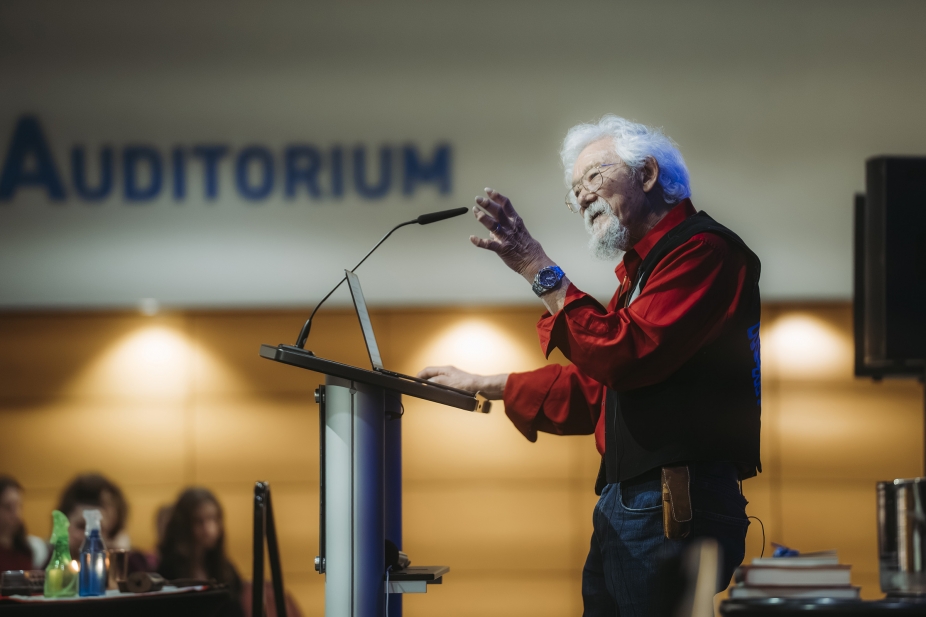
 David Suzuki chronicles his journey from a childhood marked by wartime internment to becoming a globally respected science communicator and environmental advocate in his latest book, latest book titled Lessons from A Lifetime: 90 Years of Inspiration and Activism. (PHOTO BY MICHAEL WILKINS/University of Windsor)
By John-Paul Bonadonna
The University of Windsor welcomed one of Canada’s most influential voices in environmental science and advocacy, Dr. David Suzuki, for a wide-ranging and candid evening that challenged audiences to confront the realities of climate change and their own role in it.
Hosted by the Faculty of Science, the School of the Environment and the Healthy Headwaters Lab, An Evening with Dr. David Suzuki drew a sold-out audience from across campus and Windsor-Essex.
The event highlighted themes from Suzuki’s latest book, Lessons from A Lifetime: 90 Years of Inspiration and Activism, which chronicles his journey from a childhood marked by wartime internment to becoming a globally respected science communicator and environmental advocate.
Suzuki spoke candidly — “as an activist, as a grandfather and as an elder” — emphasizing the urgency of the current environmental crisis.
“We stand at an unprecedented moment in all of human history when we, one species, have become so powerful, yet so thoughtless, that we are undermining the very future of generations to come.”
Drawing on decades of scientific research and global environmental reports, Suzuki traced a sobering timeline of missed opportunities. From the 1992 “World Scientists’ Warning to Humanity” to more recent climate data, he argued that humanity has failed to act decisively despite clear and repeated warnings.
“We have failed to act,” he said, noting that global emissions continue to rise even after decades of international climate summits.
![[IMAGE_ALT_TEXT]](/news/sites/uwindsor.ca.news/files/davidsuzuki_uow_facultyofscience-05009_web.jpg)
Beyond the data, Suzuki’s message was deeply human. Reflecting on his grandchildren, he described a personal accountability that drives his advocacy.
“My grandchildren will grow up in a radically diminished world from the one that I knew as a child,” he reflected.
“So I have a responsibility to fight for their future.”
Throughout the evening, Suzuki returned to a central idea that has defined his career: the interdependence between humans and the natural world. He challenged the dominant worldview that places humans above nature, arguing instead for an “ecocentric” perspective rooted in relationships and reciprocity.
“We are the Earth,” he reiterated, underscoring humanity’s inseparable connection to the planet.
He also highlighted the importance of Indigenous knowledge systems, praising their long-standing emphasis on balance, respect and stewardship. These perspectives, he noted, offer essential guidance in addressing today’s environmental challenges.
He urged attendees to focus their efforts locally. Drawing on examples from across Canada, he described grassroots initiatives ranging from renewable energy projects to ecological restoration efforts.
“Get your act together in your community and find out who your neighbours are,” said Suzuki, referencing activism models in Finland where citizens are encouraged to prepare collectively for climate-related disruptions.
Suzuki also challenged individuals to rethink consumption and lifestyle choices, suggesting that meaningful change begins with personal accountability.
“Cut your consumption in half in a year,” he urged, framing it as a tangible step toward reducing humanity’s ecological footprint.
![[IMAGE_ALT_TEXT]](/news/sites/uwindsor.ca.news/files/davidsuzuki_uow_facultyofscience-04925_web.jpg)
In a particularly candid moment, Suzuki acknowledged that the window to prevent the worst impacts of climate change may have already narrowed significantly. Still, he rejected despair in favour of action grounded in responsibility and connection.
“Hope without action… is not hope,” he said.
Following the talk, attendees had the opportunity to meet Suzuki and have copies of his book signed, made available by Biblioasis Bookshop.