
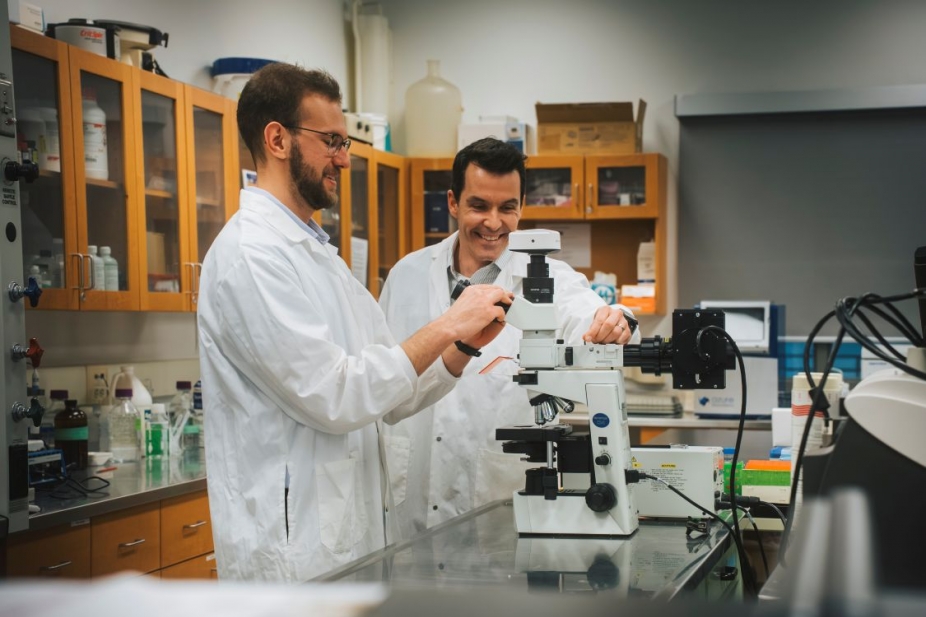
 Dan Scurto recently led a research project focusing on the impact of circadian rhythms on muscle regeneration alongside faculty supervisor Dr. Matthew Krause (MICHAEL WILKINS/University of Windsor)
By Kate Hargreaves
How does the timing of an injury affect the regeneration of that muscle tissue?
That’s what new research out of the Faculty of Human Kinetics sought to explore.
In a recently published article in the American Journal of Physiology: Cell Physiology, Human Kinetics research associate and recent M.Sc. graduate Dan Scurto, along with colleagues including professor Dr. Matthew Krause, investigated how the timing of a muscle injury within the body's daily cycle influences the recovery of that muscle.
“Circadian rhythms have been a relatively explosive area of scientific interest in the last 15 years or so, at least in terms of their impact on peripheral tissues like muscle,” explains Krause. “We are now realizing how impactful circadian rhythms are, and how far-reaching their effects are on our bodies.”
He says that while circadian rhythm biologists may have known this for decades, other fields are only more recently catching up to the importance of designing studies with this timing in mind.
As an undergraduate kinesiology student supervised by Krause, Scurto became interested in how sleep and skeletal muscle regeneration intersects, which he says opened the door to a deeper dive on circadian rhythms in his graduate studies and beyond.
As kinesiology is a multidisciplinary field with a variety of directions to take, Scurto was able to focus his research at the cellular level.
“Ultimately, everything we are doing is geared toward human health,” says Krause. “Regarding our curiosity and our science questions, we are trying to find answers through a molecular and cellular lens.”
In designing this study, Scurto and the research team looked to fill a gap in the literature around longer-term impacts of time of injury.
“A lot of times when research is being performed on muscle regeneration, there’s a lot of different cellular processes that happen in the first seven days post-injury” explains Scurto. “But there are lingering regenerative processes working in the background as the muscle matures and finishes recovering from that injury.”
He notes that a lot of existing literature on timing of muscle injury focused on this acute stage, leaving the question of what the long-term effects are.
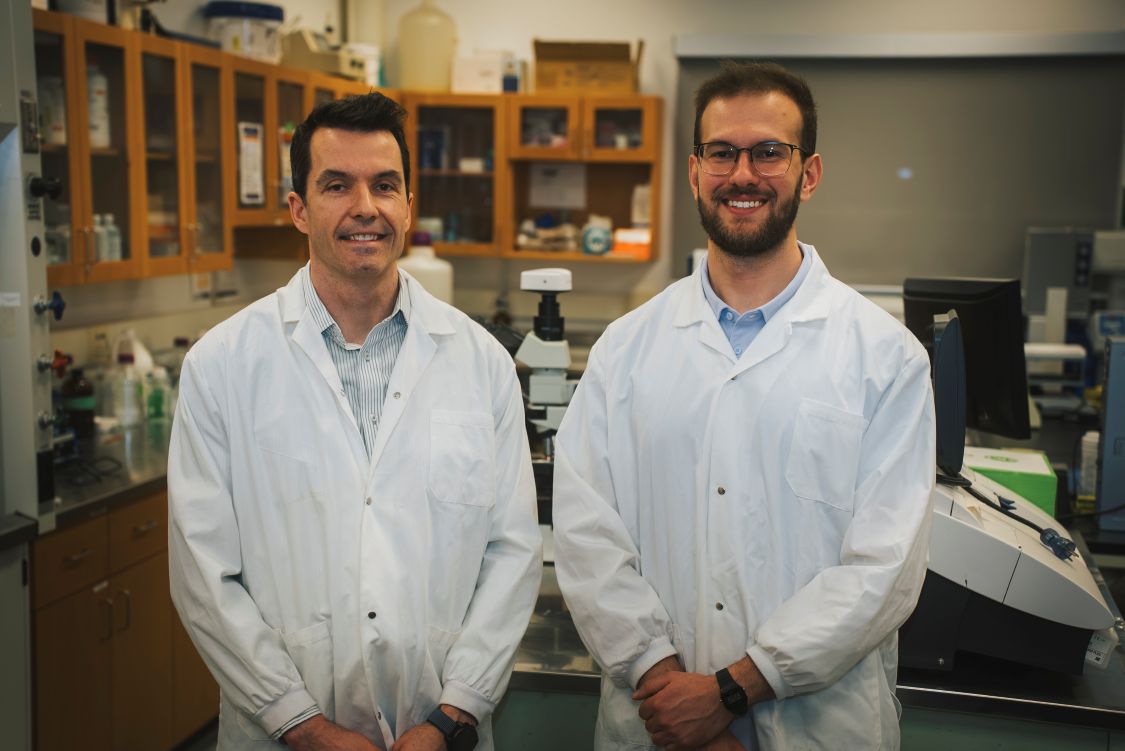
To explore this, the researchers designed a study to determine how time of injury influenced the muscle fibres in both the short and longer-term using a mouse model.
The process was not without its challenges as the lab lighting had to be carefully controlled to maintain circadian rhythms.
“We had some very dim red LED lights that we would use during nighttime experiments,” explains Scurto. “It was a fun dance of trying to prevent exposure to bright light while maintaining a safe environment.”
Comparing rest phase injuries to active phase injuries, the researchers found that more smaller muscle fibres were present even weeks later when injuries occurred during the rest phase of the circadian cycle, leading to every researcher’s favourite question: why?
“Currently we don’t have an explanation for why those smaller muscle fibres persisted into the later time point,” says Krause, noting that building further understanding of this mechanism will be necessary before proceeding to human studies.
“There’s still a lot to cover using the current model,” he says.
Future work, however, may involve assessing the impact of intense exercise at different points of the circadian cycle in order to study this in humans.
While people generally can’t time their injuries, there may be implications for time of day and exercise recovery.
Krause is quick to note, however, that regardless of what is molecularly most ideal, it is better to get your exercise when you can get it versus not doing it at all.
To learn more, read the full article here.