

French at the University of Windsor Faculty of Law
Are you a Francophone or have completed your high school studies in a French-language school, a French immersion program, or an equivalent program?
The Faculty of Law at the University of Windsor offers the opportunity to pursue your legal studies in French while developing skills that will support you in the field. Whether you want to maintain your proficiency in French or deepen your knowledge of French common law, there are several options available to you.
At Windsor Law, you can take courses in French, participate in moot court competitions, join vibrant Francophone communities on campus and beyond, and access development opportunities that will strengthen your language and legal skills. These experiences will allow you to develop your legal vocabulary, drafting and advocacy skills, while preparing you to practice law in both of Canada's official languages.
The French Common Law Certification Program (CCLF)
The French Common Law Certification Program (CCLF), offered by the University of Ottawa, allows French-proficient students to obtain a certification in French common law at the end of their three years of study in the JD program at the University of Windsor, the University of Calgary or the University of Saskatchewan.
The CCLF offers in-depth training in language rights, legal writing, and advocacy in French. Individuals enrolled in the program also complete a semester exchange at the University of Ottawa, participate in the Michel-Bastarache Moot Court Competition and are paired with mentors from the French-speaking legal profession to complete a credited internship in French.
This unique experience provides students with the knowledge, skills and tools needed to provide quality legal services in French and meet the needs of Francophone communities across Canada.
For more information about the CCLF, please contact Gabriel Poliquin, Program Director, at gabriel.poliquin@uOttawa.ca
Courses in French
*Offered in partnership with the University of Ottawa's Faculty of Law, these courses mandatory for students enrolled in the CCLF program. They are also available to students who have completed a French immersion program or equivalent up to grade 12.

These courses are a first step towards a training that will allow our students to:
- Access high-level professional opportunities, including internships at the Supreme Court of Canada and in international organizations, where legal training combined with proficiency in both official languages is a significant advantage;
- contribute to improving access to legal services in French for Francophone communities; and
- develop a solid command of French legal terminology and hone their legal writing and advocacy skills.
These courses are offered by Professor Gabriel Poliquin of the University of Ottawa. To learn more about the CCLF program, or if you would like to access the full program information in French, visit the University of Ottawa’s CCLF program page.
Moot Court Opportunities
Students who wish to improve their advocacy skills in French can participate in several competitions throughout their studies. These experiences develop research, legal writing, and oral argumentation skills, while representing the Faculty of Law on the national stage.
Opportunities include:
- CNNC Moot Court Competition - Francophone Team
- First Nations Moot Court Competition - Francophone Team
- Michel-Bastarache Competition
- Laskin Contest
The French Society of Windsor (Faculty of Law)
The French Society of Windsor (Faculty of Law)
The Société française de Windsor is a student club dedicated to promoting equity, inclusion and diversity within the Faculty of Law at the University of Windsor.
The club brings together Francophone students, as well as anyone interested in the French language or Francophone culture. It fosters a sense of belonging by providing a space where members can exchange, develop their network and share their interest in the Francophonie.
The French Company has several objectives:
- create an environment conducive to exchanges in French;
- provide opportunities to practice French in an academic and legal context;
- Promote access to bilingual employment opportunities in the field of law;
- Promote Francophone programs and initiatives at the University of Windsor and the Windsor-Essex region to strengthen the vitality of the Francophone community.
To learn more or get involved:
- Instagram: @societefrancaisedewindsor
- Student clubs: https://www.windsorsls.com/active-clubs
French Library Resources
The development of a solid legal vocabulary is an essential part of the practice of law in French. Several reliable resources are available to students to deepen their knowledge of legal terminology and common law concepts in French.
We invite you to consult the following resources:
- Jurisource
- AJEFO (Association des juristes d'expression française de l'Ontario)
- Department of Justice Canada
Students can also contact the staff at the Don & Gail Rodzik Law Library for assistance in locating legal resources in French and continuing their learning.
Opportunities for external placement and bilingual employment
The University of Windsor's Faculty of Law regularly offers French-language employment and job placement opportunities through Symplicity. This platform allows law students to access positions related to their legal education and language skills.
It is recommended that you check Symplicity regularly so that you do not miss out on available opportunities, such as research assistant (RA) positions in French. These experiences allow students to:
- improve their French in a professional legal context;
- develop their research skills; and
- gain relevant experience for a career in law where bilingualism is a strong asset.
Students can also contact Professor Gemma Smyth, who is responsible for internships with organizations and companies, to learn more about internships, placements or research projects in French.
Opportunties in Law (French) and Statistics
|
Fact: According to Statistics Canada (2023), almost 1/4 of businesses in Canada offer at least one service in French. |
Fact: The Law Society of Ontario collects statistics on lawyers who practice in French or who identify as Francophone or who offer services in French. |
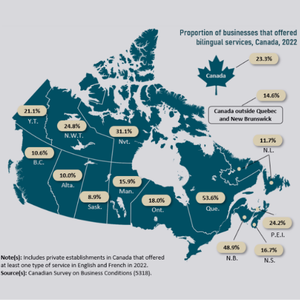
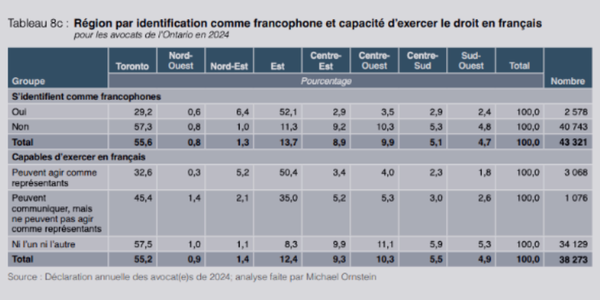
The Law Society of Ontario produces a statistical portrait of licensees in Ontario each year, which includes statistics on the population of Francophones and bilingual people in the legal profession.
Bilingual or French internships and opportunities
The Supreme Court of Canada Law Clerk Program offers internships in English and French:
- The Court of Appeal for Ontario, Clerkship Program: A Position Reserved for a Bilingual Candidate
- Ontario Superior Court of Justice, Articling Program: Bilingualism is required
- Ontario Public Service Careers: A list of bilingual or francophone employment positions in Ontario (legal services, including positions for the Ministry of the Attorney General)
- The Law Society of Ontario (LSO): Several opportunities in French/bilingual
- Legal Aid Ontario: offers bilingual positions
Brief of the Franco Committee of the University of Windsor (March 2024)
Versions available in English and French:
This thesis focuses on the importance of strengthening the Francophonie at the University of Windsor, both on campus and in the Windsor-Essex region. He points out that promoting the French language would better meet the needs of the bilingual job market, attract more Francophone and Francophile students, and promote access to various sources of government and other funding.
The document highlights the already significant Francophone presence within the University and the regional community, while emphasizing that it remains insufficiently recognized due to a lack of visibility, data and programs offered in French.
Among the proposed recommendations are:
- obtaining resources and funding to support the Francophonie;
- better visibility of French on campus
- the identification and mobilization of members of the Francophone community
- the development of more programs and learning opportunities in French
- the creation of institutional structures that promote the Francophonie
The long-term goal is to make the University of Windsor a recognized university destination for Francophone and Francophile students, locally, nationally and internationally.
The French history of Windsor and the Windsor-Essex region dates back to the early 18th century, during the time of French colonial expansion in North America. In 1701, French military contractor Antoine Laumet de Lamothe Cadillac founded Fort Pontchartrain on the north bank of the Detroit River, in what is now downtown Detroit.
Beginning in 1734, the French Crown began to grant land to French settlers mainly from Quebec, particularly along the Detroit River. The land on the south bank of the river played an essential role in the livelihood of the communities established in the region, particularly through hunting and the natural resources of territories such as the Canard River.
In 1747, French Jesuit missionaries established a mission to the Huron-Wyandot communities on the south bank of the Detroit River, near the present location of the Ambassador Bridge. Soon after, the allocation of agricultural land led to the development of Francophone communities, including the Petite Côte (now LaSalle) and parts of what is now downtown Windsor.
The agricultural territory of the region was then characterized by long, narrow plots giving access to the river, known as "ribbon farms". These farms extended over much of what is now Windsor, from the Detroit River to Cabana Street (formerly Cabanat). The French-Canadian families who live there form large communities with deep roots in the region.
During the second half of the 19th century, Windsor's gradual urbanization transformed the traditional agricultural landscape. Despite these changes, French remains a widely used language in the city and in several communities in Essex County. However, the adoption of the Ontario Act restricting French-language education in 1912 led to a significant setback in the institutional transmission of the language.
Today, the Francophone presence remains an important part of Windsor-Essex's cultural identity. A significant portion of the region's population has French-Canadian origins, and more than 13,000 Francophones live in the city of Windsor and surrounding areas. In addition, more than 38,000 residents report having a knowledge of French.
The Francophone community of Windsor-Essex also benefits from a dynamic institutional network. The region is home to 52 schools offering French-language and French immersion programs, as well as post-secondary education opportunities offered by Collège Boréal and the University of Ottawa's Windsor campus.
Other important Francophone organizations and institutions in the region include Radio-Canada, the Bilingual Legal Aid Clinic, the Carrefour communautaire francophone de Windsor-Essex-Kent, the Comité local en immigration francophone de Windsor-Essex-Chatham-Kent, the Réseau des femmes du Sud-Ouest, the Club Richelieu de Windsor and Place du Partage de Windsor.
The Francophone presence is deeply linked to the very origins of the University of Windsor. When Collège de l'Assomption, the forerunner of the University of Windsor, was founded in 1857, it was initially run by French-speaking priests and was a continuation of Notre-Dame de l'Assomption Parish, Ontario's first French-speaking Catholic parish, founded in 1767 by the French-speaking Belgian Jesuit Pierre-Philippe Potier.
This involvement of Francophone communities in the development of higher education was not unique to Windsor. In the nearby Detroit area, Father Gabriel Richard, a native of France, was also one of the founders of the University of Michigan, which was established in 1817 before moving to Ann Arbor.
Today, the University of Windsor continues to play an important role in the development of the university Francophonie. It offers a dynamic program in French studies as well as a specialization in French as part of the political science program.
The University also has more than 40 professors from several disciplines who have a mastery of French and who can contribute to Francophone teaching, research and initiatives. These faculty members come from various regions of the Francophone world, including Africa, Quebec, Europe, Ontario, and Haiti, and have recognized expertise in areas such as the history of the local Francophonie, language rights, and Francophone minority communities.
The Francophonie is also present in several sectors of university life. For example, Professor Vincent Georgie of the Odette School of Business is the Executive Director of the Windsor International Film Festival, which regularly presents a large selection of French-language films. Several members of the academic and administrative staff also contribute to this Francophone presence, including Chantal Vallée, head coach of the women's basketball team.
Finally, the proportion of Francophone and Francophile students in the university community is an important component of the University of Windsor's identity. This presence provides a solid foundation for continuing to develop initiatives that promote learning, research, and access to academic and professional opportunities in French.