
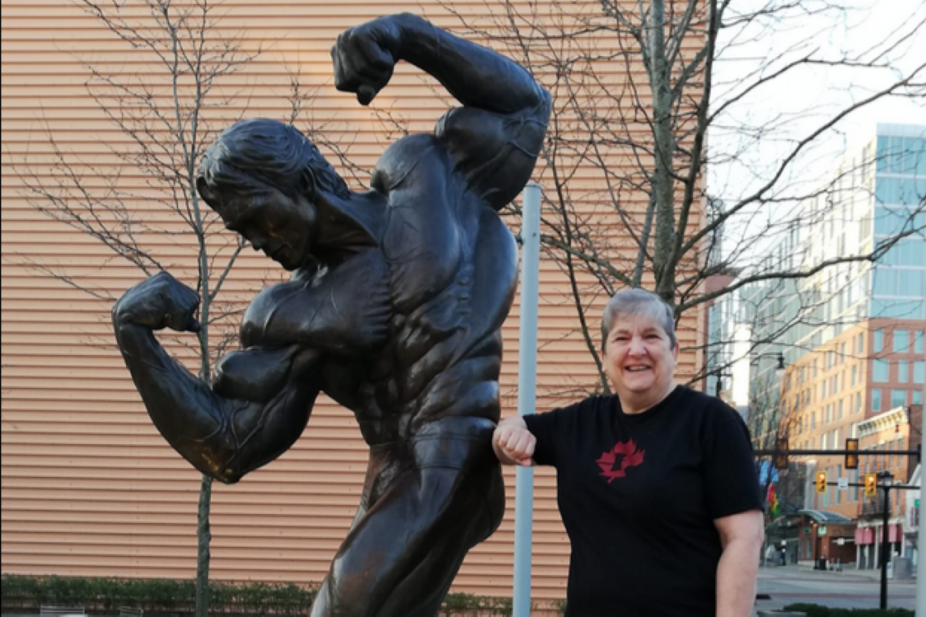
 Jeanine Watt is a graduate student, two-time UWindsor alumna and world record-holding powerlifter (PROVIDED BY J. WATT/University of Windsor)
By Kate Hargreaves
Jeanine Watt (BSc ’78, LLB ’88) joined a gym in 2018 to stay active as a semi-retired lawyer.
“I knew that if I retired, the only thing that would get any exercise was my thumb on the remote control,” she jokes.
This March, she will take the main stage at the Arnold Sports Festival as a pro competitor in the Arnold Armlifting Championships.
At 69, Watt is expected to add more accolades to an already impressive résumé, holding three world records in powerlifting.
Strength sports were not always on her radar. The two-time University of Windsor alumna and current graduate student in kinesiology and health studies initially set her sights on masters track and field.
Realizing that running was not her strong suit, Watt turned to strength events like shot put, but it was a chance encounter that led her to try out powerlifting.
“I ran into a young woman in the locker room at my gym who said she had a world record in powerlifting, and I thought whoa! I bet I could do that,” Watt says.
Balancing part-time work as a human resources lawyer with her workouts, and despite pauses in training due to pandemic lockdowns, Watt managed to work up to her own world records as a bench press specialist.
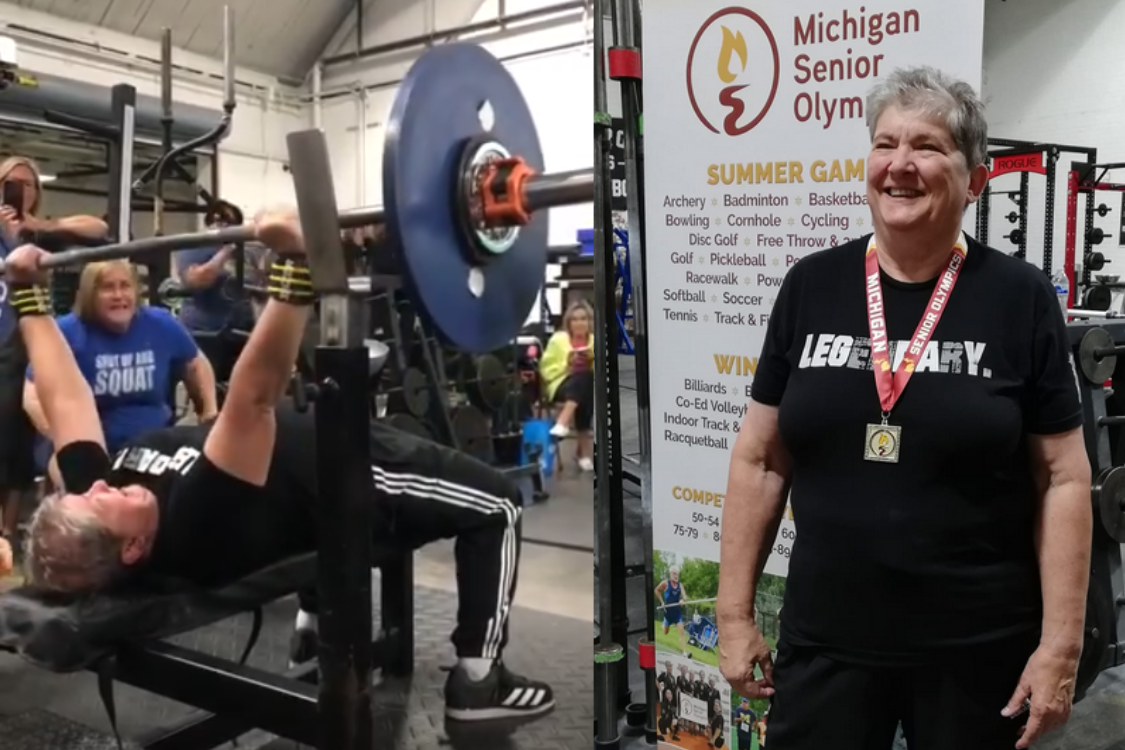
Then, in 2024 she was ready for her next challenge.
“I always need to have a goal,” she laughs.
With her undergraduate background in biology combined with her experience as an athlete, Watt began her master’s degree under the co-supervision of Drs. Sean Horton and Paula van Wyk.
“I’m grateful that Sean and Paula took a chance on me,” Watt says. “I’m not your typical graduate student, and they’re so supportive.”
van Wyk, however, suggests that Watt may have been the one taking a chance.
“Jeanine may say we took a chance on her, but it may actually be the other way around,” van Wyk says.
“We have been exploring the engagement of older adults, or the lack thereof, in varying physical activity and sports. Strength training was a bit of a new avenue, and each time we meet to discuss research, I am learning new and fascinating aspects of powerlifting. Jeanine brings passion and experience, and we are tying that together with literature and theory.”
The support Watt has received extends beyond her supervisors to her peers in the Faculty of Human Kinetics, as she explains that the generation gap far from impedes her connection with her classmates.
The same goes for the culture at the gym where she trains.
“I’ve never had a problem with being underestimated,” she says. “Even the younger guys at the gym would just say ‘wow!’”
For her thesis research, Watt is interviewing fellow master’s women powerlifters about their motivations and experiences with the sport.
She notes that while older women powerlifters are far from common, the culture that kept them out of gyms in prior decades is changing.
“A woman I know my age who started lifting in the 1970s, she got a lot of flack at that time and misogynistic comments,” Watt explains.
“Another woman, a pioneer in powerlifting, couldn’t even work out in her university gym without her husband there with her. In the ’70s, I couldn’t play handball at the YMCA because it was for men. Now I’m not seeing that as much.”
van Wyk notes, however, that while more common in recent years, there is still work to be done in gender equity in gyms.
“A gap remains for older adult females,” she says. “Habitual, or lifelong, engagement in physical activity is important for everyone. Yet, there are many reasons why women reaching older age to have been steered away from such pursuits.”
In addition to more support for women in weightlifting spaces, Watt says she has experienced more welcoming gym environments for older people in recent years.
“Lifting is so important to older women,” she says. “When women think of exercising, they think of cardio often, but that doesn’t help with muscle loss with aging. It doesn’t help with bone mass.”
Horton, Watt’s co-supervisor, echoes this sentiment.
“One of the most interesting aspects about Jeanine’s chosen sport is how it challenges certain stereotypes related to gender and sport,” he says.
“Older women who powerlift aren’t really the ‘norm,’ but she can potentially serve as a bit of a role model to others. Not that older women need to powerlift competitively, obviously, but basic weight training can be so important to maintaining function, improving balance and preventing osteoporosis.”
Even for Watt, a regular gym-goer, learning about the aging process and the role of exercise has influenced her own relationship with movement.
In van Wyk’s course on healthy aging, Watt noticed that her own sense of balance was lacking while testing some older adult subjects.
“I’ve added that into my exercise routine now,” she says. “I spend a certain amount of time every week standing on one foot.”
While her focus in the short term is on the Arnold Sports Festival in Ohio, Watt is excited to finish her research and see what’s next for her academically, including potentially going on to further graduate study.
“Jeanine's work will illuminate how strength sport shapes identity, resilience and empowerment in later adulthood while challenging age and gender stereotypes to inform more inclusive practices within athletic communities,” says van Wyk.
She hopes that her research will help encourage more people, particularly older women, to incorporate weight and resistance training into their lifestyles.
“I’m hoping we can get more people to lift weights to help with balance and that kind of thing,” she says.
“It will be fantastic for them in their successful aging journeys.”
This article is part of the University News series Aging Well.
Update: Jeanine Watt went on to take the gold medal and set two world records in her age class at the 2026 Arnold Classic. Congratulations Jeanine!