
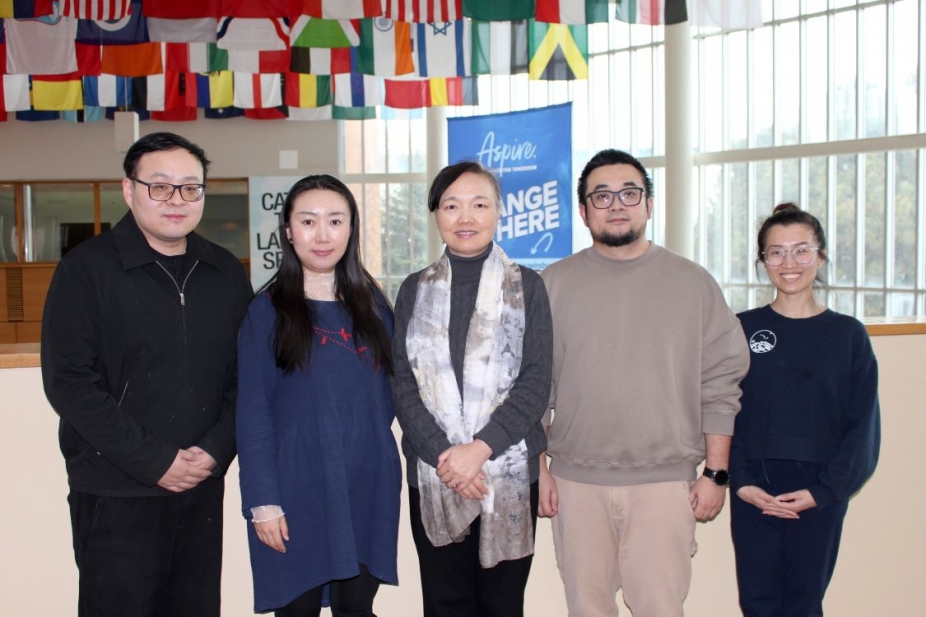
 Conference chair Dr. Shijing Xu (centre) with the CSE planning committee (ANGELA KHARBOUTLI/University of Windsor)
By Kate Hargreaves
This August, educational researchers from around the world will share their perspectives as the University of Windsor's Faculty of Education hosts the 3rd Chinese Society for Education (CSE) Annual International Conference.
Taking place Aug. 10 to 12 at UWindsor, the conference’s theme is “West-East Reciprocal Learning for a More Inclusive World: Global Perspectives, Local Practices.”
“The conference theme aligns strongly with the University’s Aspire strategic commitments to global engagement, Truth and Reconciliation, equity, sustainability and community partnership,” says Dr. Shijing Xu, conference chair, UWindsor education professor and associate dean of teacher education and CSE rotating president 2026.
“This will be a high-impact international academic gathering that reflects Windsor’s globally connected and locally grounded identity.”
Bringing together around 150 university educators, graduate students, school educators, Indigenous community educators and community-based environmental practitioners, the conference will encourage the sharing of effective local practices in environmental sustainability education and global stewardship within teacher education and school education.
“By convening this interdisciplinary dialogue — engaging social scientists (especially teacher educators and school educators), natural scientists, and Indigenous knowledge holders — the conference will bridge diverse cultural perspectives and demonstrate how local sustainability practices both shape and are shaped by broader global insights, thereby generating impact within and beyond the social sciences and humanities,” explains Xu.
She also describes the conference as a “wake-up call to reconnect education with Indigenous and Eastern wisdom,” especially amid growing AI fatigue and rapid technological change.
“Beyond technological innovation, the event emphasizes balance, relational responsibility and ethical perspectives needed for sustainable and humane futures," she adds.
Anishinaabe Elder Martin Millen has been invited to share teachings on the Eighth Fire — a prophecy that calls people from diverse directions and knowledge traditions to come together in restoring harmony with the Earth.
“This message resonates deeply with the conference's focus on West–East reciprocal learning, underscoring the importance of grounding future-oriented education in relationships, place and enduring cultural wisdom,” says Xu.
This sense of reciprocity and global connection is exemplified in the conference being co-hosted by Columbia University’s Center on Chinese Education, Education University of Hong Kong, Nanjing University Institute of Education, Tsinghua University School of Education, Western University Faculty of Education and Yunnan Normal University Future Education Institute.
Researchers of Chinese education as well as international education more broadly are invited to submit abstracts regarding cross-border collaboration and its impact on inclusion, sustainable development and mutual understanding.
Submissions should deal with either the overarching conference theme, or one of seven sub-themes:
- Learning across cultures: valuing diverse ways of knowing for planetary coexistence
- From global perspectives to local actions: Place-based educational practices in teacher education and school education that nurture community, responsibility and Earth stewardship
- West-East reciprocal learning for harmony between ecology and education (especially in teacher education and school education)
- Futures of education: Reimagining learning, teaching and schooling for a just and sustainable planet
- Chinese education and global education at crossroads: Toward regenerative futures
- Regenerating education amid climate crises: Learning to live within the earth’s limits
- Interdisciplinary and cross-border collaboration: Co-creating sustainable learning communities
Submissions of abstracts are now open until March 15, 2026. To submit an abstract or for more information, visit the conference website.
The CSE planning committee consists of chair Dr. Shijing Xu and committee members Dr. Chenkai Chi, Dr. Yishin Khoo, Yuhan Deng, Luyao Tan and Shuya Du.