
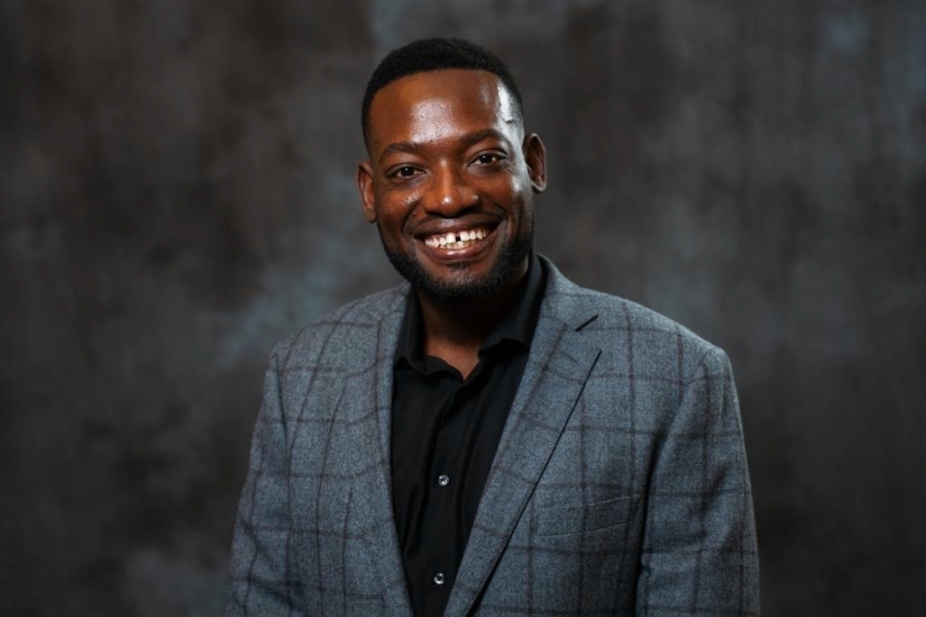
 Dr. Carlo Charles, professor in the University of Windsor’s Department of Sociology and Criminology, will host two upcoming events exploring migration, race, sexuality and the experiences of queer and trans migrants in Windsor. (MIKE WILKINS/ The University of Windsor)
By Lindsay Charlton
From a young age, Dr. Carlo Charles has been interested in the human experience, first exploring that curiosity through art and storytelling.
As a boy growing up in Haiti, the sociology professor wrote songs, poetry and plays. By age 14, he had formed a theatre troupe of about 25 friends and staged plays at local churches for the community.
"I grew up in a very cultural environment where a lot of people are interested in literature and theatre. That's how I became involved in the arts," Charles said.
When the feature film Rescapé de la Vengeance was produced in Haiti after he finished high school, Charles was invited to help with the movie — which he ended up directing.
Early interest in storytelling
It was that interest in stories and a desire to understand people that propelled Charles into the field of psychology and sociology.
He moved to Toronto after completing his bachelor's degrees in France, earning a master's in sociology and migration studies at York University before completing a dual PhD in sociology and geography from McMaster University and the Université des Antilles and the Social Science Research Laboratory at France’s Centre national de la recherche scientifique.
Now a faculty member in the University of Windsor's Department of Sociology and Criminology and a member of the Black Scholars Institute, Charles is also the 2025-26 Humanities Research Group (HRG) Faculty Fellow — a distinction that provides a one-term teaching release for faculty to pursue major research or creative projects.
He also led the winter semester HRG Student Fellowship program, mentoring three undergraduate and three graduate students as they explore graduate school applications, career paths and creative work.
"I have this vantage point of being in social sciences, but also in the arts and I am deeply interested in understanding the humanity in people, which I believe is why I was selected," he said.
Exploring migration and identity
Charles's research explores how migration relates to race, sexuality and economic inequality for both migrants and non-migrants in the Americas, the Caribbean and Europe.
He will discuss this work at Rethinking Migration through the Margins, hosted by the HRG on Thursday, March 19, at 5 p.m. in the Jackman Dramatic Art Centre's Hatch Studio. The lecture is free and open to the public.
"It's going to be a really interdisciplinary take on how we can study migration from the social sciences, arts and the humanities," he said.
His background in geography informs this work alongside sociology. Where sociology examines how inequality shapes integration — through gender, race, sexuality, ethnicity and class — geography asks where people actually land and what those spaces make possible.
"If a migrant comes to Windsor and they live downtown, what kind of access does that area give them, as opposed to Tecumseh or Amherstburg?"
"It brings, for me, a much more concrete and grounded perspective to migration studies than just the social and political aspects we tend to study in sociology," he said.
Bringing research into creative work
All this knowledge is threaded through the art he creates.
"I tackle everything from a very human perspective," Charles said.
Bouncing between Canada and France for about 13 years as he completed his post-secondary education and became a professor, Charles co-wrote Kap O Mond! with fellow playwright Alice Carré, a play exploring what he described as "French colonial amnesia" that ran for about three years in Paris and surrounding communities, along with Martinique and Guadeloupe.
"It's the idea of how French people tend to forget the colonization they inflicted on many other countries," he said. "As a sociologist and playwright, I was able to create situations that really delve into this idea."
Charles has also written a research-based manga graphic novel for teens and youth. Louis's Story, inspired by his dissertation on how sexuality influences transnational relationships, follows a young queer Haitian man navigating his identity and a secret long-distance relationship with his migrant partner in Canada.
"It's fundamentally a love story. All my stories are love stories, but I bring a lot of social and political things into this story and make it light enough so that kids can read and understand it."
Used in the Martinique school system to mobilize social science research to young people, Charles is now adapting Louis's Story into a play.
He is also completing a book — the first of its kind, he says — examining how men in Haiti form and sustain queer relationships with Haitian immigrants across seven countries of the diaspora.
"Looking into what is the meaning of those relationships for these men, how do they send money to help people back home, how does that shape ideas about homosexuality in Haiti, and what does that tell us about migration in general and about how sexuality shapes migration."
By centring sexuality in the study of transnationalism, his research aims to contribute to conversations about migration, relationships and inequality, while exploring how global movement shapes local ideas about morality, community and belonging.
Queer migration in Windsor
When Charles first moved to Windsor nearly three years ago, he was struck by just how many queer migrants call the city home.
"In my mind, queer migrants would usually go to Toronto or Montreal — the big cities. I had no idea how many lived here, and since then I've been thinking about how I can give more visibility to these people," Charles said.
He soon met Anold Mulaisho, who had recently moved to Windsor from Zambia. After enduring repeated acts of homophobia at home and later in South Africa, Mulaisho found safety through asylum in Canada, where he has continued advocacy work on behalf of queer migrants.
"It's fantastic what he's been doing," Charles said. "When we met, I knew we needed to find a way to work together."
The resulting project, examining the community-building experiences of Black queer and trans migrants in Windsor, came to fruition last year. Now, in recognition of the United Nations International Day for the Elimination of Racial Discrimination, Charles is hosting an event to share those findings.
In partnership with the Queer and Trans Migrant Advocacy Alliance and the Black Scholars Institute, and supported by the Run for Rocky Legacy Project, Black Queer and Trans Migrants and Racism in Windsor-Essex County takes place Friday, March 20, at the University of Windsor.
The day will feature research presentations, community testimony and an accountability-focused panel including Irene Moore Davis, Greater Essex County District School Board trustee Christie Nelson and Rev. Joseph Livingston of the Metropolitan Community Church of Windsor.
Scholars from London, Ottawa and Michigan will share findings on 2SLGBTQIA+ migrant integration and community building, and five Windsor migrants will share their own stories directly with the public.
"They'll be sharing their own stories with the public, so people can hear directly from them, not from just me, the researcher, but from them personally," Charles said.
The event runs from 9 a.m. to 5 p.m. in Room 1101 of the Leonard and Dorothy Neal Education Building, with the morning session available via Zoom (Meeting ID: 988 7746 1957).
It concludes with performances from two Detroit-based drag performers at the Black Scholars Institute in the CAW Student Centre. Registration is available at eventbrite.ca.