
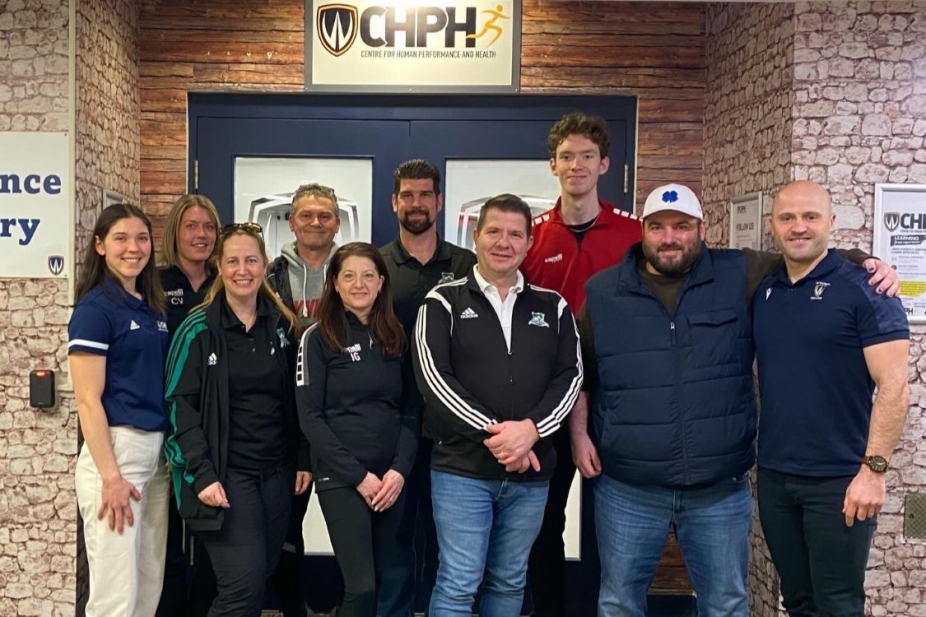
 MSc student Abigail Passy (far left) and supervisor Dr. Andrew Perrotta (far right) met with representatives of local soccer clubs (MANWELA YADKOO/University of Windsor)
By Kate Hargreaves
Playing a 90-minute soccer game requires a lot of energy: sprinting, tackling, recovering and then running some more.
That’s not to mention hours a week of on-the-pitch and off-pitch training.
When this energy expenditure is not matched by energy intake, relative energy deficiency — commonly known as REDs — can occur.
For adolescent female soccer players, REDs may be a growing issue.
MSc Kinesiology and Health Studies student Abigail Passy is hoping to help soccer organizations spot red flags to identify and prevent REDs.
“REDs within adolescent female soccer players is typically an understudied and underrepresented group,” Passy explains, noting that the field of REDs research in all sports is itself still developing.
First described as the female athlete triad — low bone density, lack of of menstrual period and disordered eating — REDs expands this definition to cover the impact of insufficient energy intake across genders.
Beyond performance impacts, REDs can lead to other physical, emotional and hormonal effects that can be dangerous for athletes, including stress fractures.
Like the female athlete triad, REDs has typically been studied in distance runners, endurance athletes or aesthetics-based sports and art forms like gymnastics and ballet where being lean is favoured.
However, Passy emphasizes that risk goes beyond these sports.
“It can really affect any physically active person,” she says.
While Passy is not a soccer player herself — she is a pole vaulter on the Lancer track and field team — she grew up training as a gymnast.
“I was once told that smaller is better. If you’re lighter, you’re going to flip nicer.”
She says these types of messages can lead to delayed puberty and other red flags for REDs in young athletes.
With funding from the Ontario Soccer Association and Canadian Chiropractic Research Foundation, Passy and supervisor Dr. Andrew Perrotta brought together soccer club leaders and coaches from Belle River, Tecumseh, and Windsor FC at the UWindsor Sports Science Lab March 14.
Representatives were invited to see the lab — which operates out of the Centre for Human Performance and Heath — and learn about REDs to encourage them to involve their athletes in the Passy’s study.
“Everyone seemed really engaged and on board. They were eager to hear about the next steps for getting their athletes involved,” Passy says of the visit.
Later this month, Passy will present her project to parents of local soccer athletes to start recruiting for her study, which will see athletes visit the Sports Science Lab for body composition testing as well as strength and endurance measurements.
Coupled with questionnaires around REDs diagnostics and red flags such as sleep disruption and relationship to training frequency, Passy’s research hopes to shed light on risks and opportunities to prevent REDs in female adolescent soccer players.
To learn more about the Sports Science Lab, visit the Faculty of Human Kinetics website.