
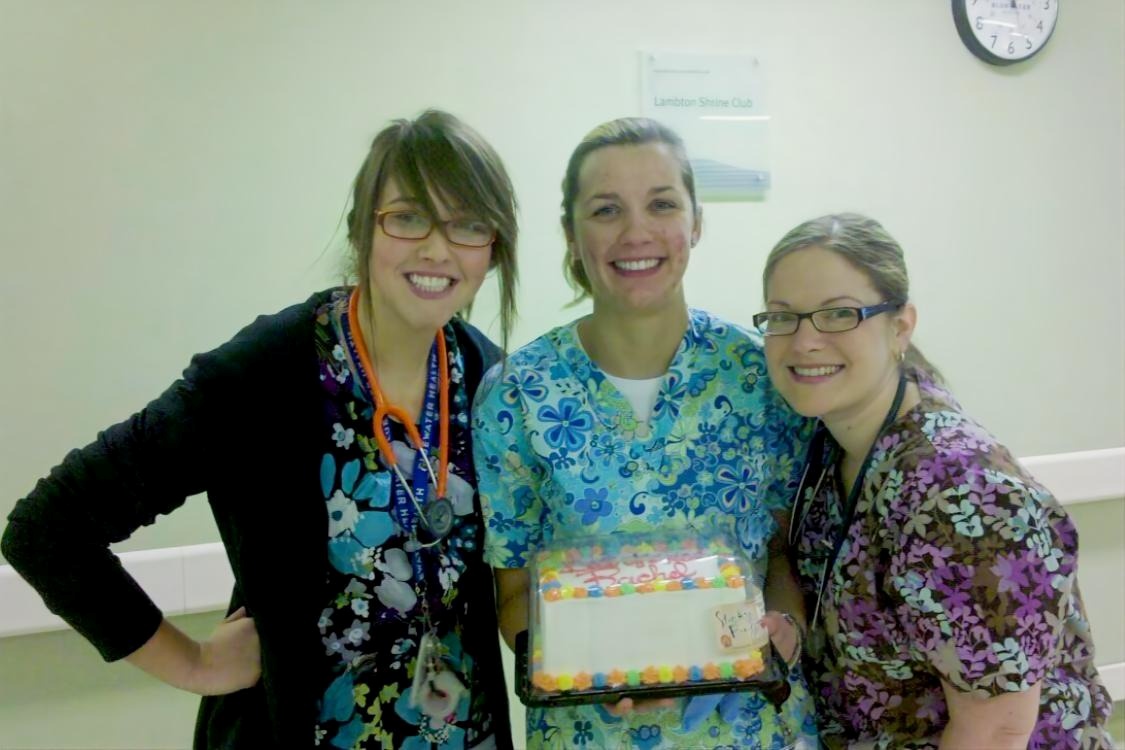
 UWindsor nursing alumna Destiny Cadarette, pictured (left) with a colleague before an emergency department shift, says the medical drama The Pitt reflects many of the realities nurses face every day — including workplace violence, emotional strain, and the fast-paced demands of emergency care. (SUBMITTED BY DESTINY CADARETTE/University of Windsor)
By Sara Meikle
What TV gets right
The medical drama The Pitt is doing more than drawing viewers — it’s sparking overdue conversations about violence in emergency departments, and the realities nurses face every day.
At the University of Windsor, faculty and frontline nurses say the show comes closer than any other to portraying life in the emergency department (ED), but it still only tells part of the story.
For Destiny Cadarette (BScN ‘17), an ED nurse in Windsor now pursuing her nurse practitioner designation, the show hits close to home.
“It’s the most accurate representation of my job that I’ve ever seen,” she said. “Some episodes felt a little too soon for me, because we’ve gone through similar situations.”
While the series accurately captures high-stakes care, Dr. Sherry Morrell (BScN ‘00, NP ‘02, MSN ‘08) notes that television still leans into drama.
“Not every moment in the ED is like that,” Prof. Morrell said. “But the situations themselves are real.”
That realism includes workplace violence, something nurses say remains largely invisible to the public.
“That scene where a nurse gets punched sparked a lot of conversation among staff,” Cadarette said. “It does happen. Not always physical, but it’s part of our daily reality.”
Dr. Gina Pittman (PhD ‘21) adds that violence is often complex.
“Sometimes people are angry and take it out on the nurse,” Prof. Pittman said. “Other times, patients are in crisis or experiencing psychosis. It’s a difficult position, because we want to be compassionate, but we also need to stay safe.”
Pittman believes shows like The Pitt could help the public better understand what nurses and staff experience.
The emotional toll of emergency care
What television may not capture is the cumulative emotional toll.
“Nurses don’t get to stop,” Morrell said. “You go from one trauma to the next without time to process it.”
That constant exposure can lead to burnout, post-traumatic stress, and nurses leaving the profession altogether. Morrell recalls colleagues walking away mid-career.
“They reach a point where they say, ‘I’m done.’ I have seen people just walk out,” she said. “I was pushed to my limit at times.”
Cadarette describes a similar strain after a recent critical pediatric incident.
“EMS got to go home. I had 11 hours left in my shift,” she said. “We debriefed intermittently, because I had other patients. It wears on your mental health.”
Dr. Rachel Elliott (PhD ‘26), a former ICU nurse whose research focuses on trauma-informed care, said more than 60 per cent of nurses report burnout and symptoms of mental health disorders. Nearly half of Canadian nurses experience abuse or violence, based on reported cases, according to a recent RNAO webinar.
“This isn’t just an individual problem, it’s a workforce problem,” Prof. Elliott said. “We’re seeing high attrition, especially among younger nurses, largely due to working conditions.”
Elliott adds that trauma often goes unaddressed in the moment.
“There is a culture where nurses are expected to normalize these traumatic experiences, compartmentalize and move on,” she said. “That’s ultimately what drives burnout and moral distress.”
Staffing pressures compound the issue.
Without consistent safe staffing ratios, nurses are often responsible for more patients than is sustainable, increasing stress, risk of violence and burnout.
“We’re asking nurses to do more with less,” Elliott said. “And that has real consequences for both staff and patient care.”
Preparing nurses for reality, not just the job description
Nursing education is evolving, and the University of Windsor is continuously evaluating and strengthening its curriculum to better prepare students for the realities of modern healthcare.
The Faculty of Nursing integrates clinical experience starting in first year, giving students early exposure to real healthcare environments.
“They’re not just learning skills, they’re learning what it feels like to be in those environments,” said Pittman.
Faculty also emphasize communication, de-escalation, and resilience.
“We try to prepare students for the fact that patients aren’t always going to be kind,” Pittman said. “I tell my students to remember people come to the hospital because they don’t feel good and you're generally not very nice when you don’t feel good.”
Elliott adds that while trauma-informed care is embedded throughout the curriculum, structured emotional debriefing is not always consistent — reflecting the same time pressures in nursing practice.
The gap between preparation and practice also raises questions about retention. While universities graduate skilled nurses, healthcare systems must ensure they can stay.
“We’re preparing excellent clinicians,” Elliott said. “But if the system doesn’t support them, they won’t remain in the profession.”
From screen to reality
For many nurses, The Pitt validates experiences that often go unseen, and they hope it does more than entertain.
“I’ve had friends watch it and say, ‘there’s no way that’s real,’” Cadarette said. “They are shocked when I tell them that is really my job. I wish more people understood this is really what we face.”
Morrell agrees growing awareness could mark a turning point.
“Maybe shows like this will help people understand and ideally, help systems become more proactive,” she said. “Too often it isn’t until after something terrible happens that they implement safety protocols.”
As the show continues to draw attention, UWindsor experts see an opportunity to connect what audiences are watching with what nurses are living — and to spark conversations leading to safer conditions, stronger supports and a more sustainable future for the profession.