
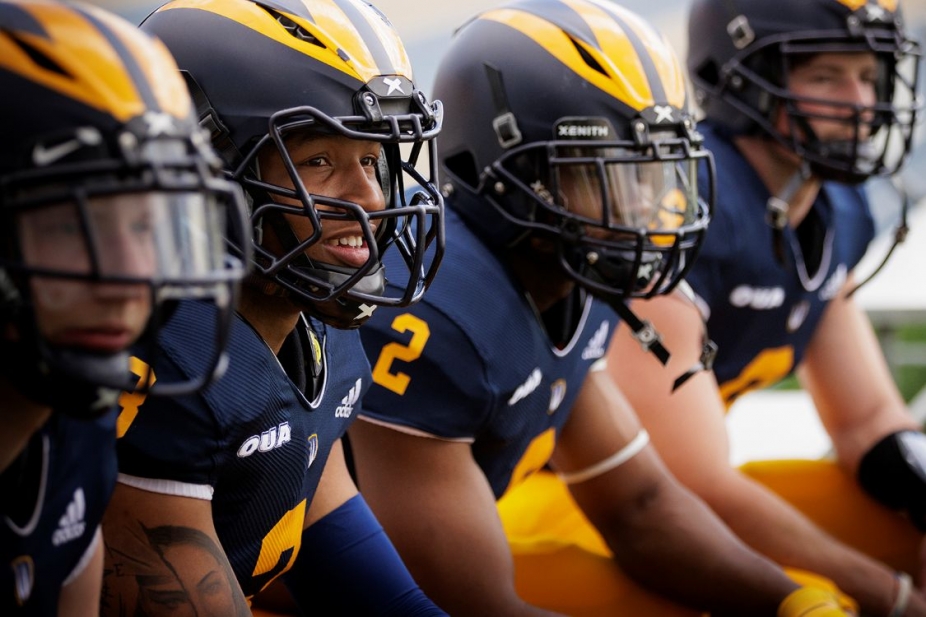
 The heavy gear required for football may put athletes at particular risk when training in extreme heat (JASON JONES/University of Windsor)
By Kate Hargreaves
How hot is too hot to exercise safely?
For Canadian varsity coaches, athletes and even youth sports organizations, getting a clear answer to that question is surprisingly difficult.
With extreme heat blanketing southern Ontario in recent weeks, UWindsor Kinesiology professors Dr. Anthony Bain and Dr. Andrew Perrotta sought out heat training guidelines governing Canadian varsity sports.
“I was shocked that we had nothing,” says Bain.
While U SPORTS, the governing body for Canadian university athletics, provides parameters for training related to air quality, lightning and wind chill, Perrotta and Bain noticed that heat-related guidelines are absent.
“With global climate change only progressing, I found it astonishing that the governing body has not addressed this,” Perrotta says. “It’s actually up to each institution.”
With Canada being such a geographically vast and diverse country and southern Ontario experiencing more frequent extreme heat in recent years, Bain and Perrotta flagged the lack of guidelines as a real danger to athletes.
“From the end of June to mid-July, we’ve had seven days in that 17-day period where the humidex was equal to or greater than 45 degrees Celsius,” says Perrotta. “At that point, the American College of Sports Medicine will say to cease all activity. It’s too dangerous.”
While U SPORTS does not host any sports between May and August, training camps for varsity sports continue during the summer.
At the same time, summer camps and youth sports in the community may power through the weather, lacking consistent policies for when to cancel to keep kids safe. As children are more susceptible to heat illness, Perrotta says getting guidelines in place is urgent.
“The clubs aren’t stopping,” says Perrotta, who has two young children participating in sports locally. “They’re leaving it up to coaches and referees who are not experts, so nobody at the end of the day is looking out for the athlete.”
In the absence of expert guidelines, the risk of illness, injury and even death is significant.
“Heat stroke, which can lead to death, is at the extreme end of the spectrum, but it goes all the way to mild heat exhaustion,” explains Bain. “You can have central nervous system disruption and multiple system organ failure, and we want to catch it before we get to that point.”
In the United States, the Korey Stringer Institute at the University of Connecticut was founded by Stringer’s widow after the NFL player died due to heat-related illness after a football training camp in 2001.
Since that time, governing bodies of collegiate and high school sports in the United States have implemented heat-related training guidelines to protect athletes.
Bain and Perrotta would like to see Canada follow suit.
“When you’re exercising, you feel hot, your heart rate is elevated, you feel fatigued and you may even get a little bit dizzy,” says Bain.
“These are signs of impending heat exhaustion or heat illness, so you’ll stop there and cool down, but with a highly motivated athlete or with a coach pushing, that motivation can override those internal signals telling your body to stop.”
Without guidelines in place, this can put athletes in a dangerous position.
“It’s the athlete who is always in that position of loss because we don’t have clear policies set in place,” says Perrotta.
While any sort of strenuous exercise can put athletes at risk, sports that require a lot of equipment like football can prevent athletes from regulating their temperature safely.
“That’s why the guidelines in the US are pretty clear,” says Bain.
“In this heat index, no gear or maybe helmets only, things like that. We want to work with coaches because you can see where they’re coming from not wanting to miss a day of training, but the safety of the athletes is paramount.”
The point then is not to avoid exercise in heat altogether but to mitigate the risk of harm while doing so.
“There’s categories,” explains Perrotta. “At a certain humidex, it might be stop all exercise or train for 20 minutes then take a water break or try to stay in the shade. There’s a continuum.”
Alongside temperature cutoffs, Bain also says that cooling strategies have been underused as part of keeping summer sports safe. Having worked with a football team in Florida, he explains that simple strategies such as having large fans at the edge of the field are already widely used elsewhere.
“If you have an athlete who is showing symptoms of heat illness, the thing to do is cool them down as fast as you can,” Bain says. “The best way to do that is an ice bath, so they’ll have some on the sidelines.”
Working alongside coaches to implement safety guidelines may also involve practising at different times of day or gradually acclimating athletes to heat conditions to reduce risk.
“We need to change the narrative and work with experts,” Perrotta says. “We don’t need to reinvent the wheel. The Korey Springer Institute, the American College of Sports Medicine, they’ve laid down clear guidelines we can adopt.”
The risk of not doing so can potentially be dire.
“It just takes one person, unfortunately, like Korey Stringer, where everything changes,” Perrotta continues. “We don’t want to wait for that point.”