
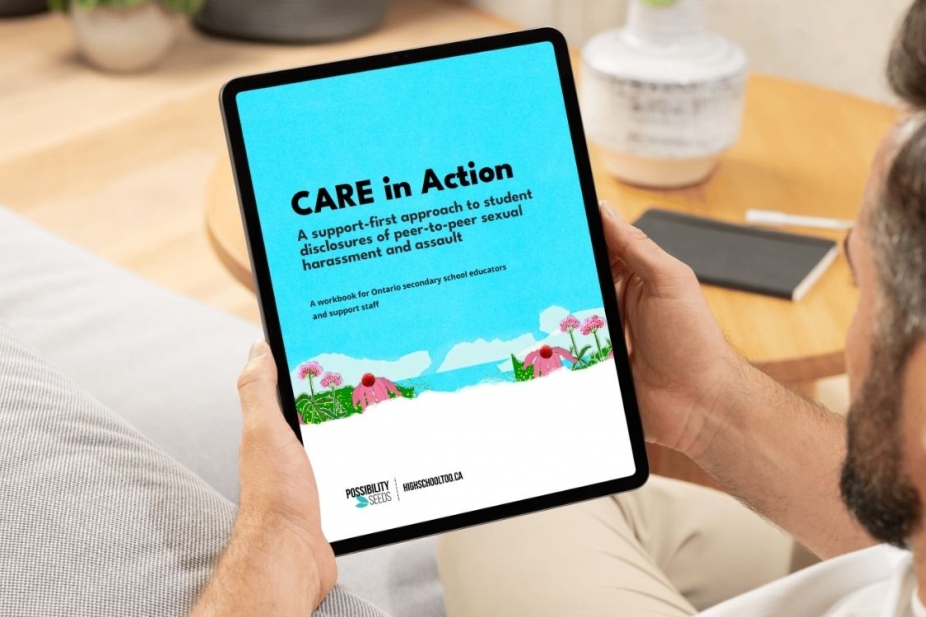
 A virtual launch Oct. 5 marks the release of a new guide to support teachers in responding to sexual violence (CANVA STOCK/University of Windsor)
By Kate Hargreaves
Before the age of 15, 45 per cent of Canadian teens will experience dating violence.
For educators who find themselves on the receiving end of disclosures, knowing how to respond can be daunting.
That’s what motivated a new guide to help teachers respond to sexual violence disclosures in trauma-informed ways.
“It is an essential resource designed to support teachers as they go through what is always messy and difficult but so important that it be done with care,” says UWindsor Faculty of Education professor Dr. Catherine Vanner.
“That’s why it’s called the CARE Guide.”
Vanner is on the advisory board of the High School Too project, led by Possibility Seeds, the Canadian social change consultancy responsible for the guide, and will be a panelist at the virtual launch event on World Teachers’ Day, Monday, Oct. 5 at 12 p.m.
The launch, co-hosted by the University of Windsor and opened by Faculty of Education dean Dr. Ken Montgomery, will feature both educator and student voices, something Vanner says is critical to the work.
“What I really like about working with Possibility Seeds is their focus on high school student voice,” she says.
“This movement entirely originated with the initiatives of high school students and continues to be driven by supporting student agency and incorporating student voices.”
The CARE Model Guide for Educators is part of the broader High School Too project, which emerged out of a series of student-led protests in 2022 against sexual violence and inadequate response by administrators in Canadian high schools.
Possibility Seeds, led by consent educator and CEO Farrah Khan, received provincial funding to formalize a collective aimed at promoting resources to support educators and students in Ontario.
“There’s a lot of fear among many teachers around the duty to report,” Vanner explains.
While teachers receive mandatory online training on the topic, it is more focused on what constitutes this duty rather than how to respond in a trauma-informed way.
Vanner says that the CARE Model Guide fills the gap in terms of how teachers can be supportive of students who disclose at the same time as looking after themselves, especially if they are survivors too.
The guide is only a piece of the work being done in this area, Vanner says. She is also involved in a research project in which high school students navigate school board policies around sexual violence to determine how accessible this information is to students when they need it.
The CARE Model Guide launch, hosted by Khan, will feature Vanner in conversation with Nadine Trépanier-Bisson, executive director of the Ontario Principals’ Council, and Haniska Shetty, a recent Ontario high school graduate and Consent Futures fellow.
“It’s a conversation dedicated to letting people know about this great guide being introduced and how it can be useful for current teachers and principals as well as teacher candidates who will be teachers in a few years,” Vanner says.
The launch takes place Oct. 5 from 12 p.m. to 1 p.m. via Zoom and is open to the public. To attend, please register online.