
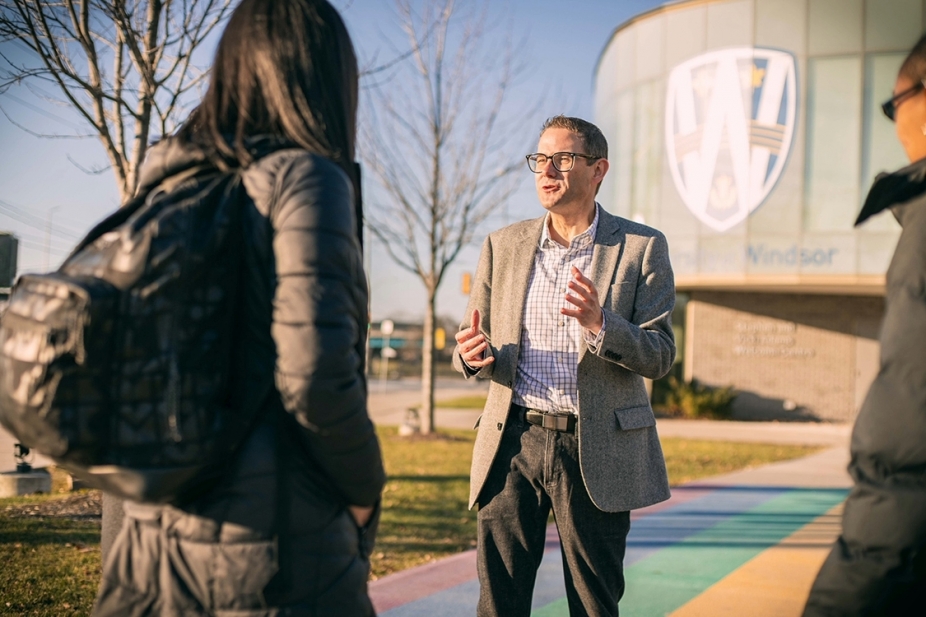
 UWindsor’s Department of Communication, Media and Film (CMF) is hosting the Canadian Communication Association’s 2026 conference. Department head Dr. Kyle Asquith is co-organizer of the event, which will bring more than 200 scholars and students to the campus June 2-4. (University of Windsor)
By Lindsay Charlton
The Canadian Communication Association was born from conversations held at the University of Windsor.
Nearly four decades later, it's coming back.
The return will bring more than 200 scholars, industry professionals and students working across communication and media from Canada and the United States to campus June 2 to 4 for its annual conference hosted by UWindsor’s Department of Communication, Media and Film (CMF).
“I’m really excited to show off our campus and city to this national community of scholars, all while exposing people to research as it’s happening,” said CCA vice-president and CMF department head Dr. Kyle Asquith.
“Academic conferences are really where you could say the latest research happens. Of course, it’s shared through books, journal articles and other publications, but those often have fairly lengthy timelines. Even in a digital age, peer review takes time, whereas there’s a lower barrier to entry for a conference presentation, and in that setting you get to hear about what people are working on right now.”
A communications and media conference at the University of Windsor in 1978 helped shape early discussions among scholars that led to the CCA, a national, bilingual organization founded in 1980 to advance research and teaching in communication, media and technology.
This year also marks the first time the CCA will host the conference independently, after years of holding the event alongside the broader Congress of the Humanities and Social Sciences on larger campuses in cities such as Vancouver, Montreal and Toronto.
Asquith said he was approached by the CCA board looking for a location that is a bit “under the radar,” yet still accessible to travellers from across the country.
“This travels to various university campuses across Canada. Getting to host it here is really meaningful for me — bringing this network of colleagues and scholars to my home campus and showing off what Windsor has to offer,” he said.
The University of Windsor last hosted the annual conference nearly 40 years ago, before this year’s return.
“It’s exciting for our department, students and the campus that this organization that hasn’t been here since 1988 is coming back,” said Asquith.
That history sits alongside Windsor’s own place in the field. The Department of Communication, Media and Film (CMF) was among the earliest media programs in Canada and the first in Ontario. At the same time, the city’s border location has long shaped its relationship with media and communication.
“Windsor being a border city creates some unique media challenges, but also opportunities, in the sense that the kind of human-created or constructed borders, a lot of media signals don’t really observe them,” Asquith said.
“The city has a very unique history in radio broadcasting, where there have been Windsor-based radio stations that enjoyed quite a bit of success in Detroit, and even further down in Ohio, with those audiences, which challenged some Canadian regulatory models.”
He explained that although the stations were licensed by the Canadian Radio-television and Telecommunications Commission (CRTC) as Canadian broadcasters, many drew large audiences in the United States.
That also meant advertising clients and revenue from across the border, creating regulatory exceptions over the years.
“Even more locally, our campus station, CJAM, which joined us as a partner for this event — and we hope attendees will visit the station while they’re here — enjoys the same dynamic. It’s a campus station, but it has had an international following, with loyal Detroit listeners and sponsors, for decades,” Asquith said.
That proximity to the border is also bringing scholars from the United States to the conference, including keynote speaker Dr. Alice Marwick, director of research at Data & Society, who studies how social media shapes politics, culture and online life.
“She’s planning to trace a longer history of digital communication and social media,” Asquith said.
“In our algorithmically filtered and digitally delivered communication world — and now, in the last few years, with AI thrown into the mix — there are so many political, economic, ethical, cultural and ideological questions worth studying. This keynote really captures all of that.”
In addition, networking events, presentations and panel discussions from academics representing universities across Canada, including some from UWindsor, will take place over the three days, exploring a range of topics from representation in media, advertising and politics, ethical podcasting and AI in news and creativity.
“There’s a wide diversity of media and communication-related issues — things that are really the hot topics right now,” Asquith said. “As someone who has travelled to this conference every year of my career, there’s always so much to learn.”
That exchange of ideas will also give UWindsor students a chance to engage directly with researchers and professionals working across the field.
“It’s such a great opportunity for our students to be exposed to the latest research and an international community of scholars,” he said. “They can learn so much from the professors here, but there are only so many of us in one department at one university. This gives students a chance to hear from people and perspectives they otherwise might not encounter.”
Asquith also noted the CCA annual conference is an important chance to showcase communications as a scholarly field of study, not only a profession.
“I think a lot of students might major in a communications program thinking more about a career, training for a profession, rather than seeing it as an academic field of study,” he said.
“At a university, we don’t just train people for media careers — we study media as a field in its own right. This gives students exposure to that side of it.”
Those interested in attending the Canadian Communication Association conference can find details on programming, speakers and registration through the association’s conference website.