
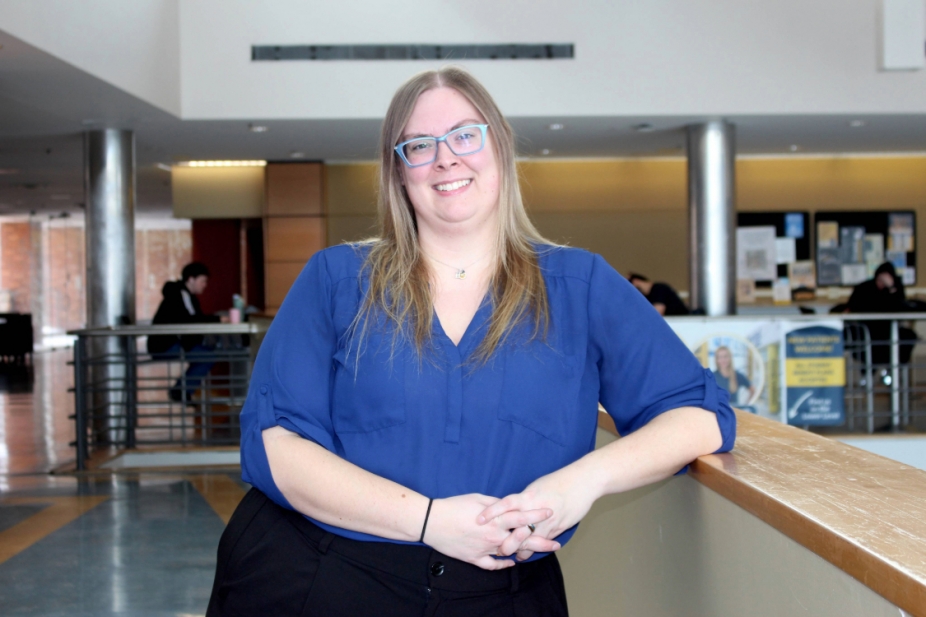
 Gena Dufoura, PhD candidate in applied social psychology, recently received a renewal of the Ontario Health Scholars Doctoral Award, administered by the Council of Ontario Universities, in recognition of outstanding contributions to women’s health research for her work exploring fear of institutional betrayal on university campuses. Pictured at the University of Windsor in Windsor, Ont., on Tuesday, Jan. 27, 2026. (ANGELA KHARBOUTLI/ University of Windsor)
By Lindsay Charlton
How institutions respond to gender-based violence can shape survivors’ recovery — and, if inadequate, can deepen harm, says a University of Windsor researcher investigating how campus responses to sexual assault influence healing and long-term outcomes.
Gena Dufour, a PhD candidate in applied social psychology at the University of Windsor, is exploring fear of “institutional betrayal” on post-secondary campuses — a concept she describes as the belief that survivors may avoid reporting an incident or seeking support services if they cannot trust their institution to respond appropriately.
“Someone might think, ‘I don’t trust that my university is going to do a good job of responding, so I’m not going to go to them when something happens,’” she said.
“My dissertation looks at these relationships and how they shape intentions to use campus services and help-seeking behaviours, which are critical for survivors of violence, including access to medical attention, counselling and support services.”
Dufour was recently awarded a renewal of the Ontario Health Scholars Doctoral Award, administered by the Council of Ontario Universities, in recognition of outstanding contributions to women’s health research.
She received $35,000 for the year, along with a $2,000 research allowance, to continue this work.
“It’s very validating,” Dufour said. “It’s a very prestigious and competitive award, and since this year is a renewal, it feels even more meaningful.”
“All researchers like to know their work is having an impact, and receiving funding shows that others see value in what you’re doing.”
Across three studies, Dufour’s research examines students’ trust in post-secondary institutions and how concerns about institutional responses may influence decisions to seek support following experiences of sexual violence.
As part of this work, she developed a scale to assess fear of institutional betrayal, first piloted with University of Windsor students and later expanded to include participants from universities, colleges and trade programs across Canada.
“My research focuses on the experiences of women and gender minorities,” Dufour said.
“I have participants in dance programs, dental programs, civil engineering, biology — a wide range of disciplines from institutions across the country.”
Dufour is currently completing the data analysis phase and examining relationships within the findings.
“I think this measure is really helpful because it can be used in campus climate surveys,” she said. “Universities regularly survey their communities to understand campus culture, strengths and student well-being.”
“This scale could be added to those surveys so institutions can get a clearer sense of whether students trust them — and what can be done to strengthen that trust.”
Dufour noted that the levels of fear of institutional betrayal in University of Windsor students seems a little bit lower than the national average, which she suggested may be linked to the visibility of sexual violence prevention and support resources on campus.
“The University of Windsor has invested in sexual violence prevention and response,” she said. “There is a range of supports and initiatives focused on prevention, education and response, which may help shape how students perceive institutional support.”
A central goal of Dufour’s work, she added, is ensuring research findings can inform real-world prevention and support efforts.
“I really feel that the work I’ve spent the past five years doing has led to knowledge that is useful,” she said. “Our Sexual Violence Prevention, Resistance and Support Services office, for example, can use information from my dissertation to inform practice.”
While her research centres on higher education, Dufour noted that the concept of institutional betrayal extends beyond campuses and can be applied to other systems, including the criminal justice system, health care and the media.
“There are many other institutions this framework can apply to,” she said.
“I plan to take what I’ve learned through my dissertation and explore what institutional betrayal looks like across other systems, particularly within the justice system.”
For information about sexual violence support services on campus, visit www.uwindsor.ca/prevent-resist-support/about