


University of Windsor/Western University
17th Annual
European Union Study Abroad Program
May 2 - May 15, 2027
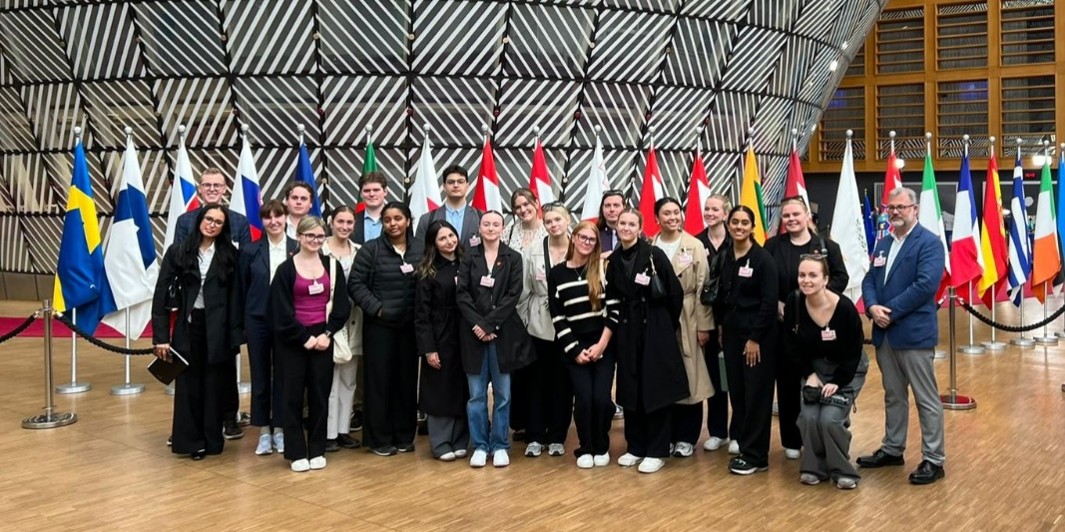
Students visit the European Council (May 2026)

If you would like to support the department’s EU program, you can make a donation to our EU Study Abroad Program Trust Fund using this QR code or by clicking here. All money will be used to defray costs for participating students.
About the Program
One of the best ways to gain an understanding of a society—perhaps the best way—is to meet its people, experience in person its streetscapes and soundscapes, and have the opportunity to question and hear from its own experts at their places of work. One acquires from such an experience a depth of knowledge and an appreciation of the lived reality of another society. Being there, immersed in its culture and its daily rhythms, can transform knowledge into understanding.
This is what our European Union Study Abroad Program aims to achieve: an understanding of EU politics, governance, and the context within which this remarkable if troubled enterprise in integration--now in its second half-century--continues to evolve. This understanding cannot be achieved in just a few weeks, but it is a start. Our EU Study Abroad Program will help you build this understanding and serve as an important touchstone experience in your studies or along your career path.
Students participating in the program will enroll in the University of Windsor course POLS-4880: The EU as a Global Actor for the Intersession 2027 semester. But this is not a classroom-based course. Our program’s model involves experiential learning and an immersive cultural experience. Aside from a couple of lectures from professors at KU Leuven and the College of Europe, the rest of our 14-day program consists of briefings from policy makers, administrators, politicians, diplomats, journalists, and NGO researchers at their places of work. This keeps us constantly on the go, travelling between locations and institutions by train, metro, and on foot. This movement is, in fact, part of your cultural immersion. You will experience personally and on a daily basis the rhythms of life in Belgium and particularly in Brussels, the administrative capital of Europe.
The detailed itinerary, which will be available by the end of March 2027, typically includes around 40 hours of meetings with people from a variety of Brussels-based institutions: officials from the major EU institutions; representatives of international institutions such as Europol; diplomats from several country missions to the EU, including Germany, the US, Türkiye, Ukraine, and others; and spokespeople for NGOs and media outlets such as the World Wildlife Fund, International Crisis Group, Payoke, and The New York Times. Cultural activities are included as well, including day trips to Antwerp, Belgium’s largest city and one of the world’s most important transportation hubs, and historic Bruges, where we will also have a meeting at the College of Europe.
Students will stay at the Irish College (https://irishcollegeleuven.eu/) in Leuven, which is also home to the Katholieke Universiteit Leuven. Founded in 1425, KU Leuven is one of Europe’s great universities and is today ranked among the top 50 universities in the world. Its past reputation was based mainly on philosophy and theology. In recent decades, however, KU Leuven also has been known for work in such fields as international law, political science, sociology, engineering, and medicine. It has been a magnet for scholars and students since the days of Erasmus and is today a member of the Erasmus network that enables European students to take courses toward their degrees at major universities across Europe.
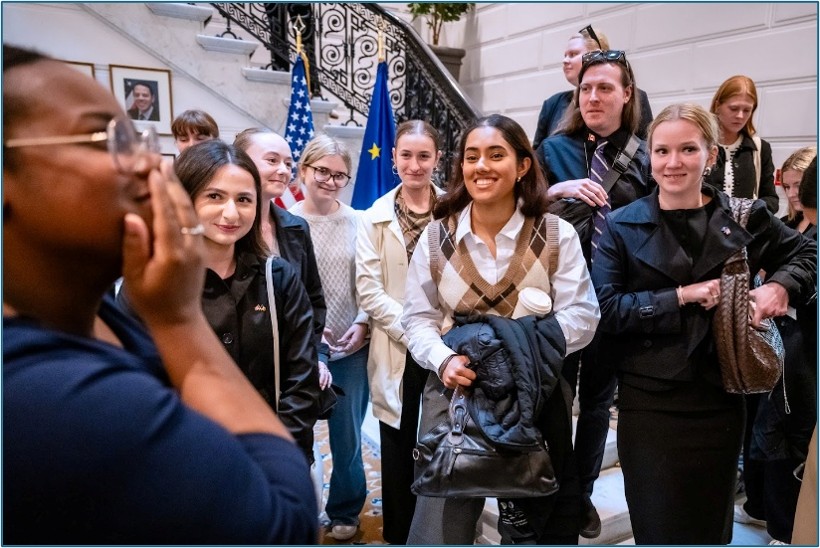
Visiting the US Embassy in Brussels (May 2026)
Photo courtesy of the US Embassy to Belgium and the EU
What some participants have said about the program
“This is a program that has truly changed my life as it has made once seemingly distant ambitions seem much more achievable and it has given me an insight into the European Union that I would not have otherwise been able to receive. From our meeting at NATO to our interactions with the staff at the various foreign missions, this trip has been the most transformative experience in my academic career.” – University of Windsor student
“Going beyond the specifics of what I learned at the various institutions that we visited, I am forever grateful for the opportunity to not only experience these incredible institutions and to shape my views on European and global politics both but to have challenged myself socially and culturally by traveling to new parts of the world. I had the great pleasure to meet and connect with students from different ethnicities and backgrounds, all of whom had found themselves in this course for a variety of diverse reasons. I got to spend my time with an exceptionally bright and eager to learn group of students and that will forever be my greatest takeaway from this trip.” – Western University student
“This trip was such a great experience, and I am so grateful to have been a part of it with you and the rest of our group. Not only was this a way to learn and grow professionally, but also individually. I learned so much and had a wonderful time throughout the entire trip, every day was something new, interesting and enriching. The meetings we had with different organisations and diplomats opened up new possibilities for me and I'm sure for many others as well.” – Western University student
Program Requirements
A formal syllabus for the course will be provided in late April before our arrival in Belgium, but in brief the program requirements are as follows:
1. Attendance at three pre-departure meetings to be held in Windsor, with London-based students joining online, during the winter 2027 semester.
2. Paper topic proposal and bibliography (~1 page): 5%
3. Research paper (~15 pages): 60%
3. Reflection journal (5-7 pages): 15%
4. Participation: 20%*
* The participation requirement will be marked on a pass/fail basis. Participating students must attend and participate in all program activities, unless illness prevents you from doing so.
The paper proposal will be due sometime shortly after our return from Belgium, and the research paper and journal will be due during the final period for the Intersession semester, usually around 4 weeks after the end of the formal program activities in Belgium. Written work is to be submitted through the POLS-4880 course Brightspace page. More details on these assignments, their due dates, and how they will be marked will be available in the POLS-4880 course syllabus.
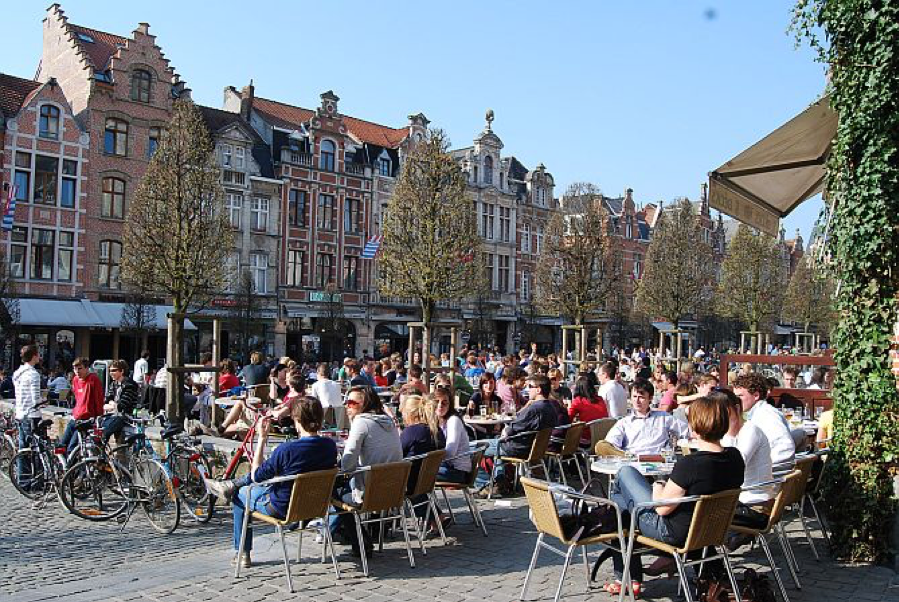
Leuven's Oude Markt, a two-minute walk from where our group stays. It is a traditional meeting place for students.
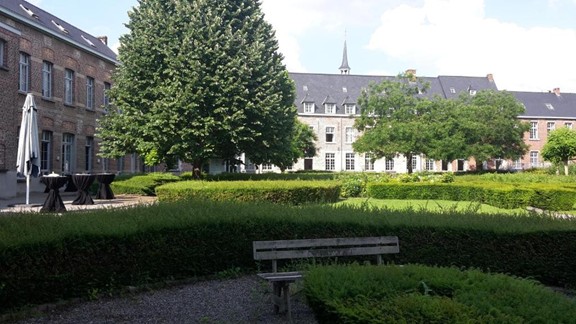
The courtyard at the Irish College in Leuven, where you'll stay.
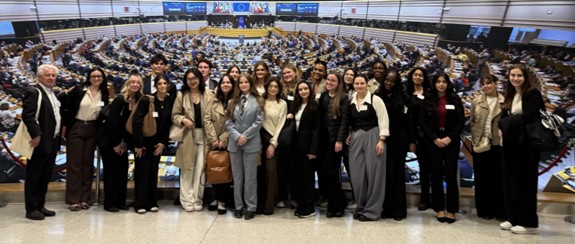
At the European Parliament (May 2025)
The Program Theme and Academic Course: The EU as a Global Actor
From modest beginnings in 1950 as the European Coal and Steel Community, with a membership of six states and limited functions related to trade and economic coordination, the EU has evolved into an association of 27 member states representing an economic market of over 450 million people. Since the 1990s, the EU has been taking steps toward playing a more active role in the world, developing aspects of a unified approach to world and regional issues that goes beyond the foreign policies of its individual member states, while also contending with internal forces and external shocks that make such coordination and integration difficult. In this course we will examine questions such as the degree to which collective EU action has and can replace that of sovereign member states when it comes to external relations; the EU’s role and effectiveness in managing and responding to international conflict, humanitarian crises, and the challenges of immigration and climate change; and what forms of influence the EU can and should wield in a world defined by growing Great Power rivalries, rising nationalism, and repeated shocks to the postwar liberal international order.
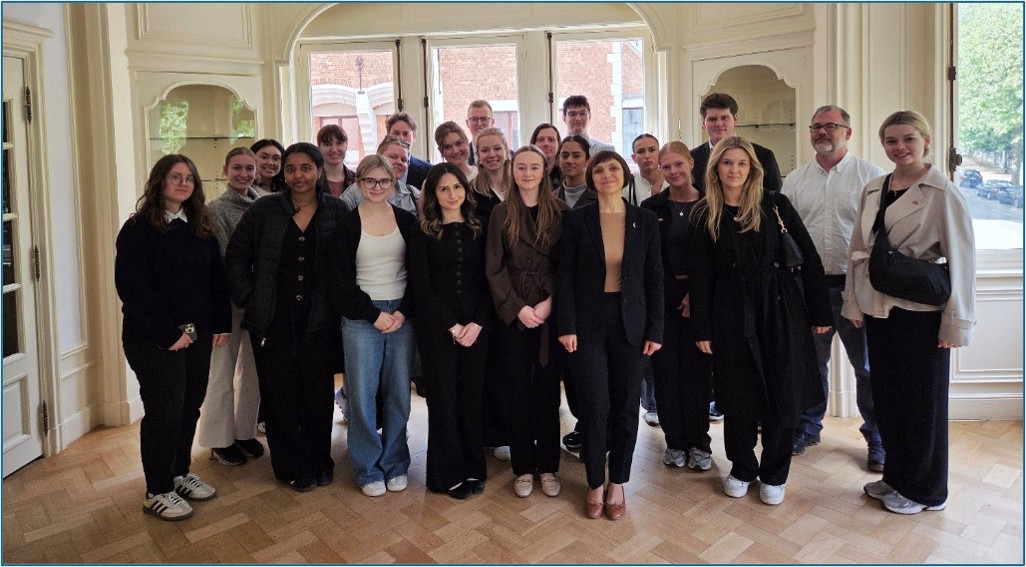
Meeting with Oksana Diakun, Deputy Head of the Mission of Ukraine ot the EU (May 2026)
Suggested research paper topics
- The impact of the Trump presidency on transatlantic relations, including between the EU and Canada
- Ideological and partisan shifts in European politics and the EU Parliament
- Conflicting visions of sovereignty between and within EU member states
- EU-UK relations after Brexit
- The EU response to Russia’s invasion of Ukraine and the prospect of Ukrainian membership in the EU and NATO
- The EU’s relations with China and the Global South
- The prospects for developing a common EU defense and security policy
- The role of human rights in the EU’s foreign policy
- The EU’s relationship with international institutions such as the UN
Many participating students have backgrounds and interests outside of political science and international relations. If anyone would like to explore the possibility of a format other than the research paper or a topic other than the options listed above, you will have a chance to discuss this with Dr. Essex and to lay out your ideas in the paper proposal assignment. Over the years we have found that most students make up their minds about their paper topic by week two of the program, after having attended meetings and talked to various speakers and to their fellow students about what they've seen and heard.
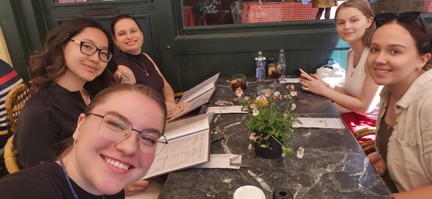
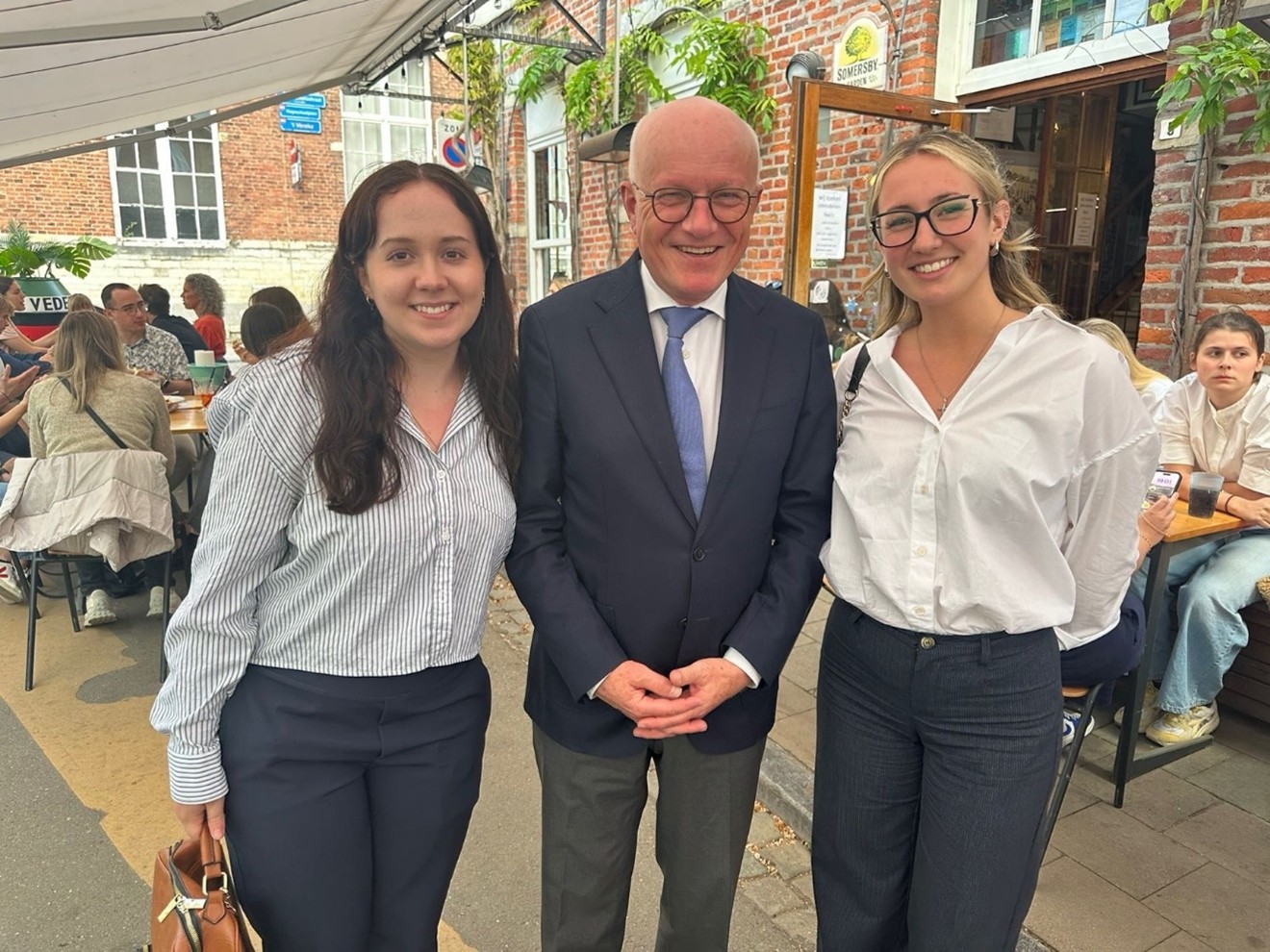
Meetings are done for the day, it's time for dinner!
Suggested Readings
As this is primarily an experiential course, there are no specific readings assigned for POLS-4880, but Dr. Essex will provide a list of recommended readings to prepare students in conjunction with one of our pre-departure meetings. These readings will, as possible, also be made available on the course Brightspace site. These readings will provide you some background on the EU and its development, major issues confronting the EU today, and the day-to-day work of diplomacy and foreign relations. Students with little to no background on the EU might want to also consult the following two resources prior to the program’s start:
Simon Usherwood and John Pinder, The European Union: A Very Short Introduction (4th ed). Oxford University Press, 2018.
European Foreign Policy Resource Guide, from the College of Europe and KU Leuven
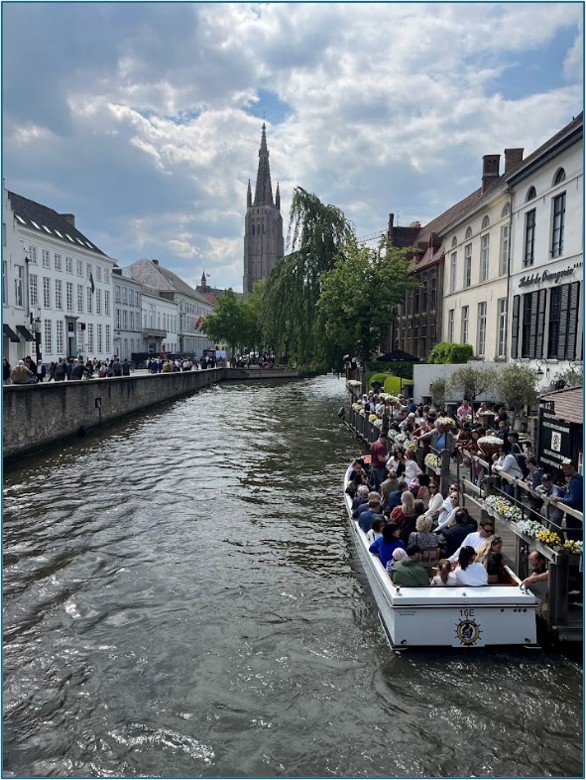
After a lecture at the College of Europe in Bruges, students enjoyed a boat tour on the city's canals (May 2026)
 After the program, students often travel elsewhere in Europe - Paris is just a few hours from Brussels by train (May 2025)
Costs
In addition to tuition fees for the UWindsor Intersession semester to enroll in the POLS-4880 course, there are other costs associated with the program, including airfare, accommodation, and daily transportation and food expenses in Belgium. The exchange rate can be unpredictable but generally does not favor the Canadian dollar. Students are expected to buy their own flights to/from Belgium, pay for their own transport costs during the course of the program, and pay for their own meals (with the exception of our opening group dinner on the program’s first day).
This information sheet provides a detailed estimate of the various costs associated with the program.
Those accepted into the program will be required to pay a $300 non-refundable deposit to the Irish College toward the cost of accommodation by late January 2027. The precise date and manner of payment will be announced at our first pre-departure meeting in January.
How to apply
University of Windsor students: Download the application form here, complete it, and email it to Dr. Essex at jessex@uwindsor.ca no later than December 18, 2026.
Western University students: You must apply through Western International at your institution. Click on https://www.uwo.ca/international/learning/go_abroad/facultyled_programs.html, then click on “Search Programs” and enter the keyword "Belgium."
For more information, contact Dr. Jamey Essex at jessex@uwindsor.ca
