
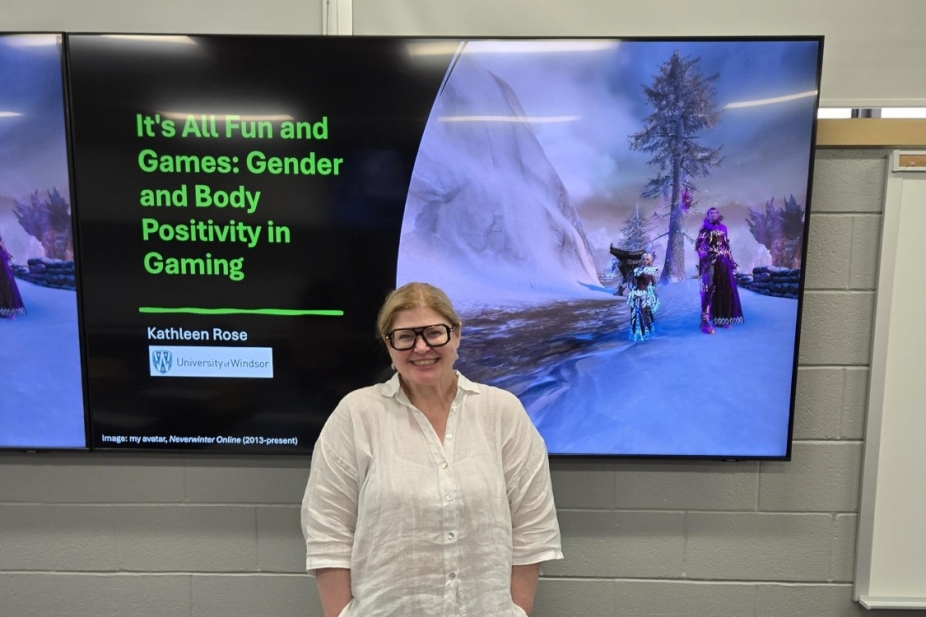
 Kathleen Rose wrote her Master of Education thesis on video games, gender and body image (PROVIDED BY K. ROSE/University of Windsor)
By Kate Hargreaves
Kathleen Rose (MEd ’25) calls herself a long-time gamer, playing early role-playing games (RPGs) like Baldur's Gate since the 1990s.
As the mother of young children at the time, and as a woman in the male-dominated video gaming space, she began to wonder about what messages these games were sending to players about gender and bodies.
“As an English teacher, games are a text. They’re a media text like anything else,” she explains.
With a prior master’s degree in English with a focus on feminist literary theory and a bachelor of education from her home province of Nova Scotia, encouraging critical thinking and media analysis was far from unfamiliar to Rose.
In fact, she had already developed a grade 11 critical thinking course for her school board in Nova Scotia in the early 2000s.
However, it was not until she started her Master of Education in UWindsor’s Faculty of Education in 2024 that she was able to connect her passion for critical media literacy and video games through her research.
Rose had taught high school English and social studies before taking some time off to start a family, eventually moving from Nova Scotia to Windsor.
When her children were grown, she had the itch to return to graduate school, initially considering a PhD in Education but choosing to reacclimatize herself to academia by taking the MEd first.
“I love to learn,” Rose says. “We are a house of learning, always learning something new.”
Applying to the University of Windsor at the same time as her son, now a third-year biology major, Rose was accepted to the MEd program and immediately found a welcoming environment in the Faculty of Education.
“The faculty is lovely,” she says. “Very nurturing. There’s not that intense sense of competition and judgment, but everybody’s still very scholarly, bright and engaged.”
While she was not sure initially of what direction she wanted to take her MEd, Rose credits this welcoming environment and the flexibility of the program for allowing her to explore and land on a direction that was right for her.
Starting in the course-based stream before eventually switching to pursue a thesis, Rose applied her past experience in curriculum development while also exploring courses that were less familiar.
Statistics, in particular, was a new experience for Rose and a nerve-wracking one at that. However, she credits adjunct professor Dr. Atinuke Adeyemi with making the experience surprisingly painless.
“I was terrified,” Rose laughs. “But she made me fall in love with math all over again and helped us all relax and focus. She took the time to explain if any of us didn’t get it. She was an inspiring educator.”
Rose also cites Dr. Naved Bakali’s course, which centred diversity and inclusion in education, as a highlight of the MEd program.
“He really created a culture of it being okay not to know things, to be uncomfortable, to help each other and bolster each other,” says Rose.
This sense of safety and support in the classroom extended from Rose's instructors to her peers.
“That’s what I love about graduate studies,” she says. “You’re not lost in a sea of 200 faces. You get to know the people in your class, the professors and the culture. I saw how many people from different walks of life all over the globe came into the program, just wanting to learn and do well and share their stories and capabilities.”
While her course work was certainly transformative, Rose was able to come into her own as an educational researcher through switching to the thesis stream under the supervision of Dr. Catherine Vanner.
“Dr. Vanner took me under her wing, and we crafted a plan for my research in video games and body positivity,” Rose explains, noting that the shift from literature to social sciences research came with its own learning curve.
Her eventual thesis project combined her gaming experience with a critical feminist lens, exploring how women gamers identify with their gaming avatars for better or for worse.
“Some women actually don’t want to reflect on their bodies at all when they play video games,” she explains of her findings.
“They don’t want another space in their life where they have to think about their bodies. And then there are people who are deeply affected.”
While the literature suggested that gamers may identify with their avatars, Rose’s research, which consisted of interviews with 11 participants, suggested that this identification could have a major impact on their body image and self-esteem.
She also found that participants who played games with no women characters available to players sometimes identified more with computer-controlled non-player characters (NPCs) so long as these were women.
For trans women and gender-queer people in Rose’s study, role-playing video games could be both a site of gender exploration at the same time as bringing up negative feelings about their real-life bodies.
“It’s fascinating because these games take hundreds of hours to finish, so you’re immersed in the world,” Rose explains. “People are having very strong feelings about themselves as a result.”
Rose’s participants also found sites of gendered resistance in gaming, pushing back against gendered roles and expectations in the games’ mechanics to reject dominant ideology.
While Rose’s thesis focused on adult women, this led her to question how much these potentially damaging effects were affecting children and what educators’ role might be in mitigating that harm.
She hopes to explore this perspective in the Joint PhD program in Education, which she is set to start this July, with classes hosted this summer on the UWindsor campus.
In particular, Rose wants to explore how educators are helping students navigate content in video games that may be harmful or discriminatory, citing the influence of the so-called manosphere in interactive video game spaces.
“You want to stand up for what you believe in, but you also want to fit in, especially for school-aged kids,” she explains. “So what kind of strategies are educators using to help kids get through that? I think that will be fascinating.”
Citing the collaborative nature of education as a service-oriented profession, Rose's eventual goal is to mobilize this knowledge to other teachers in order to help them better support students.