
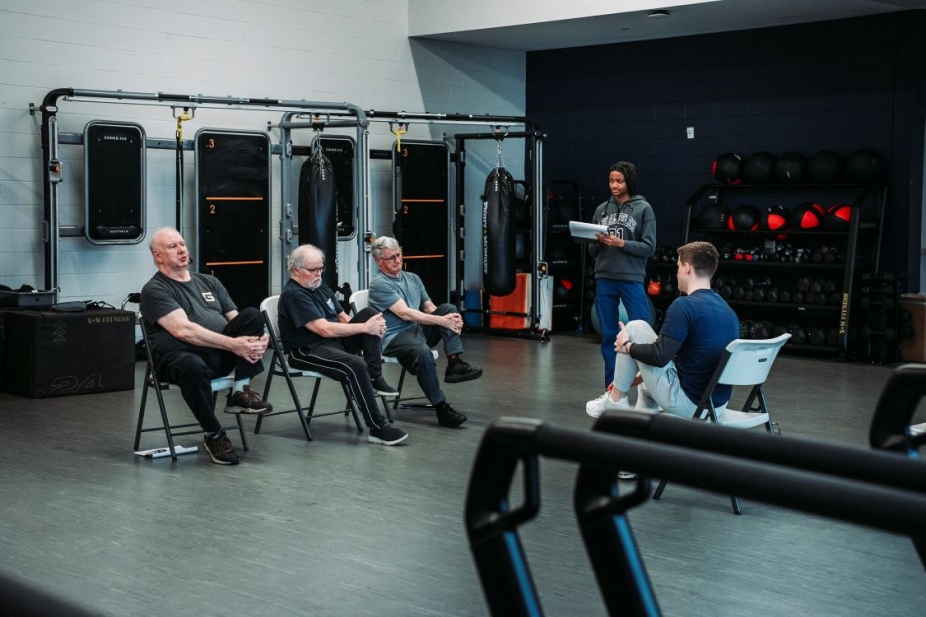
 Physical activity is key for everyone, including older adults. (MIKE WILKINS/University of Windsor)
By Kate Hargreaves
Just 10 minutes of physical activity a day can be the start many people need to get moving, according to Dr. Paula van Wyk, professor in the Faculty of Human Kinetics.
Physical activity is especially important for older adults as the aging process can lead to loss of strength and function.
“In general, people are aware of the potential benefits of engaging in physical activity,” she says.
Still, according to van Wyk, only a small percentage of older adults meet the recommended guidelines for physical activity.
“It is advised that adults and older adults should engage in at least 150 minutes of moderate-to-vigorous physical activity each week,” she explains, noting that twice a week muscle-strengthening activities and activities that challenge balance are also recommended.
However, van Wyk says that some can find the recommendations overwhelming, lacking context or examples, or even perceive them as too time-consuming for a busy schedule.
“As a result, people tend to be less active and more sedentary,” she says.
Risks of a sedentary lifestyle
Dr. Sean Horton, professor in the Faculty of Human Kinetics, explains the risks of a sedentary lifestyle.
“You’ve likely heard the expression ‘sitting is the new smoking,’” says Horton.
“Sitting for vast amounts of time each day is not great for our health. And going to the gym for an hour doesn’t necessarily make up for all of the time spent sitting. The evidence suggests that building more movement into our day, throughout the day, is important to maintaining good health.”
van Wyk explains that sarcopenia, loss of skeletal muscle mass, strength and function can start as early as someone's 30s, making physical activity increasingly important with age.
“There seems to be this acceleration period when a person is around 60 to 65 years of age,” she says.
“This means, as we age, we can become more at risk of experiencing weakness, slower speeds and falls. In addition to proper nutritional support, physical activity, especially when it is inclusive of resistance training to help build muscle strength, can help delay the decline one might otherwise experience.”
“Physical activity is important to maintaining flexibility, muscle strength, bone density and overall function,” adds Horton.
“It’s a combination of both reducing time spent sitting and getting some physical activity to increase your heart rate and get your muscles engaged. Incidentally, this could apply to all of us, irrespective of age.”
Getting started with physical activity
As to where to start, van Wyk recommends starting small.
“I like to tell older adults, and people in general, to try and start with ten minutes of physical activity a day. Arguably, we can all find ten minutes,” she says, adding, “the first ten minutes does not need to be climbing a mountain.”
Instead, she recommends recognizing your own abilities and finding ways to break up long periods of sitting.
For those who can stand and walk, this might mean walking a few blocks to get a coffee instead of driving.
Strength training can even be done without leaving home.
“You do not need to go to a gym,” says van Wyk.
“You can, but you don’t have to. There are several items even in your own kitchen that can be beneficial.”
She suggests trying soup cans as weights for resistance training, using a closed umbrella as a stretching tool to improve reach and flexibility and doing single-leg stands, calf raises or chair sit-to-stands to work on balance.
Buddy up for lifelong fitness
Having a buddy can also make incorporating movement more fun.
“Whether that is a walking buddy, a gym buddy or a pickleball buddy, having at least one other person to connect with can help hold you accountable but can also make physical activity more enjoyable,” van Wyk says.
Horton agrees. “Social engagement is often a really important part of physical activity,” he says.
“Having someone, or a group, to go for a walk with, or play a sport with or go to the gym with can be an effective way of getting people involved and keeping them involved. Some would argue that the social component is just as crucial as the physical component, considering that older adults often feel somewhat lonely and socially isolated.”
Whatever you choose to do, picking an activity you enjoy is key to keeping moving.
“That may look very different depending on who you are, and your preferences, but whether it’s walking, playing a sport, yoga or gardening, finding something that’s enjoyable and doesn’t feel like a ‘chore’ can help people be more active,” says Horton.
Get some sleep
In addition to a focus on movement, van Wyk highlights prioritizing quality sleep as central to good health as we age.
Getting seven to eight hours a day of good-quality sleep is part of Canada's 24-Hour Movement Guidelines.
Having a consistent routine for bedtime and wake up can help older adults rest easy at night while limiting sedentary time during waking hours to under eight hours per day.
With items found around the house and a short time each day, anyone can get started on incorporating more physical activity, which can go a long way to improving health outcomes as we age.
“Sedentary behaviour and physical inactivity among older adults are connected to such concerns as chronic disease, frailty and premature death,” says van Wyk. For these reasons, ongoing research is critical to continue exploring ways to improve outcomes.
This article is part of the University News series Aging Well.