
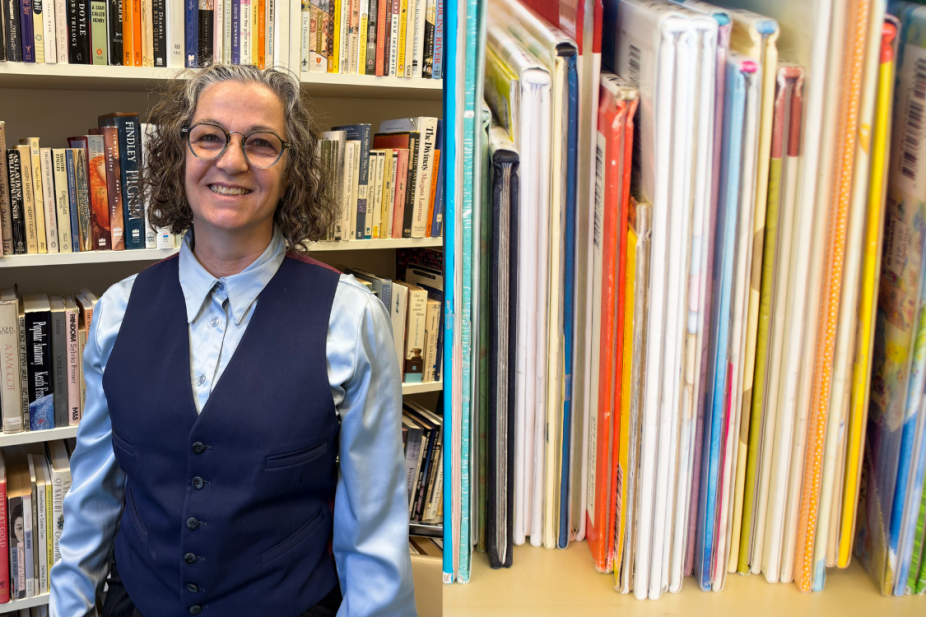
 Dr. Nicole Markotić is one of the organizers of an upcoming colloquium on precarity in children's literature (left: K.HARGREAVES/University of Windsor; right: CANVA STOCK/University of Windsor)
By Kate Hargreaves
With children’s literature becoming a flashpoint for controversy in both the United States and Canada, the question of who is represented in stories for kids and how those stories are told appears more urgent than ever.
An upcoming colloquium hosted by the University of Windsor department of English will focus on precarity in children’s literature, examining the ways in which marginalized identities are represented in texts for children.
“Children’s books perpetuate notions of what it means to be normal,” explains professor of English and creative writing Dr. Nicole Markotić, who is co-organizing the colloquium.
“If you look at fairy tales, disabled characters are always evil or they’re good characters who’ve been punished. What does that tell us about the world, that this is what we present to kids?”
While Markotić’s research focuses predominantly on disability, she emphasizes the ways that identities overlap as opposed to existing in a vacuum.
This overlap is part of the motivation behind the colloquium’s focus on precarity in its broadest sense.
“It’s a way of saying there are many ways of being precarious,” says Markotić.
Co-organizer and colloquium presenter Dr. Jeremy Fairall (MA ’15) researches the way queer histories are represented in children’s literature.
“How do you teach something that has often been a history of precarity at the same time as eliciting a kind of queer joy that people are trying to focus on now?” he asks.
“This is also a very precarious time for queer people, for any people who aren’t part of the very small category of people that you can be without being in peril these days. I’m looking at teaching a precarious history in a precarious time in a way that elicits joy.”
He describes this work, and examinations of precarity more broadly in children’s literature, as particularly urgent given attempts at book bans on supposedly inappropriate materials in Alberta.
“There is a lot of misinformation about the kinds of books being assigned in schools and targeted toward children in libraries,” says Fairall.
“The fact that they’re banning books is fascinating and obviously very worrying, and it certainly speaks to the urgency of the kind of work we are doing. With this colloquium, I think the message is, these books are not bad for you. Learning about other people is not bad for you.”
Markotić echoes this sentiment.
“Wouldn’t it be great if there were stories out there that at least made children aware that the world isn’t always just one thing?”
Both Markotić and Fairall will present their research at the colloquium, which takes place Saturday, March 7 in the McPherson Lounge, Alumni Hall from 8:45 a.m. to 5:30 p.m.
Panels will delve into queer identity, race, gender and other factors influencing precarity, analyzing literature from fairy tales to young adult fiction, picture books and graphic novels.
“We have a really impressive range of research coming in,” says Fairall, whose own research focuses on visual texts, including picture books and graphic novels.
Presenters include world-renowned experts in the field such as Dr. Lissa Paul from Brock University and UWindsor alumnus Dr. Jeremy Johnston (MA ’16), now a professor at Illinois State University as well as UWindsor professors Dr. Carlo Charles and Dr. Danielle Price.
UWindsor graduate students will also present their research in addition to a panel of four undergraduates from the department of English.
“They are the next generation of scholars,” says Markotić of the student presenters. “There aren’t a lot of books out there on disability in children’s lit, this kind of intersectional precarity, so they are the next scholars in an area that is just beginning to open up.”
Discussion and questions are not only welcomed but encouraged with time for conversation built into each panel.
“The conversations we have after the panels and with the audience are going to be really exciting,” Markotić says, noting that the colloquium is open to all.
“We hope people attend who are interested and may not be academics. Anyone interested in children’s lit and how characters who may be precarious navigate their stories or are given stories in a certain way. This is a topic that interests a lot of people.”
The colloquium kicks off with a pre-conference reading on Friday, March 6 featuring incoming UWindsor writer-in-residence and acclaimed children’s author Christopher Paul Curtis. This free event is open to all and takes place in McPherson Lounge, Alumni Hall starting at 7 p.m.