
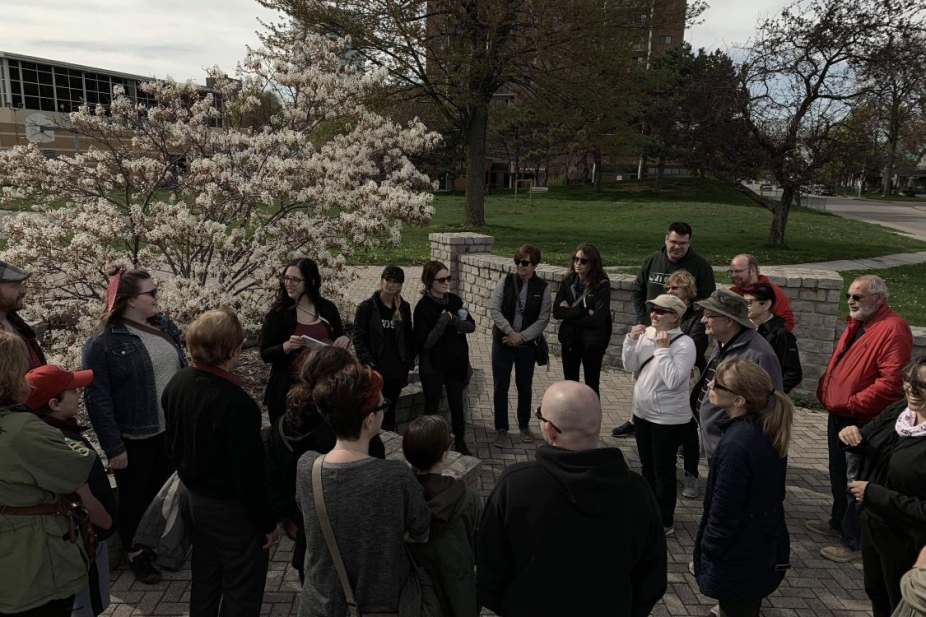
 Sarah Morris (back row, third from left) leads a Jane’s Walk in Windsor (PROVIDED BY S. MORRIS/University of Windsor)
By Kate Hargreaves
Ever wanted to learn about historical burial practices, the Underground Railroad, heritage architecture, labour history, local ecosystems and more, all for free?
These are only a handful of topics covered by the Windsor-Essex Jane’s Walk Festival, taking place across three weekends: April 23 to 26, April 30 to May 3 and May 9, 2026.
Inspired by urbanist and activist Jane Jacobs, Jane’s Walks were started in Toronto in 2007 by Jacobs’ friends to celebrate her legacy after her death in 2006. Since then, these volunteer-run walks that celebrate local neighbourhoods have expanded around the world.
The first Jane’s Walk in Windsor took place in 2009, organized by UWindsor Law Librarian Mita Williams, with the event growing in scope and popularity in Windsor-Essex ever since.
Sarah Morris (BA ’12), who attended her first Jane’s Walk in 2015, recalls jumping right in as a host and then a participant.
“At the time, the City of Windsor was organizing the Jane’s Walks, and they put out calls for hosts,” says Morris.
“I'm a nerd who loves history and my neighbourhood. I wanted to share that love with the community. I was hooked.”
After hosting her first walk centred on buildings that no longer exist in downtown Windsor, Morris says she attended other Jane’s Walks events and became more involved, eventually taking over as organizer for the festival in 2018.
“The festival has grown significantly, and we’re really proud that we’re one of the largest Jane’s Walk festivals in Canada,” says Morris. “This year we have 63 events over nine days.”
“I am a firm believer that if you want something cool in your community, you have to be part of making it happen. I started organizing Jane's Walks because I wanted to highlight how many amazing groups, organizations, causes and ideas were happening in the community.”
Morris sees Jane’s Walks as a kind of sample platter where people can get to know a variety of local groups and people and perhaps join in.
“It’s really exciting to know that you’re introducing people to neighbourhoods they’ve maybe only driven through, and now they’re having a chance to not only walk through them but also meet the neighbours and learn the history and how it all came to be.”
As the festival has grown, one of the biggest changes has been increasing its accessibility. Morris explains that in addition to Jane’s Walks, organizers have added Jane’s Tours of historic building interiors and Jane’s Talks — seated presentations that are more accessible to those who may have more limited mobility.
They’ve also prioritized including accessibility information about each event on the website to empower people to attend events that suit their mobility, comfort level and interest.
The festival has grown to cover two weekends, encapsulating not only Windsor but municipalities around Essex County.
“That change totally came out of the community,” Morris says. “A couple years ago, we tried out a few events in Amherstburg and had a huge attendance, and in our attendance survey, people said they would love more events in the county.”
This year’s festival includes first-time communities such as Cottam, Comber and Woodslee.
“I grew up in Windsor and Tecumseh,” Morris says, “but I’ve never been to some of these communities. Even for someone who has been here my whole life, there’s something new to discover.”
A returning favourite from the county is a walk focused on migrant workers’ perspectives in Leamington in partnership with a community group serving migrant workers in that area.
The festival regularly partners with local organizations such as the Windsor Regional Society of Architects, the Ontario Architectural Conservancy and the Friends of Ojibway Prairie, bringing their efforts together to reach new audiences and neighbourhoods.
In Comber, the Community Catalysts walk will be hosted by the Centre for Cities at Windsor Law.
“The walk is yet another milestone in our partnership with the Municipality of Lakeshore and highlights UWindsor alumni working together within the community,” says Kaitlyn DiPietro (BA '18, MEd '20), a research associate at the Centre for Cities.
Community Catalysts will be co-hosted by Centre for Cities’ Crystal Waddell along with Jacob Dickie, who will guide participants along Comber’s Main Street and discuss the role of nature, farming and industry in Comber alongside main street design and catalytic development.
Jane’s Walks are free and open to all; however, registration is required as many events have already filled up.
“People are curious about the places where they live and visit,” says Morris.
“We often have some very niche topics that will bring out people who are very enthusiastic about that, but we also have people who are like Deadheads and come to 20 events over the course of the festival because they are passionate about Windsor-Essex and want to learn more.”
Morris says that in addition to new participants each year, many people find themselves returning to Jane’s Walks year after year because there is so much variety and opportunity to see communities through a different lens.
“For instance, in Amherstburg, we have events about Black history, transportation, archeology, military history and the arts community,” says Morris.
“It’s the same place, the same landscape, but we’re allowing different lenses to bring that to life.”
She also highlights the joy of getting together with a group of people in-person and on the street to experience the topic in an active way.
“It’s such a different experience than looking at a video online when you can be there, ask questions in real time, and be out in the world talking to people,” she says.
For those interested in hosting a Jane’s Walk next year, applications open Jan.1, 2027.
“Every year, we have an open call for events, and any person or organization can submit an application,” says Morris.
“You have one hour, so you can really paint the picture of however you’d like to bring it to life through your topic.
“Our hosts are a huge range of people from professionals who might be doing this through an organization or museum or amateurs. The root of the word amateur is ‘love,’ so if you’re an amateur that means you’re in love with the topic.”
“There’s not a lot of opportunities in the community where you can learn about local history, the environment, social issues, architecture, urban design and more,” says Morris. “It’s like a little free university you can get for a couple of days.”
For more information and to register, visit WindsorJanesWalk.ca.