
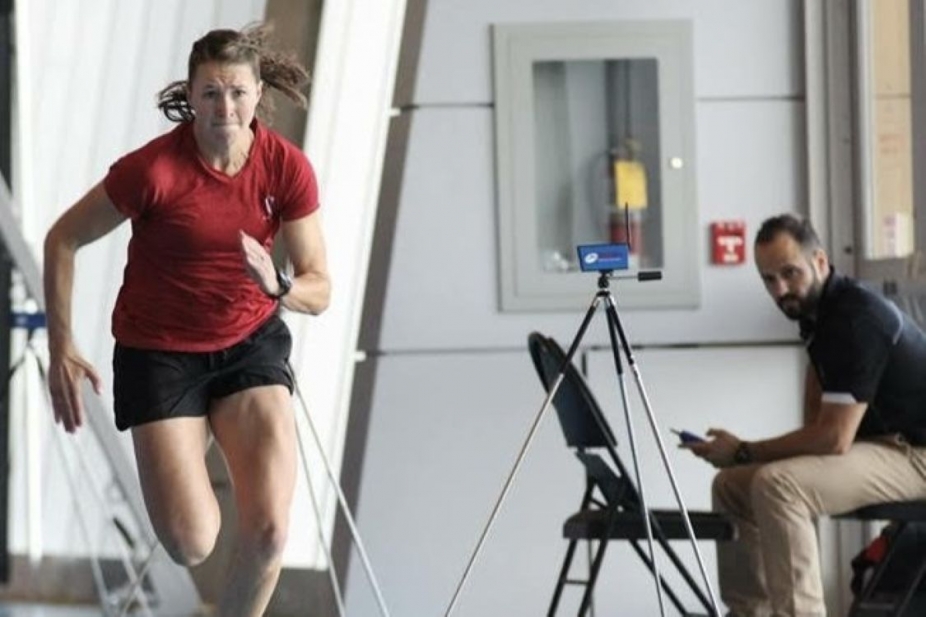
 Dr. Andrew Perrotta worked as the physiologist with the Canadian national women’s field hockey team during the Rio Olympic cycle (PROVIDED BY A. PERROTTA/University of Windsor)
By Kate Hargreaves
For female athletes — and women in general — bone health is key to long-term health.
At the same time, research on women’s physiology has often been overlooked in medicine and sports science.
As part of a new partnership with Field Hockey Canada, kinesiology professor Dr. Andrew Perrotta and the University of Windsor’s Sport Science Laboratory are working to help change that, examining the spine health of female field hockey players on Canada’s national team.
“With women, it’s really important that they prep their body physically for later in life when they go through menopause and bone mineral density goes down due to changes in estrogen,” Perrotta explains.
“It’s really important for female athletes and women in general to develop as much bone mineral density as possible early in life, during adolescence, so that it prepares them for later when they go through that change.”
In the case of field hockey, Perrotta explains that the unique physical demands of the sport mean a focus on spine health is particularly important. Because field hockey sticks are both shorter than those used in ice hockey and can only be used on one side, players must bend over and sometimes twist their bodies to hit the ball.
“It means that you’re always flexing your body, which puts a lot of stress on the lumbar vertebrae,” Perrotta says.
When combined with the risk of bone density loss later in life, this stress on the spines of elite female athletes makes the research partnership with Field Hockey Canada a practical one.
“My lab does applied research,” Perrotta explains. “When we answer a question, the answers have an immediate impact on athletes’ daily lives.”
Perrotta’s relationship with Field Hockey Canada began during his doctoral work when he served as the organization’s physiologist during the Rio Olympic cycle. As part of this role, Perrotta collected several years’ worth of data on athletes’ body composition and performance, including bone-density data from DXA scans.
For this latest partnership, Perrotta reached out to Field Hockey Canada CEO Susan Ahrens to request the organization’s support in using that data for a study of athlete bone health over time.
“Field Hockey Canada has always been one of the national organizations that has teamed up with universities,” he says. “I think that we need to develop this form of relationship more with universities and sport so we can work together.”
In addition to support from Ahrens, Perrotta credits his mentor, the late Jack Taunton, a longtime sport medicine leader and former Olympic chief medical officer, with opening his eyes to practical sport science research.
“He was a champion for field hockey and research, so I hope to carry on that legacy of connecting field hockey to academia,” Perrotta says.
This legacy of mentorship continues in Perrotta’s lab, where he trains undergraduate and graduate student researchers in applied sport science.
“I came to the University of Windsor four years ago, and I created the Sport Science Lab with the mandate to create highly qualified personnel through graduate studies and get them integrated to work with our Lancer varsity teams,” says Perrotta.
“My graduate students get certified when they’re done their undergrad degree, and they start training and monitoring our Lancer athletes, getting hands-on experience and conducting applied research.”
As part of this training pathway, Perrotta ensures that he is supporting women researchers studying women athletes and their physiology.
“I make a point to find fantastic female researchers to come into the lab who focus on this area of women’s sport,” says Perrotta. “That’s important. They know things that I don’t know because I’m not female, so ideas that I have are often improved.”
Those researchers are often athletes themselves and can bring their lived experience as women in sport to the lab.
“For the longest time, researchers haven’t made a strong effort for equal inclusion of women in sport science research, often because their bodies are different, and that affects the outcomes being examined, and that’s done a massive disservice to them,” Perrotta says.
“So, appreciating that men and women’s bodies are different, understanding that outcomes might be different if you’re collecting at different phases of the menstrual cycle, we can utilize forms of statistics that can account for these differences. There’s really no excuses.”
While field hockey is the focus of Perrotta’s current research, he sees the applicability of studying bone mineral density in female athletes across sports, with opportunities to apply the findings to Lancer athletes.
“We could do better in monitoring our athletes at the varsity level,” he says.
By understanding varsity athletes’ body composition, including bone mineral density, athletes and coaches can apply that knowledge to adjust training and nutrition.
“Examining athletes during the pre-season and post-season periods, providing consistent education sessions that allow for dialogue, we can prevent a lot of issues by being proactive,” Perrotta says.
Once he has the results from his analysis of years of spine health data, he hopes that Field Hockey Canada will be able to do just that: apply the answers practically to help support women athletes, their coaches and practitioners in being proactive about long-term health.