
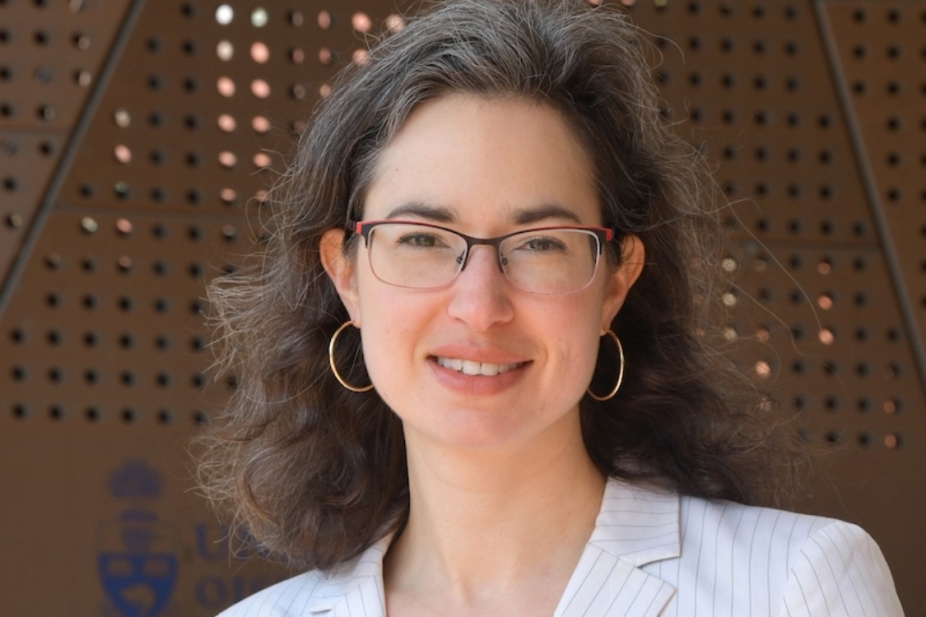
 Dr. Lauren Bialystok will be the keynote speaker for the 2026 summer session of the Joint PhD in Education, hosted at UWindsor this July (PROVIDED BY L. BIALYSTOK/University of Windsor)
By Kate Hargreaves
Dr. Lauren Bialystok never wanted to research artificial intelligence (AI).
"I feel like AI chose me more than I chose it,” she says.
However, with the ubiquity of AI, including in her field of education, Bialystok found herself drawn to the topic.
“I’ve seen changes over the last few years that portend such enormous shifts in what education is for and how we go about our business,” she says.
“I didn’t feel like it was possible to research anything else or continue to teach the way I had been until I forced myself to take a closer look.”
An associate professor at the University of Toronto’s Ontario Institute for Studies in Education (OISE), Bialystok will share her insights into AI and educational ethics as she delivers a public lecture at the UWindsor Faculty of Education July 14.
While she makes no claim of background in coding or computing, Bialystok’s expertise in the ethics of education allows her to link insights into AI use with broader conversations around authenticity, originality and the overall aims of education.
Titled Train your Brain: The Imperative of Education in the Age of AI, Bialystok’s lecture will argue for the prioritization of human cognitive development in an AI-dominated world.
The talk is the keynote address for the Joint PhD in Educational Studies’s summer session, which will welcome doctoral students from across the country to the University of Windsor for the month of July.
For those in educational studies, few shifts have been more immediate than AI’s impact on assessment.
“Teachers, instructors and professors in every level, subject and type of formal schooling, we’re all trying to figure out how to give meaningful and fair assessment of what students are learning when it has become possible to magically outsource pretty much anything we ask them to do,” Bialystok says.
While most educators have acknowledged that they can’t pretend AI doesn’t exist, Bialystok says that finding ways to move forward in the era of AI can be challenging.
“We do have to adapt,” she says. “I think this bodes major threats to education, but we have to adapt.”
However, adaptation does not mean acquiescence, Bialystok notes, drawing a distinction between those who embrace AI enthusiastically and those — like herself — engaging in informed resistance.
“There are some absolutely amazing educational uses,” she says.
“The trick is cordoning off the benefits of AI from the ability to use it to shortcut education.
“There has to be pushback,” she adds, “but I don’t think that puts me in the category of a full-fledged Luddite who believes we can just return to 1990.”
Some of this pushback seems to be coming from young people themselves, as stories of convocation speakers being booed by graduands for praising AI have started appearing in the news.
“I herald that as a positive sign,” Bialystok says. “But I don’t hold out a lot of hope that it will turn the train around. I think young people know full well what kind of world they’re growing up in and inheriting, and they have every reason to be mad at us.”
"The critical and imaginative thinking that’s evinced in those kinds of moments is exactly what the encroachment of AI into education is threatening,” she continues.
“It’s encouraging to see young people thinking without prompts and thinking against powerful incentives and distraction mechanisms.”
Bialystok cautions, however, that those who find themselves most able to resist, perhaps turning to more analogue and low-tech alternatives and pursuits, will likely be those who already hold the most privilege in terms of cultural capital and socioeconomic standing.
“I don’t think it’s unrealistic to think that at least for some portion of kids in 10 years, education will mostly be a chatbot,” she says.
For the graduate students among her audience as she delivers her keynote, the impacts of an AI-embedded educational future are likely to be extensive.
“For grad students, there are material questions about the ethics of using AI in research and their future job prospects as well as the purpose of pursuing education at the highest levels in this environment,” Bialystok says.
“I think about how it impacts teaching and assessment and how it affects scholarship and formation in a discipline in order to become a future professor.”
She’ll address both these issues and more in her talk, suggesting that the notion of training your brain is at risk of being lost across disciplines, fields and broader society.
All are welcome to attend Dr. Bialystok’s keynote July 14 from 2 to 4 p.m. in the Toldo Health Education Centre Room 204.
Bialystok will visit both Joint PhD doctoral seminar classes July 15 to continue the discussion.
For more information, including on applying to the Joint PhD in Education, visit jointphdined.com.