
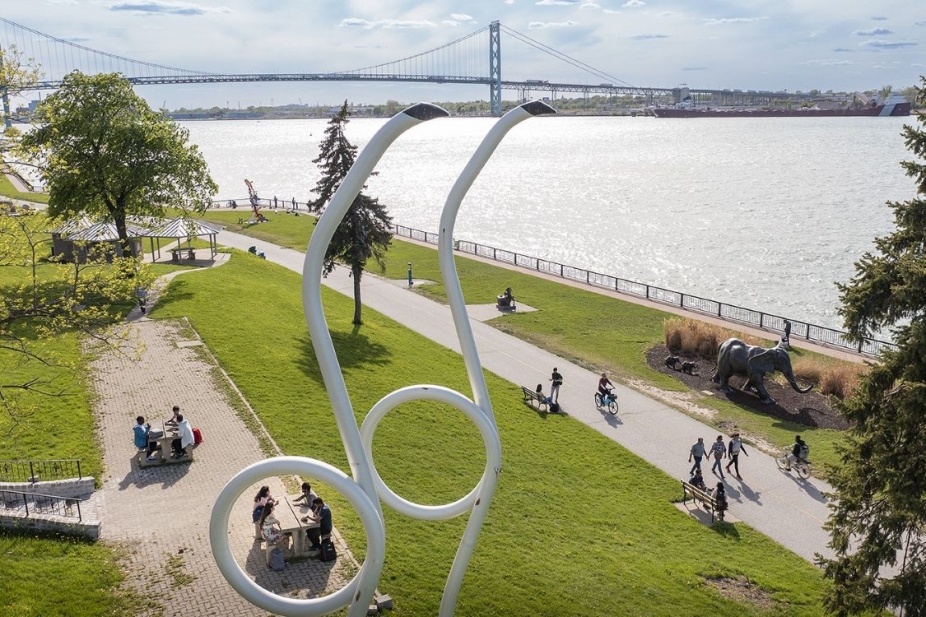
 Joint PhD in Educational Studies students are spending July 2026 on UWindsor's campus (FILE/University of Windsor)
By Kate Hargreaves
On an extremely hot day in early July, 42 doctoral students arrived on the University of Windsor campus for the Joint PhD in Educational Studies 2026 summer institute.
Over the whirr of handheld fans, first-year students introduced themselves to one another while second years exchanged hugs and life updates after a year apart.
Unique in Canada, the Joint PhD is a collaborative program among three institutions that take turns hosting the summer institute each year. Hailing from across the country and around the world, students from the University of Windsor, Lakehead University and Brock University are spending July 2026 in Windsor, exploring educational research together.
Dr. Lana Parker, professor in the Faculty of Education and director of the Joint PhD Program, says the unique structure of the program allows students to not only collaborate with colleagues from three institutions but also to have access to three sets of faculty members with a variety of specialties and interests.
“Our program really permits a wide and dynamic range of perspectives, of methodologies, of educational interests, contexts and areas of focus, so that no matter what your curiosity or research question is focused on, you’ll find some kind of fit across these three programs and certainly across the three universities,” says Parker.
Students choose from three fields of study: cognition and learning, educational leadership and policy studies and social, cultural and political contexts of education, which Parker notes are broad and overlapping.
“That produces really unique kinds of opportunities and synergies where a student will come in with a research idea and find a fit with a supervisor or committee member, and that will spark new pathways for both the student and the faculty member, which is really exciting,” says Parker.
Sometimes, students arrive thinking they want to study one topic and discover a different site of curiosity through their work with faculty.
“The opportunity for that kind of partnership and collaboration while respecting the specificity and diversity that our program represents is really important,” she says.
“I think that’s what has made it a success for the past 25 years and hopefully will keep it successful for the next 25.”
Collaboration with peers is also central to the summer institute experience. While the online courses in the program offer flexibility, Parker says spending July in person is where the connections between students are formed and deepened.
“These summer institutes, the DS1 and DS2 sessions, are so vital for getting a sense of place and togetherness,” she says.
Second-year doctoral student Shantelle Browning-Morgan says having the support of her cohort has been instrumental in tackling statistics in DS2.
“It has been over 20 years since I last took a statistics course during my Master of Education degree, so the learning curve has been quite steep, but it has stretched my thinking and strengthened me as a researcher,” she says.
“With such a rigorous course, the support of my cohort and the flexibility and availability of our instructors have made all the difference in the world.”
Based in Windsor herself, Browning-Morgan has also enjoyed introducing her colleagues to her city.
“It's been especially wonderful having my colleagues here in Windsor, and I hope we have the opportunity to enjoy dinner together so they can experience our world-famous Windsor pizza and some of the city's rich history before residency comes to an end,” she says.
Parker echoes this hope that students get a taste of Windsor while they’re here.
“I hope that students get out into the city, whether it’s their local community and they bring a fresh lens to it, or it’s a community they’ve been invited into.”
“Windsor is a beautiful and diverse and dynamic place to live, and it’s a great opportunity to be in the city. They have an opportunity to get to know new people, visit local restaurants, patronize local shops, take bicycle rides or walk along the riverfront and really get a sense of how people are living in this community.”
With intake for next year open until Oct. 1, Parker is quick to debunk the misconception that only classroom teachers or administrators need apply.
“While there is certainly room for that cohort, we’re also interested in the kinds of teaching and learning that can take place in non-formalized education settings too, outside of schools,” she says.
“That can happen in business contexts, in non-profits, in public agencies. Really, it happens everywhere. We’re interested in education writ large.”
She encourages anyone curious about the program to apply and see where it can take them.
“People confront whether they belong in this type of program if they don’t have an education background, whether they belong in graduate work if they haven’t had a traditional academic trajectory,” Parker says.
“Once you get through that hurdle of putting in the application, a whole new horizon opens up if you’re accepted into the program, and that horizon is worth the hurdle.”
To learn more about the Joint PhD in Educational Studies or to apply, visit JointPhDinEd.com.