
 Kate Reynolds aka the Lavender Librarian got started with social media storytime in 2020 (PROVIDED BY K. REYNOLDS; TEMPLATE VIA CANVA STOCK/University of Windsor)
By Kate Hargreaves
With her glitter-covered eyeglasses, Kate Reynolds (BMus ’06) knows that she looks like a children’s librarian. However, part of her goal as the founder of Storytime Solidarity is to shake up assumptions about who leads storytime.
Known to tens of thousands of social media followers as the Lavender Librarian, Reynolds’ approach to children’s literacy prioritizes inclusion, joy and access in the face of exclusionary narratives about who does and does not belong.
Reynolds’ foray into social media storytime began during COVID-19 lockdowns. As a children’s librarian with Windsor Public Library, they pivoted to livestreaming.
“But I wanted to do more,” they say. “So I started the Lavender Librarian.”
Drawing on her background as a classically trained vocalist, Reynolds began sharing not only stories but also the songs she was writing, to help to demystify masking for protection against COVID.
“I wrote around 20 songs about face masks,” they say, sharing these with not only families but other children’s librarians online.
Around the same time she launched the Lavender Librarian, Reynolds was diagnosed with autism at age 35, inspiring her to share her experience with followers.
“My first thought was that if I had seen one person whose autism manifested like mine, I might have figured it out sooner,” she says.
“Autism is just a different operating system. I wanted to normalize it, and I found so much peace understanding that about my own neurology. I wanted to pay it forward by sharing my story in the hopes that other people might find out about themselves.”
In addition to advocating for autistic voices, Reynolds speaks about disability and other chronic conditions.
Her own experience navigating the health-care system with osteogenesis imperfecta, colloquially known as brittle bone disease, indirectly led to her expanding the Lavender Librarian into the Storytime Solidarity network.
“I was in a really low place in 2021,” Reynolds explains. “In eight years, I broke four limbs, three of them lower and requiring bed rest. I was two weeks out of knee surgery in a bed at my parents’ house.”
During this difficult time, Reynolds learned that a popular Facebook group among children’s librarians was folding.
“20 minutes later, Storytime Solidarity was born,” she says. “Within a week, we had 400 members, within a few weeks a few thousand, and we’re at over 6,000 now. The goal was to help children’s librarians find one another.”
With a mandate to help early childhood educators connect and build equitable and inclusive storytimes together, Storytime Solidarity’s emergence from Reynolds’ experience with disability and marginalization was a natural extension of her advocacy.
“There’s this stigma against hiring people with disabilities,” she says. “We’re people who have a lot to offer, and I think all traditionally excluded people have these great stores of knowledge that haven’t been accessed.”
Combining her disability advocacy — especially as a global ambassador for IFPA Psoriasis — with her musical training, Reynolds is in the process of writing and recording a children’s album about psoriasis.
“We’re calling it the Psoria Fish,” they say.
“We’re thinking, what do kids really care about when they have psoriasis? The grown-ups take care of the medical side, but they care about the way their friends treat them. The songs are based on how to be a good friend to somebody with psoriasis.”
A collaboration with composer and co-fonder of Art Song Lab Dr. Michael Park, the album demystifies both chronic illness and classical music, drawing on the work of Schubert as the basis for the songs.
“One of the songs we are using is also the song the Samsung washing machine plays when it finishes,” Reynolds laughs.
“So we’re hoping that earworm helps give some familiarity because classical music feels so intimidating. But this is just going to be a silly song about some fish who become friends.”
If an active social media presence and children’s musical recordings were not enough, Reynolds and their Storytime Solidarity colleagues Rosie Camargo, Ingrid Christina and Anne Coppell are also releasing a new book, The Seriously Silly Storytime Survival Guide, in early 2027.
Like Storytime Solidarity itself, collaboration was key to bringing the book project together.
“What really brought it together was that I started to meet other people who were all over the world who were doing similar types of work with children and wanted to support each other,” Reynolds says.
“Those of us working with under-fives in terms of music and books have a lot in common and there's some beautiful networks springing up around it. I'm just so grateful to be a part of it.”
The book project came about when Reynolds and her co-authors noticed a gap in resources on how to facilitate children’s storytimes, without relying on a script, instead creating original materials and bringing an authentic presence to the space.
“We deliberately brought in a lot of our friends who are in demographics you don't picture at storytime,” Reynolds says.
“We have multiple Black male librarians that we spoke to and people of all different groups.”
While Reynolds and the Storytime Solidarity group are working to advance inclusion in children’s literacy, others are challenging or banning materials they deem inappropriate because they feature underrepresented characters and experiences.
Citing American scholar Rudine Sims Bishop, Reynolds says that “children need mirrors into their own lives and windows into the lives of others. If you don’t have enough mirrors, you feel like you don’t matter.”
Book bans, she says, are trying to tell kids just that. “They’re trying to say that some people matter but not all people, and maybe people matter differently, and that’s a dangerous and frankly appalling way of looking at things.”
“If children have too many mirrors, they don’t understand other people’s experiences, so children need books about kids whose lives are like them and a lot different from them.”
Beyond race, gender identity and family structure, Reynolds says some of their favourite books deal with families using food banks and experiencing food insecurity, helping children understand experiences different from their own.
“What they're getting before they're five is not just pre-literacy but their understanding of what makes a human being,” Reynolds says.
“And they're going to grow up to be healthier, kinder, more balanced people, and kinder to themselves as well, if they see a much wider range of that. To love children is to love all children without preferencing some children over others.”
Reynolds has also taken her advocacy beyond Canada, participating in events all over the world in her role with IFPA. Dring an IFPA trip to Kenya, they presented a storytime for children living in the Shelter Children's Home alongside Kenyan librarian Purity Kavuri-Mutuku, who Reynolds describes as a "superstar and kindred spirit from the other side of the world."
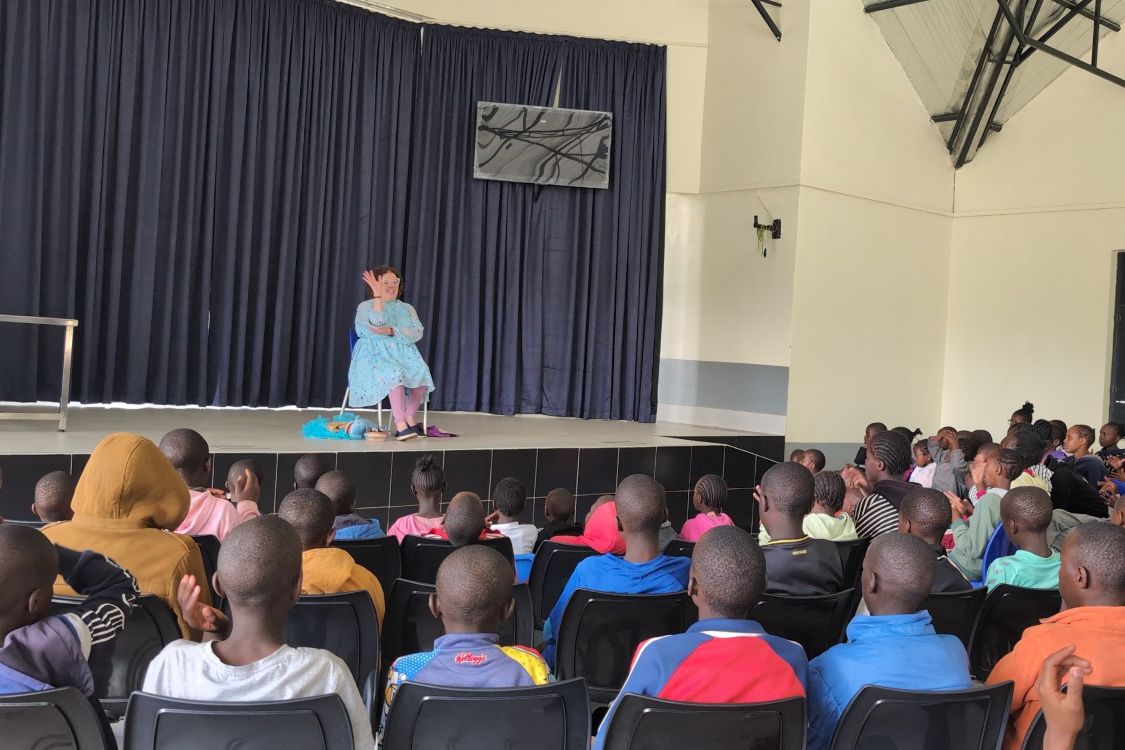
Those experiences, along with collaborations with colleagues in New Zealand, have led to her involvement in Indigenous language preservation projects through children’s songs and lullabies.
“When I travel, regardless of the purpose of the trip, I try to visit as many libraries as possible,” Reynolds says.
“I feel like you learn so much about the community and the culture of literacy visiting libraries. The bigger the library the better, of course, but I want to learn all of the details and find ways to grab a little bit of extra library joy and bring it home to Windsor."
Having all these projects underway may sound overwhelming, but that library joy keeps Reynolds moving forward in her work.
“I think that it's really important that we keep finding the joy for ourselves,” she says.
“This is not an easy time to be an empathetic human being. Finding ways that we can help, leaning into servant leadership and joyful service to others, the joy that we can control, and leaning into that joy is what it's going to take to get through this.”
“One of the things I wanted to share was a combination of library joy, how much I believe in libraries and their important role in the community as really a vital service,” they continue.
“When people are having a hard time, libraries are often the first place they go. I believe in libraries on every level. So many services are neutral, but the library is all about freedom and access that everybody gets. There is just something so beautiful in the way libraries are kind of solidarity in action.”