
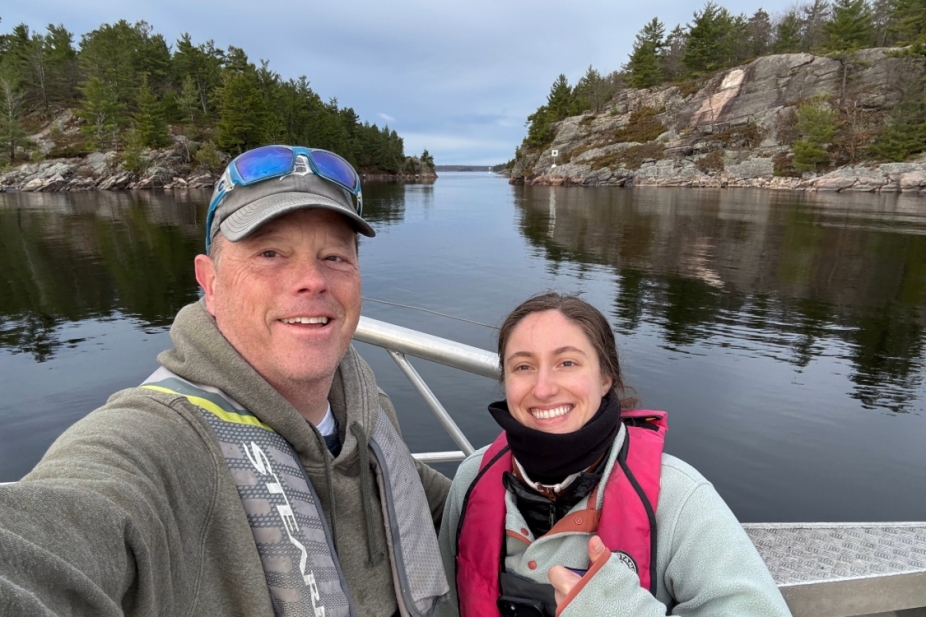
 Aaron Fisk with former graduate student and current RAEON glider technician, Lydia Paulic, in Parry Sound. (Courtesy of Aaron Fisk/University of Windsor)
By Sara Elliott
For more than two decades, University of Windsor researcher Dr. Aaron T. Fisk has helped change how scientists understand freshwater ecosystems – from how contaminants move through aquatic food webs to where fish travel, feed and spawn across the Great Lakes and the Arctic.
That body of work has now earned Fisk one of Canada’s highest academic honours.
The University of Windsor professor in the School of the Environment and Tier 1 Canada Research Chair in Changing Great Lakes Ecosystems has been named a Fellow of the Royal Society of Canada in recognition of his national and international contributions to aquatic research and leadership.
“I was genuinely surprised that I was elected and honoured to receive this news,” says Fisk, researcher with the Great Lakes Institute for Environmental Research.
“I’m humbled by the people who are Fellows of the Royal Society.”
In its more than 130-year history, the Royal Society of Canada has inducted just over 3,700 scholars, artists and scientists. Fisk joins them for research that has advanced understanding of aquatic ecosystems and helped inform fisheries management, ecosystem restoration and environmental policy in Canada and around the world.
“Fisk’s research has transformed our understanding of freshwater ecosystems while helping to protect one of Canada’s greatest natural resources, the Great Lakes,” says Dr. Shanthi Johnson, vice-president, research and innovation, at the University of Windsor.
“His election as a Fellow of the Royal Society of Canada recognizes decades of scientific excellence, innovation and leadership that have advanced freshwater research and strengthened the University of Windsor’s impact, locally and globally.”
Originally hired at UWindsor as an aquatic toxicology researcher, Fisk has broadened his work over the course of his career to examine how aquatic ecosystems function and respond to change.
A major focus has been aquatic food webs. Using stable isotopes, Fisk studies what animals eat and traces trophic connections from algae and plants to top predators.
“If you understand the food webs, then you can also study contaminant dynamics,” he says.
That work has helped researchers understand not only how energy moves through aquatic ecosystems but also how contaminants can move through them.
Fisk spent formative research years in the Arctic, but over the past decade much of his work has focused on the rapidly changing Great Lakes.
One of the tools transforming that research is acoustic telemetry, which uses tags implanted in fish to track their movements over time.
“Acoustic telemetry allows us to understand where critical habitat is, where fish potentially interact, where their important spawning grounds are,” Fisk says.
“On a bigger scale, it contributes to overall ecosystem and fish population management.”
Through the Great Lakes Acoustic Telemetry Observation System, known as GLATOS, Fisk is involved in projects tracking multiple fish species across Lake Ontario, Lake Huron and Georgian Bay.
In the Georgian Bay and Parry Sound area, he collaborates with scientists on both sides of the Canada-U.S. border to study how a rainbow trout aquaculture facility affects the movement and feeding of wild fish.
Fisk has also helped build the infrastructure that allows other researchers to study freshwater systems in ways that were not previously possible.
He is a leader in the Real-Time Aquatic Ecosystem Observation Network, or RAEON, which he helped establish with support from the largest Canada Foundation for Innovation grant ever awarded to the University of Windsor.
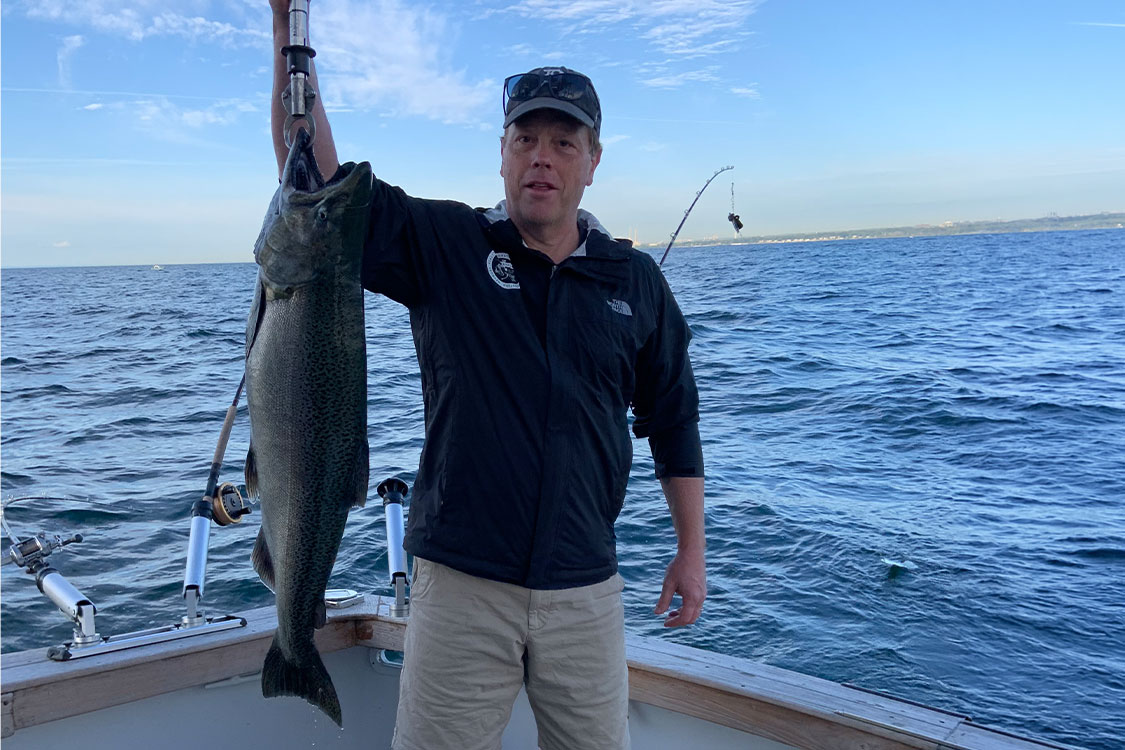
Aaron Fisk on Lake Ontario catching and tagging chinook salmon. (Courtesy of Aaron Fisk/University of Windsor)
He also plays a leading role in freshwater observation initiatives including the national Global Water Futures Observatories and the Cooperative Institute for Great Lakes Research at the University of Michigan.
“We’re providing all kinds of cutting-edge instrumentation like Slocum gliders, which are autonomous underwater vehicles, and we help facilitate researchers getting access to the data and the infrastructure so they can go out and do their research,” Fisk says.
The need for that research is becoming more urgent as the Great Lakes face pressures from fishing, invasive species, nutrient pollution and climate change.
“We’re seeing profound changes to our climate,” Fisk says.
“And that is resulting in warmer water, warmer lakes and that is really starting to change how the lakes function and behave and set up.”
Those changes carry consequences beyond the ecosystem itself. Recreational and commercial fisheries worth billions of dollars depend on healthy fish populations and functioning Great Lakes ecosystems.
Fisk points to the decline of yellow perch in Lake Erie as one example close to Windsor-Essex.
“Catches are at a historic low and that has a profound impact even beyond the ecosystem itself because yellow perch are a recreationally and commercially important species,” he says.
Understanding the food web provides researchers with a baseline against which they can measure those changes and model what may happen next.
“I think fully understanding those food webs, having a baseline of what those food webs look like and how they function and doing modelling allows us to forecast what the potential impacts of a warming Great Lakes ecosystem will be and which species will be the winners and losers,” Fisk says.
That information can help scientists and resource managers anticipate changes to water quality, fish populations and the broader health of the Great Lakes.
The ability to track individual fish has been particularly transformative.
“We’ve had a revolution in the last 15 to 20 years in the Great Lakes,” Fisk says.
“Tagging fish and watching them move and seeing where they move and identifying important habitats has profoundly changed how we look at those ecosystems and how we manage them.”
Fisk’s influence extends beyond his own research.
He has published more than 330 highly cited scientific papers, including work in Science, secured millions in research funding and helped build some of Canada’s most influential freshwater research networks.
He has also mentored more than 60 graduate students and postdoctoral fellows, many of whom now hold leadership positions in universities, government and research organizations across Canada and internationally.
“Looking back, one of the most rewarding parts of my career has been working with talented students and early-career researchers and watching them grow into outstanding scientists,” he says.
"I’m really proud of my former postdocs and graduate students.”
Fisk also credits the colleagues and collaborators who have contributed to his work over the years.
“I’ve also been incredibly fortunate to collaborate with exceptional colleagues across Canada and around the world,” he says.
“Any success I’ve had reflects the dedication and generosity of the many people I’ve had the privilege to work with and I’m grateful to have been part of such a supportive scientific community.”
Long before he was tracking fish across the Great Lakes or building national freshwater research networks, Fisk’s curiosity about science and nature began at home.
“I’ve always had an interest in science and nature, which I think came from my dad and mom,” he says. “I’ve always liked animals and was science-driven since I was a little kid.”