
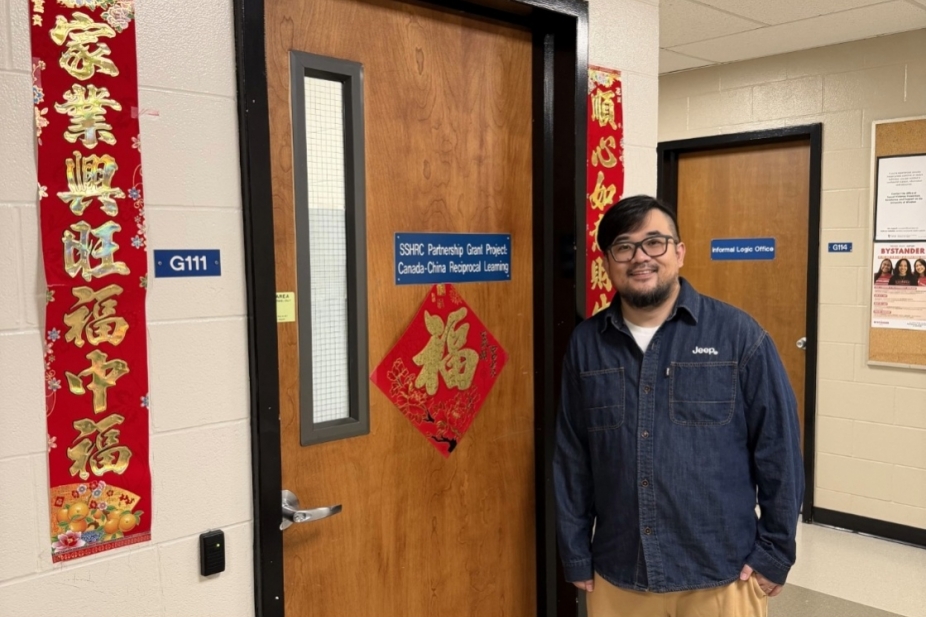
 Luyao Tan is part of the Reciprocal Learning Program, where he works as a research assistant for Dr. Shi Jing Xu. (Courtesy of Luyao Tan/University of Windsor)
By Vanessa Bumanlag
As artificial intelligence becomes increasingly common in classrooms, language teachers face new questions about their role in helping students learn.
For University of Windsor PhD student Luyao Tan, the rise of AI presents an opportunity to reconsider what teachers contribute beyond language instruction — particularly when it comes to cultural understanding and human connection.
"Teachers have an opportunity to rethink their roles and how AI can support students' learning," said Tan, who is currently developing his dissertation proposal examining how AI may influence language teachers' professional identities.
"It's changing the roles teachers have in the classroom. Teachers are no longer just linguistic educators. We are intercultural communicators."
Tan's interest in the relationship between language and culture draws on his experiences studying and teaching in China, the United States and Canada. His research focuses on how teachers understand their professional roles and communicate with students across cultural backgrounds.
A former English as a Foreign Language (EFL) instructor in China, Tan said his experiences in the classroom prompted him to reconsider what makes an effective language teacher.
While AI can assist with tasks such as grammar correction and language practice, Tan believes teachers have an important role in helping students understand the cultural context and meaning behind communication.
"We need to adapt to things that AI cannot do. I want to help language teachers to reconsider what they need to be in a world where AI is changing how we teach," he said.
Rather than viewing AI solely as a challenge, Tan encourages language teachers to consider how the technology could support their instruction while allowing them to place greater emphasis on cultural understanding and meaningful communication.
"Language teachers need to become a bridge to connect different groups of people that have the ability to use different languages," he said.
Tan believes the conversation about AI in education should extend beyond how students use the technology to consider how teachers' responsibilities are changing. He also sees opportunities for educational institutions to support approaches that draw on teachers' cultural knowledge and experiences.
"Teachers need some cultural competence training to teach how to interpret meanings from different cultures and communities," he said.
Through his doctoral research, Tan hopes to better understand how language teachers perceive their professional identities as AI becomes more common in education, and how those perceptions influence their approaches to teaching.
"This will help teachers to focus beyond their linguistic knowledge to help adapt to their changing environment," he said.
Having successfully completed his portfolio defence, Tan is preparing for the next stage of his doctoral research. Tan plans to begin with a survey of English language teachers and use the results to guide follow-up interviews.
He hopes the two phases will help him better understand how teachers see their professional identities and responsibilities as they teach across cultures and navigate the growing use of AI.
Tan also draws on his experience teaching English as a Second Language (ESL) in the United States, giving him firsthand insight into the challenges language educators face.
"I can understand the pressures and challenges teachers are facing. I am doing what I can to help teachers navigate what they need to do in this changing environment," he said.
As AI continues to reshape education, Tan hopes his research will contribute to a better understanding of how teachers can adapt while preserving the human connections central to language learning.
For him, the question is not simply what AI can do in the classroom, but what teachers can offer that technology alone may not provide.