
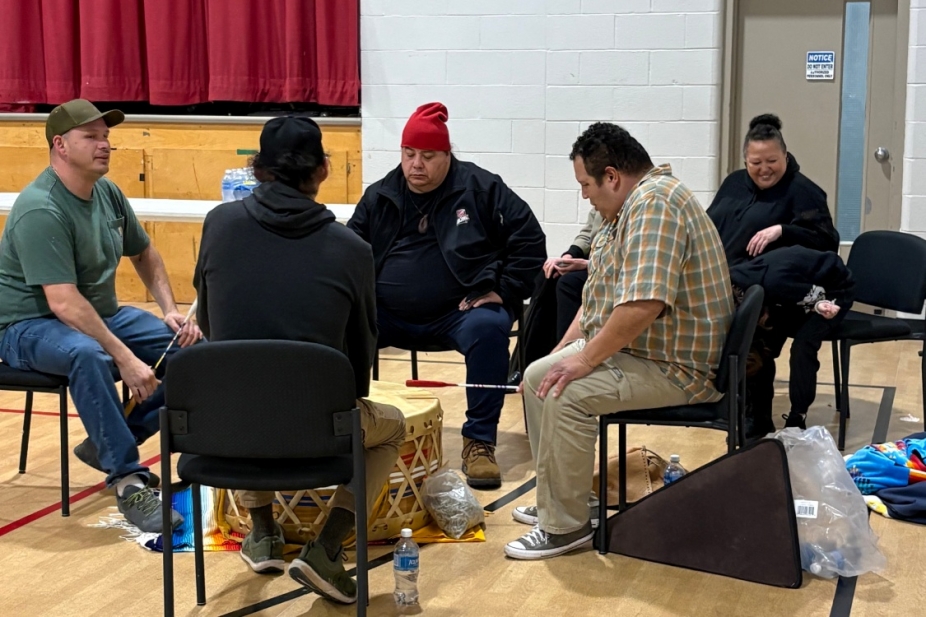
 Members of the Aamjiwnaang First Nation community gather around a traditional drum, opening and closing the students' visit with ceremonial songs that honoured culture and connection. (SUBMITTED BY GEMMA SMYTH/University of Windsor)
By Sara Meikle
For first-year law students at the University of Windsor, learning about access to justice often begins in the classroom.
But on March 20, that learning extended beyond campus, onto the lands of Aamjiwnaang First Nation.
Supported by UWindsor’s Article U: Diversity, Indigeneity, and Anti-Racism Professional Development Fund and Windsor Law, students in the Access to Justice course travelled to the community near Sarnia for a day of land-based, experiential learning centred on environmental and treaty rights.
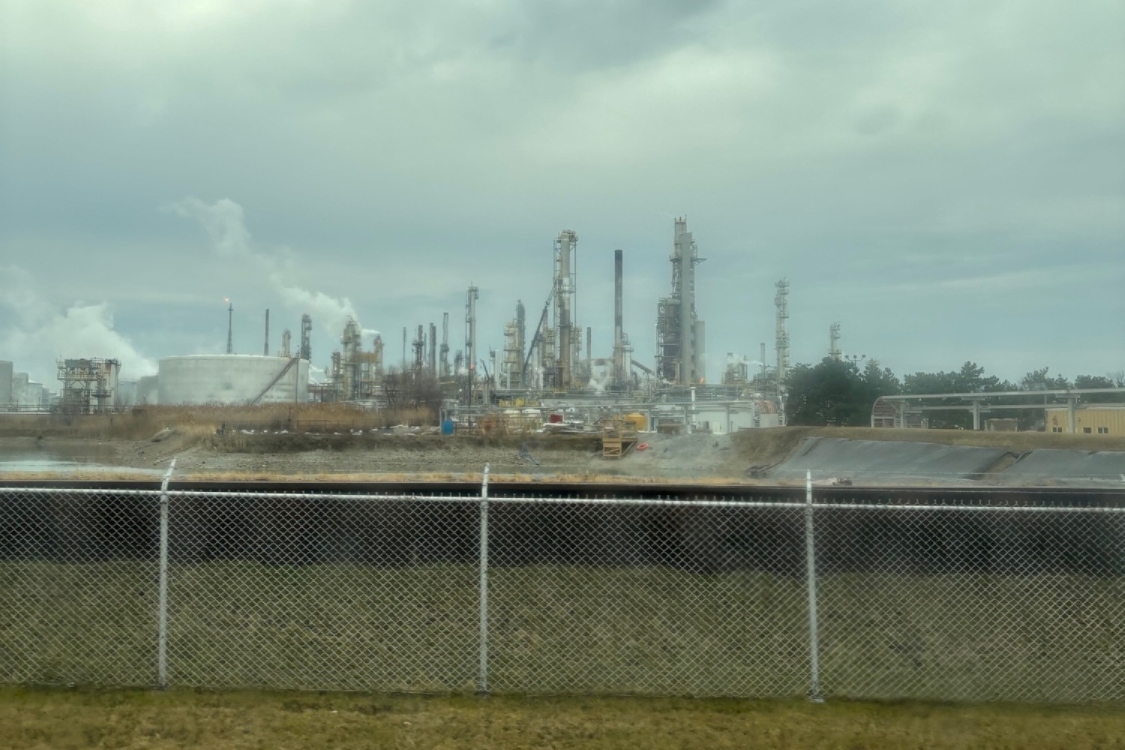
Organized by Windsor Law professors Gemma Smyth and Danardo Jones and hosted by Matt Stone, Legal Aid Indigenous services lawyer and Aamjiwnaang member, the visit included a guided “toxic tour” of the surrounding industrial area — often referred to as “Chemical Valley” — alongside panels with legal experts and community advocates. The day included a sacred fire ceremony and opened and closed with traditional songs, grounding the experience in community and culture.
Crystal George (LLB ‘05), a Windsor Law alumna and member of Aamjiwnaang First Nation, accompanied the group.
“This type of land-based experiential learning provides students with a direct, lived experience that will hopefully challenge their preconceived ideas,” said George.
“Students were exposed to urgent access to justice issues facing Indigenous peoples in this area. These experiences can broaden law students' knowledge and their career aspirations.”
For many students, the impact was immediate.
Lilly Blevins, a first-year law student, described the final stretch of the bus ride into the community as “dystopian,” surrounded by industrial plants and emissions encroaching on residential land.
“It was unsettling to be in the vicinity of all those plants," she said. “Realizing that people live within that sea of industrial plants and emissions and that this is their everyday reality made it even more shocking.”
During the tour, students stopped near the site of a recent oil spill along the St. Clair River. Just metres away stood homes within the community.
“The company said the spill was contained, but they were still actively digging and investigating. It showed a lack of transparency and how dangerous the situation really is,” Blevins said.
Speakers throughout the day, including lawyers, advocates and community leaders, unpacked the complex legal landscape surrounding environmental regulation, jurisdiction and Indigenous rights.
Students heard how regulatory systems often assess industrial emissions individually rather than cumulatively, despite the concentration of facilities operating simultaneously in the area. They also explored jurisdictional challenges stemming from overlapping federal, provincial and municipal authority and the lasting impacts of land dispossession.
For first-year law student, Brandon Amaya, the experience reshaped his understanding of environmental justice.
“To see how companies have devastated the land in the name of profit was disheartening. The people are unable to live peacefully on their homeland,” he said.
A moment during the tour particularly stood out for him — the strong scent of benzene and the burning throat sensation it caused among the group.
“I am grateful for the opportunity to go on the trip,” Amaya said. “It reminded me that becoming a lawyer involves ensuring access to justice for all, even if it involves challenging our current capitalist system.”
The visit highlighted the limits of existing legal frameworks. Environmental law experts explained that it can be difficult to use Charter rights in climate-related cases, and that there are still gaps in enforcement and accountability.
For Smyth, these moments are central to legal education.
“Opportunities like this allow students to engage directly with the lived realities behind the legal issues we study,” she said. “It deepens their understanding of what access to justice truly means and what it requires from them as future lawyers.”
Beyond the legal insights, the experience underscored the importance of listening, relationship-building and community-informed advocacy.
For students, it was a powerful reminder that the law is not abstract, it is lived and deeply connected to people and places.
At Windsor Law, experiential learning opportunities are designed to challenge perspectives and prepare students to navigate complex, real-world issues. In doing so, they help shape not only legal knowledge, but also the kind of thoughtful, principled lawyers students will become in their future practice.