
 Education, nursing and social work students spent three weeks on the annual Teach Tanzania service-learning trip (CLINTON BECKFORD/University of WIndsor)
By Kate Hargreaves
When recent nursing graduate Eunice Kungu travelled to Tanzania as part of the University of Windsor’s 2026 Teach Tanzania trip, it was for the second time.
Kungu, who is originally from Kenya, first participated in the 2025 trip when she was a third-year nursing student. When the opportunity arose to return in 2026, she knew she wanted to go back.
“What motivated me to return was the connection we built with the community and seeing the positive impact that comes from being part of this initiative,” Kungu says.
“When I first visited last year, it genuinely felt like coming home. The people were incredibly welcoming, and I felt a strong sense of belonging. Returning this year truly felt like going back home, while also giving me another opportunity to give back to a region that is very close to my heart.”
Each spring, Dr. Clinton Beckford, professor of education and vice-president, people, equity and inclusion, facilitates the Teach Tanzania trip as part of a service-learning course in the Faculty of Education.
Students join Beckford for a three-week trip to Tanzania, where they work with local educators, healthcare workers and community members, building their practical skills alongside Tanzanian professionals.
During their first trip to Tanzania, Kungu and fellow nursing graduate Grace Okello received training from a local physician on a lifesaving device designed to reduce maternal mortality. This year, they collaborated with that physician to provide the same training to staff at a local hospital.
“It was really rewarding to go from being learners to becoming educators,” Kungu says. “Seeing how partnerships can support local health-care professionals and ultimately improve patient care reminded me just how meaningful collaborative global health initiatives can be."
Okello, who is also originally from Kenya, says the trip gave her the opportunity to reconnect with East Africa after moving to Canada in 2015 while combining her passion for nursing, community service and global health.
In Tanzania, she helped administer polio vaccines and educate families about childhood vaccinations, walking from home to home to answer questions and debunk misconceptions.
“Knowing that these conversations could help prevent disease and protect children in the future made the experience unforgettable,” says Okello.
As she enters her nursing career in the step-down intensive care unit (ICU) at Corewell Health in Detroit, Okello says she will bring lessons learned in Tanzania with her.
“The trip strengthened my communication skills, cultural awareness and confidence in providing health education to diverse populations,” she says.
“It reminded me that nursing is not only about treating illness but also about empowering individuals with knowledge so they can make informed decisions about their health."
This year’s Teach Tanzania trip included not only nursing and education students, but also future social workers for the first time. In the lead-up to their departure, the group ran fundraisers to bring in money and supplies for the communities they visited, departing in April with many hockey bags full of school supplies and hygiene products in tow.
Despite all the preparation, recent education graduate Abbey Philbin says it wasn’t until they arrived that she realized the true impact of the trip.
“It is not until you are at Bright Future School in Moshi, playing outside with the students, or in Singida at Pastor John’s church, singing with the community, that you truly understand how special this trip is,” she says.
Despite some initial nerves, the students were warmly welcomed into the communities they visited.
“The first day, I did not know how the students would react to strangers entering their school,” recalls second-year education student Josephine Pirrone.
“As soon as we arrived, the students ran up to us to hug us and talk to us. They were so welcoming that it brought tears to my eyes.”
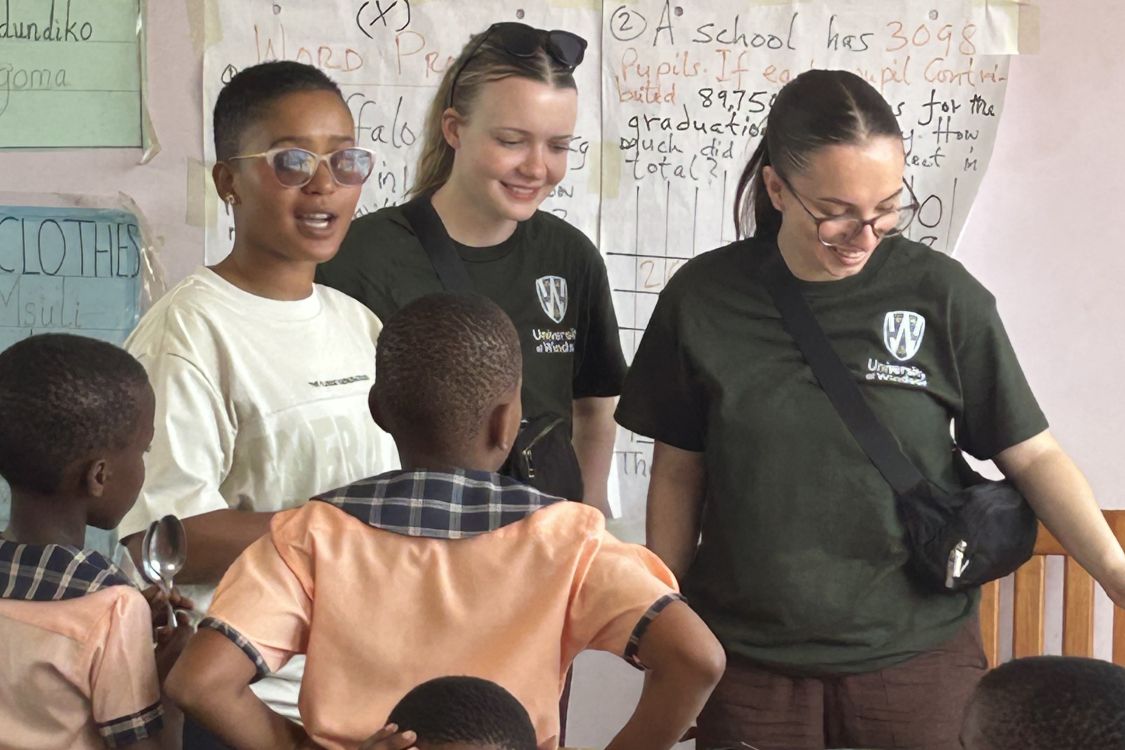
Beckford says that he appreciated how the students embraced the local cultures of the communities they visited.
“I was particularly impressed with the respect and compassion with which they treated everyone we met and worked with,” he says.
“Their passion for working with these vulnerable populations was impactful.”
One of the initiatives students helped run was the Girls Leadership and Empowerment Program. First-year education student Emilia Cuerrier led girls through yoga and breathwork as part of the programming.
“It was fun teaching them the poses and hearing them laugh as they would fall over or play around with it,” she says.
“As the girls got more confident, we would get into some flows, hold hands, speak affirmations out loud and do group breathing. I found that those moments were when I got the chance to deeply connect and come together with the girls.”
The education students also learned from the Tanzanian teachers about their practices.
“We had the opportunity to split into different classrooms to observe how the students learn and help with anything the teacher might need,” says Pirrone.
“Through this experience, I saw how much love each teacher has for their students. All lessons were very hands-on and interactive. Teachers would go outside to play soccer or dance with the students rather than taking that time to rest, which shows how important it is to them to make their students feel seen and cared for.”
The lessons that UWindsor students learned during their time in Tanzania will stay with them as they begin their future careers.
“They have a saying in Tanzania ‘pole, pole’ which translates to ‘slowly, slowly’ in English,” says Amanda Stockwell, a recent concurrent education and ECE graduate.
“Something I learned from those in Tanzania is to use ‘pole, pole’ in everyday life, which means to have patience and live in the present rather than in the future.”
Stockwell also emphasized the way the trip made her reconsider the material resources she may take for granted in her classroom back home.
For Cuerrier, the trip reinforced the importance of creating safe spaces for students.
“It inspires me to be the kind of teacher that is always approachable to my students and creates a classroom where everyone can feel safe,” she says.
Importantly, Teach Tanzania is not about arriving in the country with all the answers. Rather, as Kungu notes, “it's about listening, building relationships and working alongside local professionals who understand the needs of their communities best.”
“The experience reinforced the importance of humility, collaboration and mutual learning.”
Seeing the impact that the trip had on the students, Beckford says he is confident that the fields of education, nursing and social work are in good hands.
“They did a lot of great work that made a difference in the lives of the students, teachers and communities we engaged with,” he says.
"The students were tremendous ambassadors for the University of Windsor in how they carried themselves and the work that they did."