
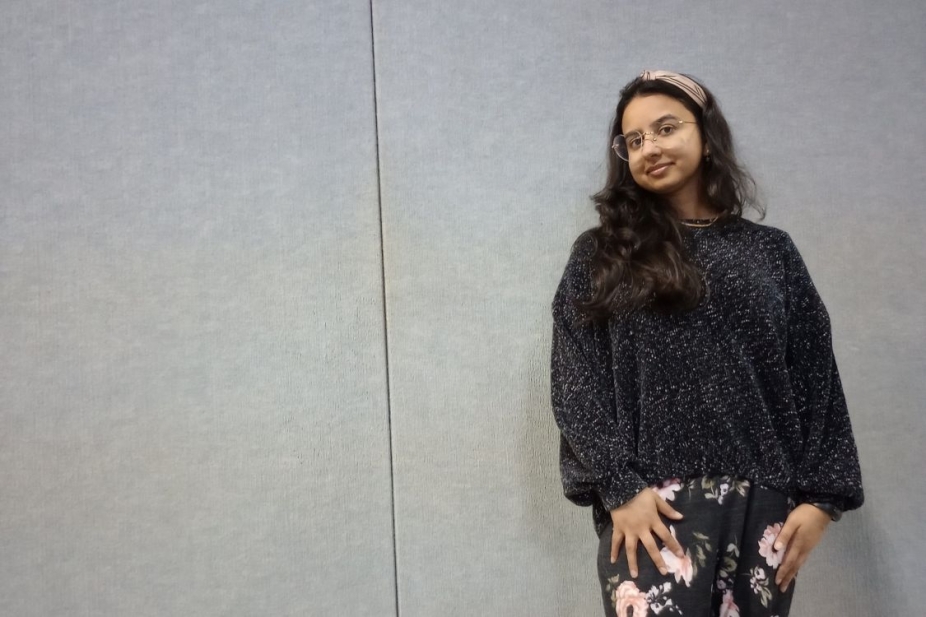
 PhD student and secondary English teacher Samita Sarkar is researching high school teachers' navigation of a changing AI landscape (PROVIDED BY S. SARKAR/University of Windsor)
By Kate Hargreaves
When Samita Sarkar was a new teacher, a lot was happening in the world. ChatGPT was going viral online — and so was a global pandemic.
As a secondary school English teacher, she found herself confronted with issues around artificial intelligence (AI) and student writing assessment with little to no policy guidance.
“We had to make high-stakes decisions around academic integrity, assessment and what counts as ‘student writing’ with no institutional guidance or administrative support,” she says.
Working with an assessment policy from 16 years ago that obviously did not address AI, Sarkar found herself and other teachers in her position having to improvise.
“That’s a vulnerable position to be in,” she says.
As a doctoral student in the University of Windsor Joint PhD in Education, Sarkar is now looking to address this policy vacuum, examining how high school English teachers are navigating AI in their classrooms and what they would like to see in emergent policies.
As a teacher-researcher, Sarkar’s first-hand knowledge of the way AI is impacting classrooms is crucial to her scholarly work.
“My position is that teacher knowledge is a valid and necessary form of evidence in policy research, especially in rapidly evolving contexts like this one,” she says.
This positionality is part of what drives Sarkar’s planned approach to her research, combining a bottom-up grounded theory method that draws on practitioner knowledge alongside her own autoethnographic insights.
“AI governance in secondary schools is emerging and under-theorized,”says Sarkar.
“I don’t want to impose a framework onto teachers’ realities. I want the theory to emerge from what teachers are actually doing and saying.”
So far, her exploration of the limited existing literature on the topic has brought several concerns to the forefront, which Sarkar hopes to explore further in her eventual interviews with other teachers.
“Without clear policy, every teacher becomes their own policy-maker,” she explains. “One teacher might allow transparent AI use for brainstorming; another might treat any AI involvement as plagiarism. Students receive widely different messages about what’s acceptable, which creates equity issues.”
Operating without clear policies also makes teachers professionally vulnerable.
“If a parent contests a grade or an academic integrity decision, the teacher has no policy to point to,” says Sarkar.
She also points to issues of moral injury in which teachers may feel pressured to change their own stances on academic integrity in efforts to keep up with the changing field of AI.
As a freelance writer for over a decade before becoming a teacher — holding a BA in professional writing from York University — this is an issue that troubles Sarkar.
“I think about the artfulness involved in concepts such as authorship, voice and originality,” she says. “AI complicates all of that as well as our very understanding of the concept of literacy.”
With all these complexities, Sarkar notes that unsupported labour disproportionately falls on women teachers.
“Over three quarters of Ontario teachers are women, and policy vacuums get filled by our labour,” she says.
“The emotional and cognitive work of navigating AI — discussing it with students, redesigning assessments around it — falls entirely on individual teachers.”
With teachers expected to lead the way on AI without support, the risk of further burnout is concerning to Sarkar, particularly for women in the field.
Sarkar hopes that her dissertation research can help provide some empirically grounded insight based in classroom realities to guide AI policy development at the secondary school level.
“Too much AI education research focuses on higher education or remains theoretical,” she says.
“Secondary schools are different, and teachers there need policy that reflects their specific context. I want to document what’s actually happening.”
She also hopes to contribute to discussions on critical literacy within the context of AI.
“What does it mean to read and write critically when a machine can generate texts?” she asks. “How do we teach students to interrogate AI outputs as political texts, not neutral information?”
Central to all of these questions is not just informing teacher education and professional learning in the K to 12 setting but grounding that research in teacher experience as both produced by and for teachers.
“Ultimately, I see this work as contributing to a vision of AI governance that is relational and practice-based — not top-down and punitive but nuanced, educative and grounded in teacher judgment,” Sarkar says.
While she remains concerned about students engaging uncritically with AI and the potential negative effects on student voice, teacher labour and equitable assessment, Sarkar recognizes AI as likely part of education going forward.
“AI is part of our 21st-century reality,” she says, “I am critical of AI, but I’m not anti-AI. I don’t think it is a bannable technology, and if critically examined, it can also be a legitimate part of literacy learning.”
Teacher Appreciation Week runs May 4 through May 8, 2026. For more information on teacher education programs or graduate programs in education, visit the Faculty of Education website.