
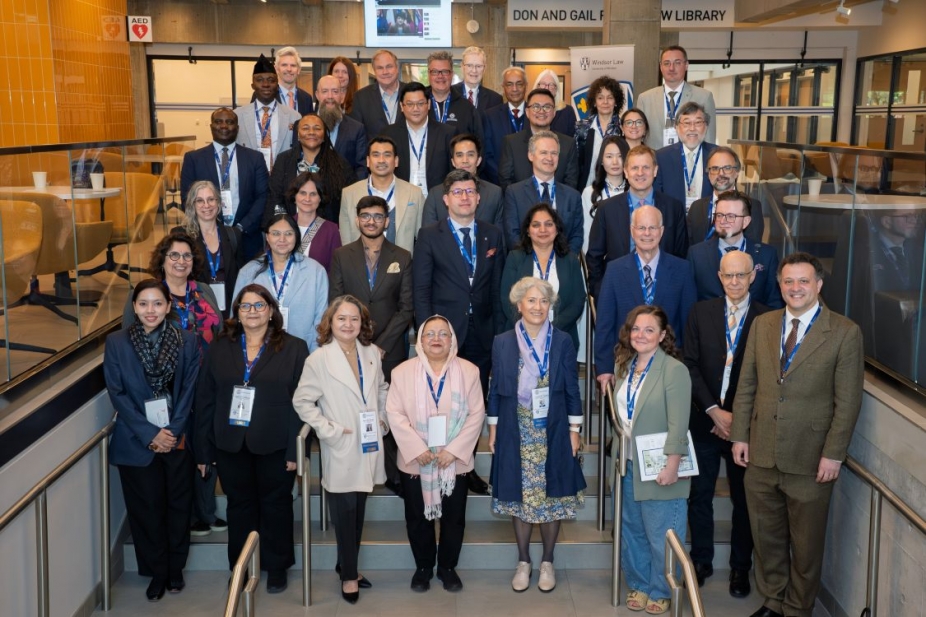
 Delegates from more than 35 law faculties across 18 countries gathered at Windsor Law’s Ron W. Ianni Faculty of Law Building on May 4 for the Global Law Deans Forum, hosted for the first time in Canada by the University of Windsor. (DAVE GAUTHIER/University of Windsor)
By Sara Meikle
For the first time in its history, the Global Law Deans Forum was held in Canada — with the University of Windsor at the centre of the international conversation on the future of legal education.
Hosted by Windsor Law on May 4, the Forum welcomed leaders from more than 35 law faculties across more than 18 countries, with most delegates attending in person and others joining virtually from around the world. Organized through the International Association of Law Schools (IALS), the gathering brought together legal educators to discuss some of the most pressing issues shaping the profession globally.
Founded to strengthen legal education worldwide, the IALS brings together law schools from different legal systems and traditions to collaborate on shared challenges and innovation in legal education.
Windsor Law Dean Reem Bahdi, who serves on the IALS board, helped position Windsor as the first Canadian law school to host the Forum through her leadership and international connections.
“There are many international legal conferences, but this Forum is different because it brings law school leaders together to talk about governance, teaching and the broader role law schools play in society,” Bahdi said. “There is a focus on preparing future legal professionals to respond to global challenges.”
The event celebrated the diversity of legal education around the world, bringing together institutions from public and private systems, as well as both common law and civil law traditions. Despite those differences, participants found common ground in the challenges facing legal education and the shared responsibility of law schools to respond collectively.
“It was very impactful because we realized that, despite operating in different contexts around the world, we’re facing many of the same issues,” Bahdi said. “There was a shared understanding that law schools have an important role to play in responding to those issues within our societies.”
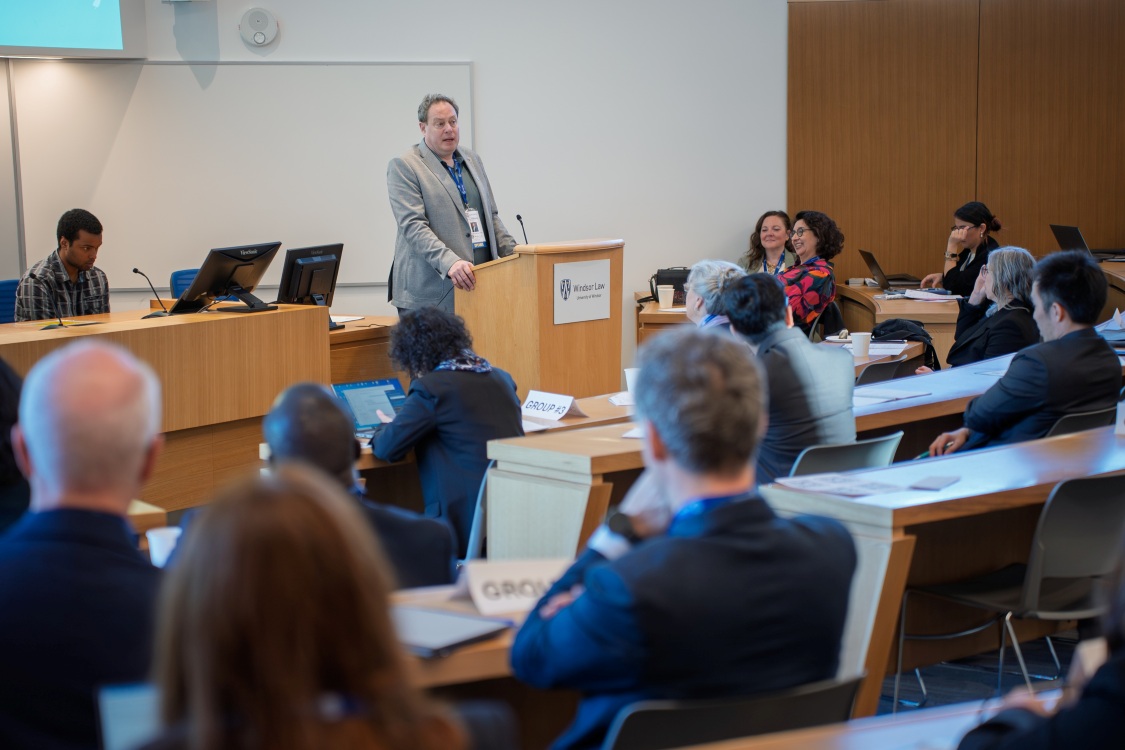
Among the key topics discussed were the future of the rule of law and the growing influence of artificial intelligence (AI). Delegates explored how law schools must prepare students not only to use emerging technologies, but also to understand the broader social, labour and environmental impacts.
“The question of the rule of law came up repeatedly,” Bahdi said. “What does it mean in a world where some people say we are seeing the law of power rather than the power of law? There was a lot of discussion about the responsibility law schools have in response.”
The gathering also created opportunities for participants to exchange ideas on curriculum and teaching innovation — conversations already shaping discussions at Windsor Law.
“We learned from one another,” Bahdi said. “There were so many creative approaches discussed, and we’re continuing conversations about how some of those ideas might shape our own curriculum and pedagogy moving forward.”
The event marked a significant moment for Windsor Law, raising the international profile of the law school, the University and the city. Delegates toured campus and enjoyed the waterfront views while building relationships and exploring future collaborations, including student exchanges, faculty exchanges and co-teaching opportunities.
“It really raised the stature of the University and of the city more broadly,” Bahdi said. “It opened the door to important conversations about future partnerships and collaboration. People were very impressed with the university and our facilities at the law school.”
Faculty and staff from across Windsor Law supported the event, including president J.J. McMurtry, who delivered a keynote address and spent time with delegates throughout the Forum, and Dr. Kristen Thomason, who presented on AI in legal education.
Alumni relations and outreach staff also participated, representing the breadth of Windsor Law’s community.
For Bahdi, the Forum underscored both the global nature of the legal landscape and the important role institutions like Windsor Law can play in shaping the future of legal education.
The Global Law Deans Forum is one of two annual gatherings organized by the IALS. The next meeting, which includes law deans and faculty members from around the world, is scheduled to take place in South Africa in September.