
 The École Polytechnique memorial event will take place Dec. 4 at 12:10pm at the Memorial of Hope between Dillon and Essex Halls (FILE/University of Windsor)
By Kate Hargreaves
On Dec. 6, 1989, Charlene Senn was procrastinating finishing her grad school homework when she saw a television news report about a shooting at École Polytechnique in Montreal.
A gunman had entered a mechanical engineering class, ordering the men to leave the room and opening fire on the women, killing 14: Geneviève Bergeron, Hélène Colgan, Nathalie Croteau, Barbara Daigneault, Anne-Marie Edward, Maud Haviernick, Maryse Laganière, Maryse Leclair, Anne-Marie Lemay, Sonia Pelletier, Michèle Richard, Annie St-Arneault, Annie Turcotte and Barbara Klucznik-Widajewicz.
Dr. Senn, who was already studying gender-based violence, says she felt sick for hours after seeing the news, not only because of the shooting itself but the fact that it was not being made clear that this was a specifically an attack on women driven by misogyny and anti-feminism.
Now a distinguished university professor in applied social psychology, Senn says that this need to name the disproportionate violence against women and girls, including trans women, as part of larger systems of patriarchy and misogyny continues almost 40 years later.
This is part of why the annual memorial for the victims of what is commonly known as the Montreal massacre remains so crucial.
Dec. 6, now the annual National Day of Remembrance and Action on Violence Against Women, is not only a day of mourning but a call to action to prevent and resist gender-based violence.
This year, the UWindsor memorial event will take place Thursday, Dec. 4 at 12:10 p.m., inviting campus community members to gather at the Memorial of Hope between Dillon and Essex halls.
The memorial sculpture, completed in 2004, is made up of 14 concrete pillars, each with a metal rose at its centre, representing the 14 women killed.
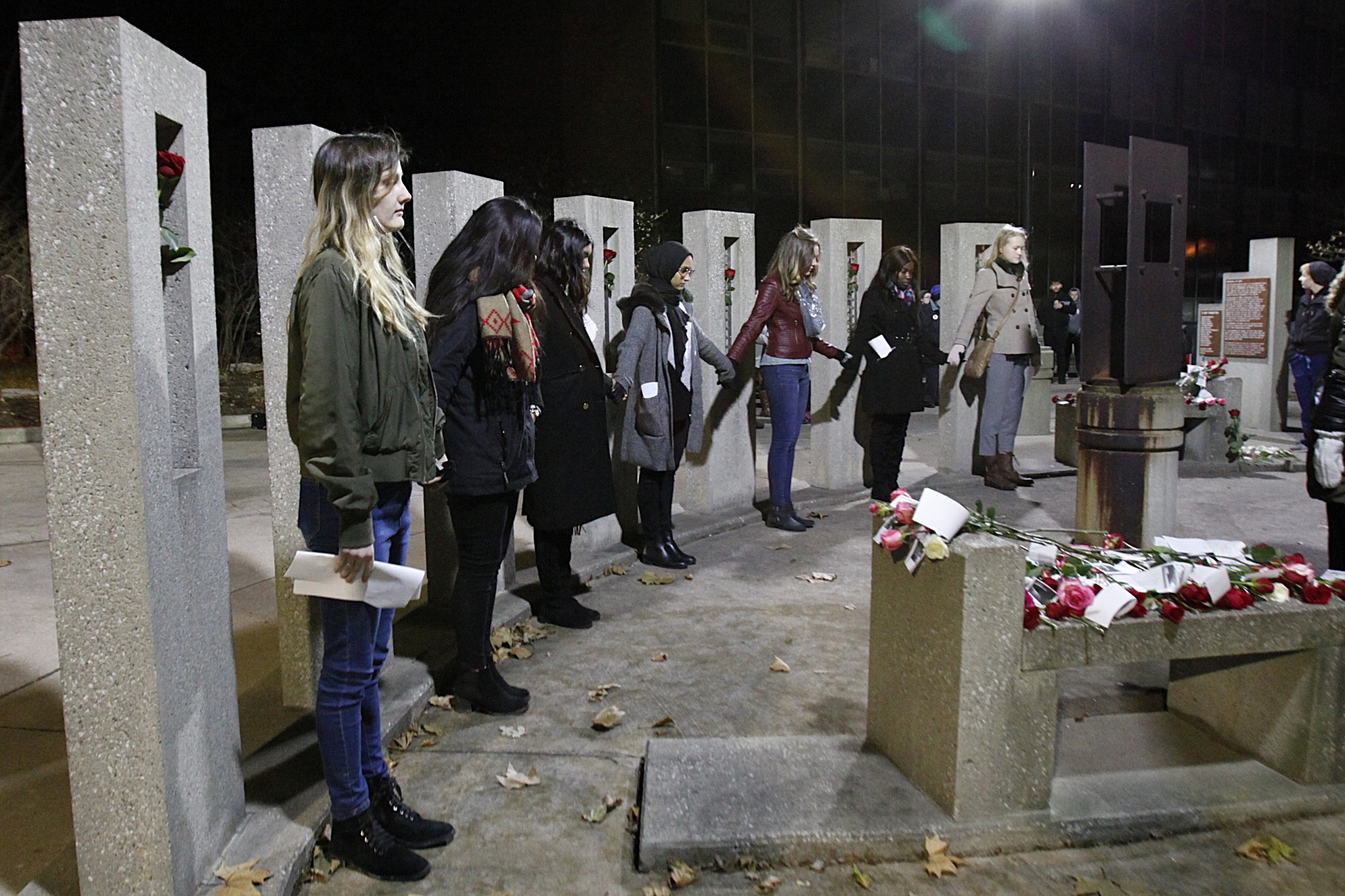
Students memorialize the women killed at École Polytechnique on Dec. 6, 1989 at the UWindsor Memorial of Hope (FILE/University of Windsor)
Organized by the UWSA Womxn’s Centre in partnership with Women in Engineering and Women in Law, the event will include a moment of reflection as well as speakers sharing about the lives of each of the victims.
Womxn’s Centre Coordinator and Bachelor of Education student Gracie Williamson says learning about their lives is crucial to reflecting on the loss and broader issues of gender-based violence.
“I’m 24, so a lot of these women were around my age and also in school,” she says.
“I resonate so much with these people who had hopes and dreams and were excited about being in school. These women were people.”
While Williamson was not yet born in 1989 when the École Polytechnique shooting occurred, she cites the importance of continuing the conversation about gender-based violence, particularly for younger generations.
“Especially now in the cultural climate with the rise of online misogyny and intimate partner violence, it feels more critical than ever to talk about,” she says.
“This doesn’t happen in a vacuum. We’re all part of this bigger system.”
Senn, who teaches a women’s and gender studies course about violence against women, has found that some of her students are indeed unfamiliar with the events of Dec. 6, 1989.
“For that monument to be on university campuses is critically important,” she says.
“It opens conversations, so when people are not sure what it is, they can ask about it, they can read the plaque. We have a place to go for these events, to actually stand there in that presence. The place matters, and the fact that it honours the women’s careers as engineers matters.”
Anne Rudzinski, manager of education and survivor support at the UWindsor Office of Sexual Violence Prevention, Resistance, and Support (PRS), echoes the ongoing importance of not only remembering but resisting gendered violence.
“Even though we've done all the activism, the rates of violence against women have not changed,” she explains.
While the mandate of the PRS office is campus sexual violence, Rudzinski notes the importance of seeing the connections between all types of gendered violence on campus and off, something Senn also points to, citing sexual harassment at work and school, street harassment, sexual assault, and intimate partner violence as all related and rooted in misogyny.
Rudzinski also draws a throughline between the violence on Dec. 6, 1989 and other anti-feminist attacks, such as the stabbing attack in a gender studies class at the University of Waterloo in 2023 as well as the van attack that killed 11 people in Toronto in 2018.
“We’re still seeing the same hatred, the same violence,” she says.
“It’s designed to make women feel scared. To make women feel scared going to university, to make professors feel scared to teach content about feminism and gender. It’s important to name that.”
She also cites the 2020 mass shooting in Nova Scotia that began as an incident of intimate partner violence and killed 22 people as well as a femicide earlier this month in Windsor.
“It’s important to name the violence,” explains Rudzinski. “Using the language of femicide, or the language or intimate partner violence instead of just saying homicide or murder.”
In addition to the importance of naming the intimate partner violence epidemic, Rudzinski emphasizes the need to adequately resource and support organizations resisting this violence and assisting survivors.
Many such organizations will be present on campus for the 16 Days of Activism Against Gender-Based Violence Information Fair, which will take place at the CAW Student Centre on Tuesday, Nov. 25 from 10 a.m. to 2 p.m.
The fair will feature organizations including the Sexual Assault Crisis Centre, Windsor Women Working with Immigrant Women, the Welcome Centre, Pozitive Pathways, YMCA, Trans Wellness Ontario, Hiatus House and more.
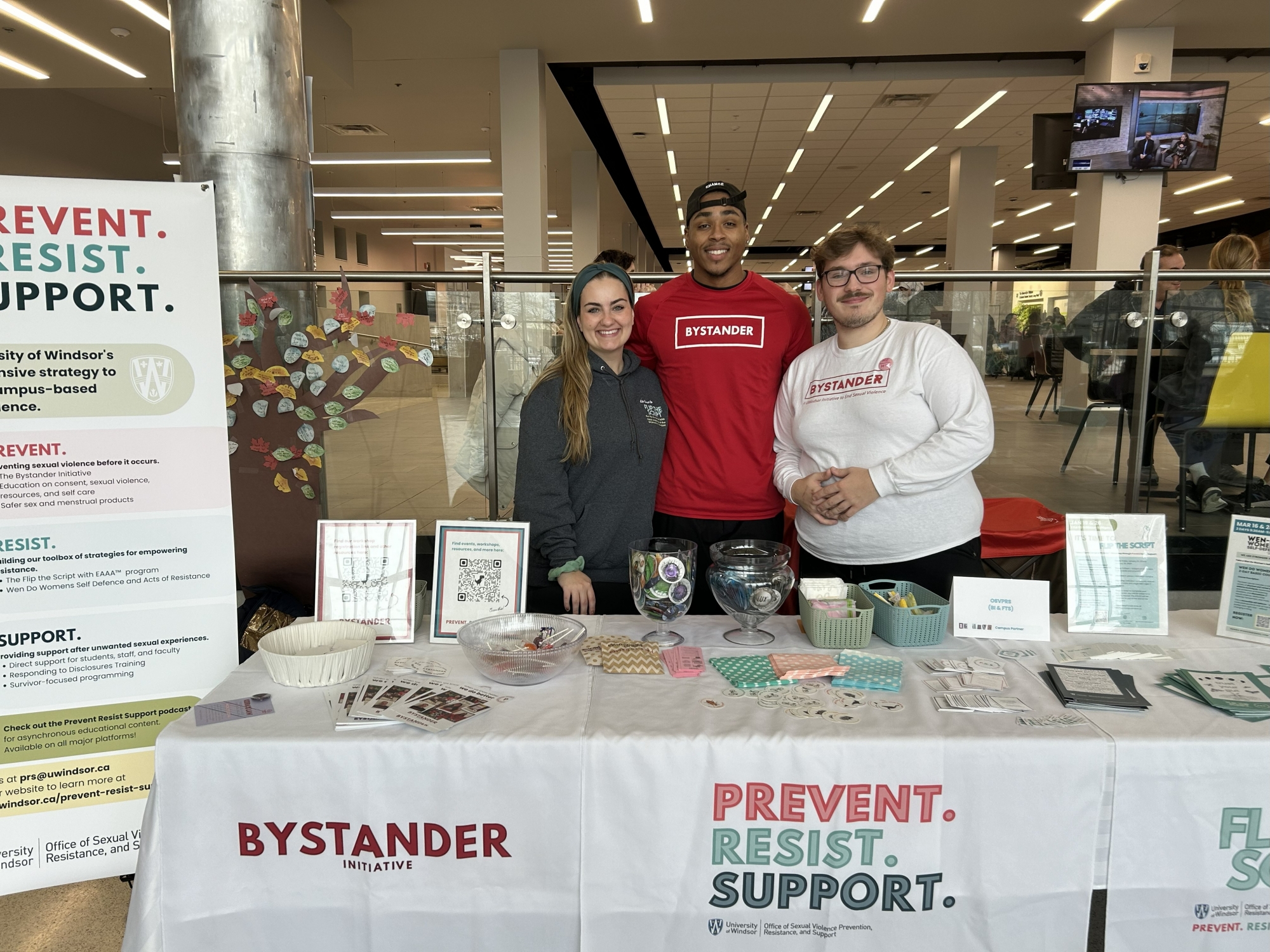
The UWindsor Bystander Initiative and Office of Sexual Violence Prevention, Resistance, and Support will be amongst those organizations at the 16 Days Fair, Nov. 5 (photo courtesy of the Office of Sexual Violence Prevention, Resistance, and Support)
Nov. 25 marks the beginning of the 16 days with the United Nations International Day for the Elimination of Violence Against Women and ends Dec. 10 with International Human Rights Day.
On campus, the I Am Sahra Bulle conference takes place Wednesday, Nov. 26 in remembrance of Sahra Bulle, a UWindsor student who was killed by an ex-partner in 2023.
Following the conference, on Thursday, Nov. 27, a Scrap & Yap crafting event is scheduled at 4 p.m. in Dillon Hall, Rm. 115, organized in partnership between the Womxn’s Centre and PRS.
“The goal for that event is to offer a self-care space as we’re spending 16 days focusing heavily on a really complex and emotionally charged topic,” says Rudzinski.
For those looking to learn more about Dec. 6, Rudzinski recommends the PRS podcast episode on the topic, featuring writer and activist Julie Lalonde.
For those experiencing gender-based violence, there is help available. A list of support services is accessible through the Violence Against Women Coordinating Committee of Windsor-Essex.