
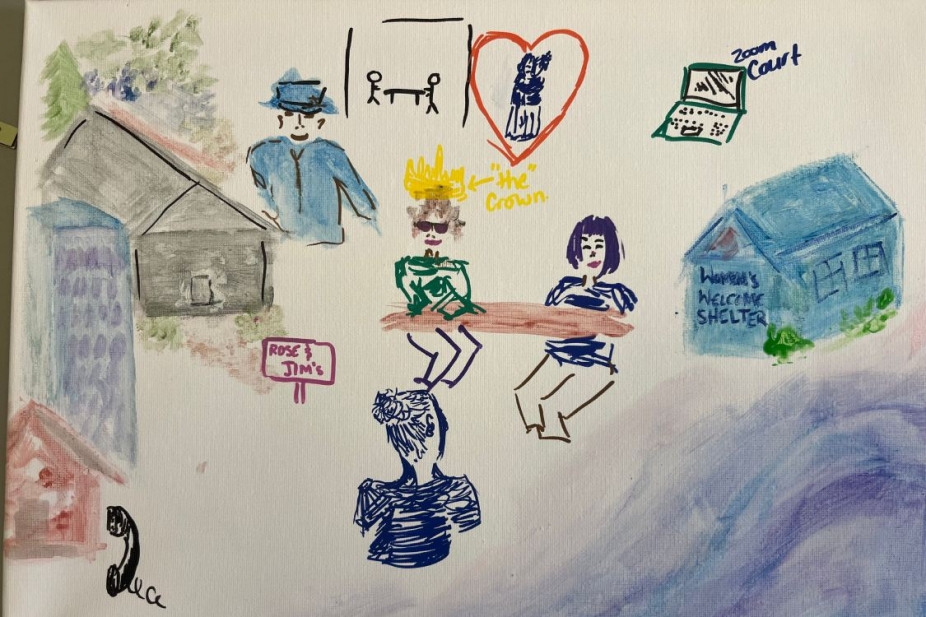
 A participant-created artwork from the study visually maps the complex help-seeking journey women often navigate after leaving a violent intimate partner. (SUBMITTED BY RACHEL ELLIOTT/University of Windsor)
By Sara Meikle
For many women leaving a violent intimate partner, the journey to safety continues long after the relationship ends.
Rebuilding health, stability and quality of life often means navigating healthcare, housing, social services and community supports — a complex process researchers at the University of Windsor are exploring through an innovative arts-based study.
As May marks Domestic and Family Violence Prevention Month, the project examines the help-seeking journeys of women who have physically separated from violent intimate partners.
Led by Dr. Rachel Elliott from the Faculty of Nursing and Dr. Kendall Soucie from the Department of Psychology, the interdisciplinary project explores how women navigate formal and informal supports after physically separating from abusive partners.
The project also includes contributions from Marissa Rakus, a doctoral candidate in the Department of Psychology and research coordinator on the study, as well as undergraduate students from the Outstanding Scholars program, Ayah Khanafer, Tess Ogunjinmi and Kylie Pazner.
Supported through WE-SPARK Health Institute with an IDEA research grant, the study uses visual art to map survivors’ experiences seeking help across healthcare, housing, community and social support systems.
“Help-seeking after intimate partner violence is not a linear journey,” said Elliott. “Women are often navigating multiple systems at once while rebuilding their health and quality of life. Through this project, we’re trying to better understand those experiences and identify ways systems can respond more compassionately and effectively.”
Participants create visual maps of their experiences using art supplies such as markers, paint, stickers and paper. The artistic process is paired with interviews that allow women to explain the meaning behind their art and reflect on barriers, supports and hopes for care moving forward.
The arts-based methodology was intentionally chosen to create a more trauma-informed and participant-centred research environment to help women tell their stories.
“For many participants, it was a cathartic exercise that allowed them to communicate experiences that may have been difficult to express through words alone,” Soucie said. “The artwork added texture, depth and insight that traditional interviews may not have captured.”
Researchers say the visual storytelling also revealed the emotional weight of navigating fragmented systems of care. Some artwork depicted women feeling trapped or invisible within institutions, while others illustrated resilience, hope and the importance of trusted informal supports such as friends and family.
Rakus, whose research focuses on gender-based violence and women’s interactions with formal support systems, helped recruit participants through a partnership with the local Welcome Centre Shelter for Women and Families.
Working closely with peer support workers at the shelter — women with lived experience navigating homelessness, substance use and intimate partner violence — helped create an environment where participants felt comfortable sharing their experiences.
Even with those supports in place, recruitment took nearly three months to secure a relatively small number of participants, a reality that reflects the instability and complexity many women experience after leaving violent relationships.
“When people are in survival mode, it can be incredibly difficult to set up a time and place to participate in research,” Rakus said. “People are trying to meet their immediate needs. Even the recruitment process itself reflected the realities of women’s help-seeking journeys.”
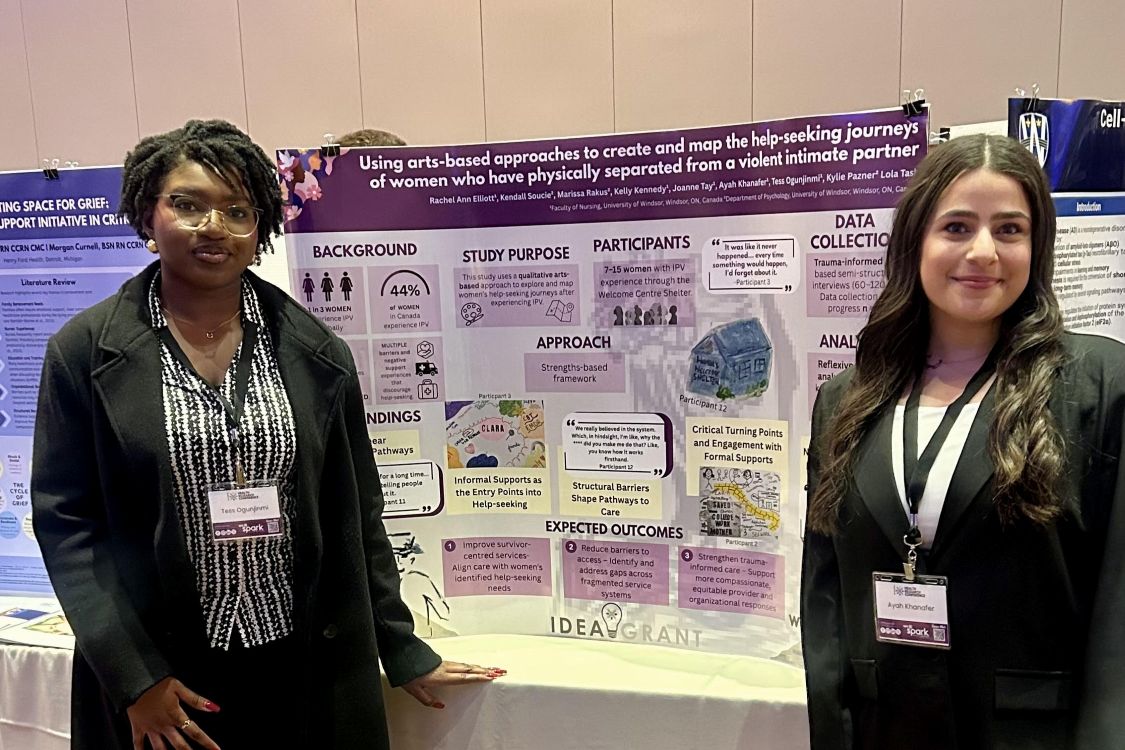
The project has also created valuable experiential learning opportunities for students through the Outstanding Scholars program. Khanafer, who assisted with transcription and analysis, noted the experience provided important insight into the realities women face when seeking care and support.
“We saw patterns of financial barriers and risks for re-traumatization. One of the main things we mentioned in our poster presentations is the need for non-judgmental and non-traumatic approaches to formal care,” Khanafer said.
Khanafer and Ogunjinmi recently presented preliminary findings at the WE-SPARK Health Conference in March, where their research poster earned an award. The poster incorporated visual elements created by study participants.
Researchers hope the project will eventually inform policy, improve trauma-informed practices across sectors and strengthen long-term survivor support. Plans are also underway to publicly showcase the artwork in a future gallery exhibition, creating opportunities for broader community dialogue and education around intimate partner violence and recovery.
“This work is about making invisible experiences visible,” said Elliott. “The women who participated showed tremendous strength and courage, and we hope their stories will help improve systems of care in the future.”
The project highlights the impactful, community-engaged research taking place at the University of Windsor — research that not only advances academic knowledge but also responds directly to urgent social issues affecting individuals, families and communities.