
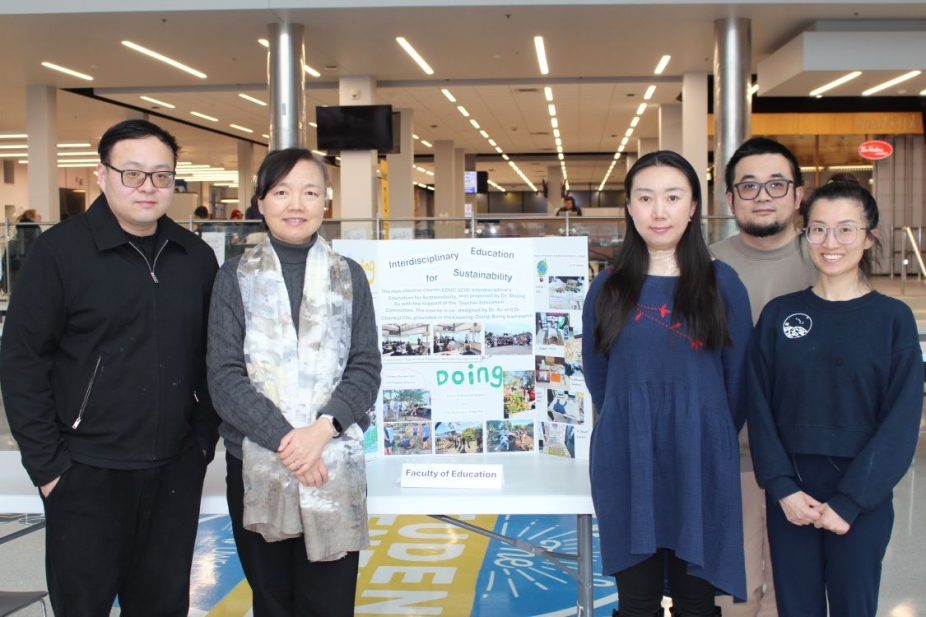
 Dr. Chenkai Chi (far left) is the instructor for the service-learning course Interdisciplinary Education for Sustainability, designed by Dr. Shijing Xu (second from left) (ANGELA KHARBOUTLI/University of Windsor)
By Kate Hargreaves
Elementary and secondary teachers play a critical role in building student skills in responsible environmental citizenship.
That’s why, when the Faculty of Education recently revised its B.Ed. course offerings, it was only logical that one of the new electives focus on environmental sustainability.
Drawing from a long program of international and intercultural research—including a focus on Canada-China reciprocal learning—professor and associate dean of teacher education Dr. Shijing Xu developed the new pre-service teacher education course Interdisciplinary Education for Sustainability.
This course integrates diverse ways of knowing and being in addressing UNESCO’s (2005, 2016) calls for the integration of sustainability education in initial teacher education.
“Education could no longer be framed only around conventional pedagogical concerns but had to respond more directly to the complex crises shaping human life in the contemporary world,” says Xu.
“It could no longer remain narrowly disciplinary or disconnected from broader social and ecological conditions.”
Drawing on her participation in a 2018 parliamentary gathering in Toronto, which featured Indigenous speakers and other climate experts, in addition to UNESCO’s emphasis on future-oriented sustainability and relationality-focused education, Xu was motivated to develop a course that pushed teacher candidates to engage with the environment locally and globally.
“The course represents the pedagogical crystallization of more than a decade of international intercultural reciprocal learning research and practice,” she says.
“It draws heavily on accumulated experience in school-based inquiry, teacher education, interdisciplinary collaboration, and global sustainability thinking.”
These priorities also align with the University of Windsor’s Aspire strategic goals around sustainability, global and local impact, equity and teaching and learning.
Dr. Chenkai Chi, a recent graduate of the Joint PhD in Educational Studies as well as instructor for Education for Sustainability, explains that teacher candidates across subject areas learn how to integrate sustainability into their disciplines, engaging in real-life problem-solving around climate change and social-environmental challenges.
“The course provides teacher candidates with opportunities to learn about the deeper meaning of sustainability from Indigenous perspectives in Canada as well as Eastern wisdom traditions that emphasize harmonious relationships of the humans, nature and society,” says Chi.
“They learn ways of interweaving diverse cultural knowledges holistically and creatively through their chosen interdisciplinary projects that promote education for sustainability in a culturally responsive manner for K-12 students.”
Chi recently attended the 3rd annual University of Windsor Sustainability and EDID Month Fair on behalf of the Faculty of Education, demonstrating the Faculty’s commitment to advancing sustainability through education.
As part of the interdisciplinary focus of the course, students have visited Dr. Trevor Pitcher’s Freshwater Restoration Ecology Centre, toured the Campus Community Garden with Jenna O’Brien and learned from guest speakers from the local educational community as well as universities around the world on how sustainability can be incorporated into the classroom.
Dr. Zhichang (Marc) Xu, associate professor at Monash University, Australia, delivered a guest lecture entitled "Indigenizing Knowledge of ‘Land’ and ‘Seasons’: A Cultural Linguistics Perspective."
Throughout the course, students have also explored multiple ways of being and knowing, including environmental stewardship practices from Walpole Island First Nation, Eastern ecophilosophies from Daoist and Buddhist traditions and relational frameworks across continents.
“The ‘Being’ component explicitly invites teacher candidates to question dominant Eurocentric assumptions embedded in educational and environmental discourse,” says Chi.
So far, the response from teacher candidates has been positive, with students citing the course as a strong influence on the kind of teachers they wish to become.
“As a future teacher, I want to design learning experiences that are interdisciplinary, hands-on and culturally responsive, helping students recognize how their choices and relationships shape a more sustainable world,” says one teacher candidate.
“This course has definitely motivated me to enhance student learning and engage students in showing respect for their environment by being more conscious of their waste and consumption,” says another.
For more information on teacher education programs, visit the Faculty of Education website.