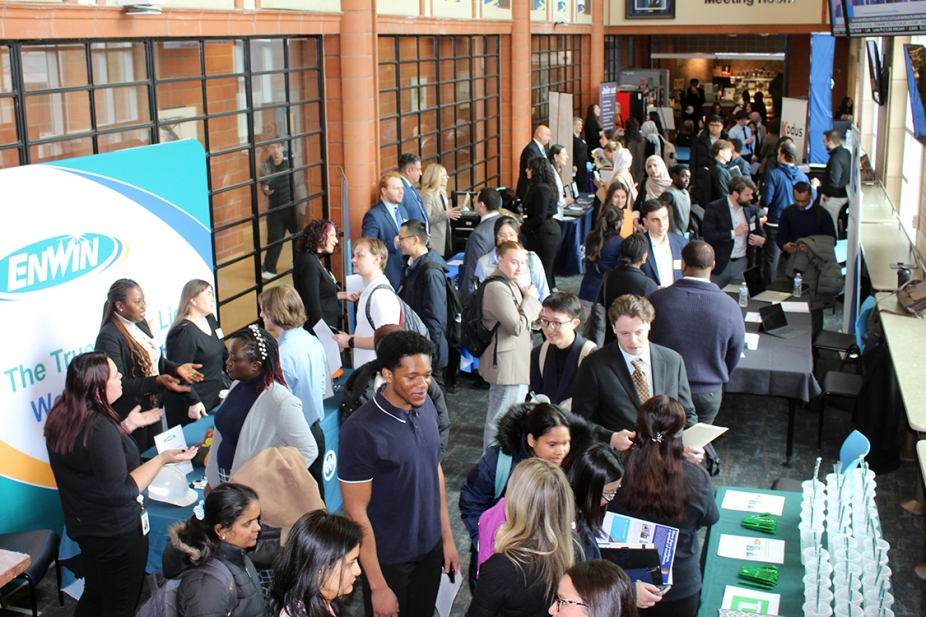
 The Odette Job Fair held on March 4, 2026, brought students and industry leaders together, sparking conversations that could shape tomorrow’s success stories. (ANGELA KHARBOUTLI/University of Windsor)
By Victor Romao
More than 200 business students met face-to-face with employers at the 2026 Odette Job Fair on March 4, connecting with hiring organizations across finance, insurance, municipal government, healthcare and gaming.
Hosted by the Odette Student Success Centre, the fair featured 15 employers representing a wide range of industries. This year’s fair recorded 365 student registrations, with 213 attending — a 22.9 per cent increase in registrations over last year.
— Published on Mar 13th, 2026
 A new report by UWindsor Human Kinetics researchers explores the risks of AI in maritime defence (CANADIAN MARITIME SECURITY NETWORK; CANVA STOCK/University of Windsor)
By Lori Bona
From navigation to monitoring ocean traffic, artificial intelligence (AI) is playing an increasing role in ships and maritime operations — including those used by the Canadian Armed Forces.
But relying too heavily on AI in maritime vessels introduces new risks for human operators and defence systems, according to a new report from researchers at the University of Windsor.
— Published on Mar 11th, 2026
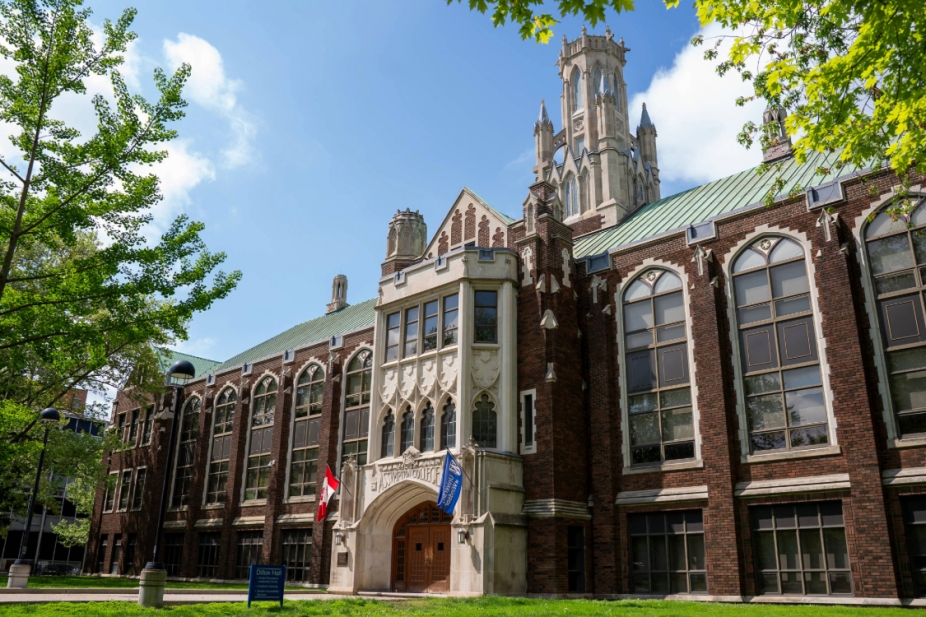 Douglass Victor Janoff will be giving a talk at Dillon Hall at the University of Windsor on Thursday, March 12, 2026. (DAVE GAUTHIER/ The University of Windsor)
At the United Nations, efforts to combat homophobic and transphobic discrimination have triggered clashes with states that challenge LGBT rights as a “legitimate” human right.
Canadian diplomat Dr. Douglas Victor Janoff examines these tensions and the reasons behind them in his book Queer Diplomacy: Homophobia, International Relations and LGBT Human Rights, which he will discuss at a talk at the University of Windsor on Thursday March 12.
— Published on Mar 11th, 2026
 The Journal of Critical Race, Indigeneity, and Decolonization (JCRID) has published another issue, this one highlighting decolonization and marginalized voices. (JCRID/ The University of Windsor)
By Lindsay Charlton
Which perspectives in academic publishing are amplified — and which are overlooked?
In its latest issue, the Journal of Critical Race, Indigeneity, and Decolonization (JCRID) highlights decolonization and marginalized voices while advancing what the editors call “knowledge globalization.”
“We tried to spread the geographic tentacles of this edition,” said chief editor Dr. Festus Moasun, a professor in the School of Social Work. “We included articles from Africa, South Asia, as well as North America.”
— Published on Mar 10th, 2026
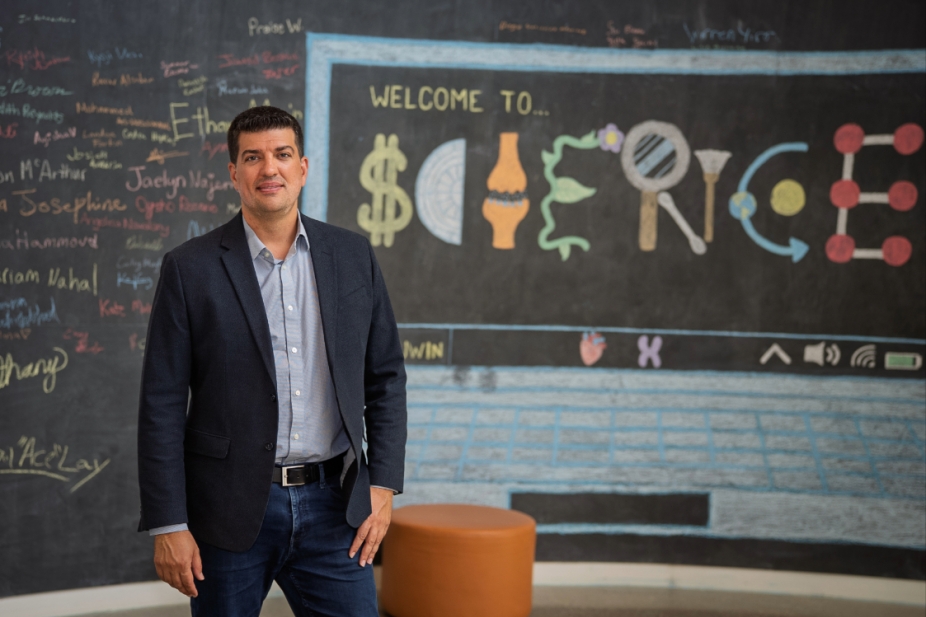 Dr. Nick Vukotic and his research group are working on making the medicines people already take work better. (KYLE ARCHIBALD/University of Windsor)
By Sara Elliott
A University of Windsor researcher is making the medicines people already take work better – and turning that science into jobs, companies and globally commercialized technology rooted in Windsor-Essex.
Dr. Nick Vukotic, Natural Science and Engineering Research Council of Canada (NSERC), and PROTO Manufacturing Industrial Research Chair in the Department of Chemistry and Biochemistry, received a 2025 Impact Award-Innovation through the University of Windsor’s Employee Recognition Awards program, recognizing his work bridging academia and industry.
— Published on Mar 6th, 2026
 Our body’s natural clock — the circadian rhythm — gets disrupted when Daylight Saving Time hits. (Photo by Adobe Stock/University of Windsor)
By Sara Elliott
Nearly half your genome operates on a clock. Daylight Saving Time throws it off.
When the clocks move forward an hour for Daylight Saving Time on March 8, our body’s natural clock — the circadian rhythm — gets disrupted.
— Published on Mar 4th, 2026
 Children's author Christopher Paul Curtis will be taking on the role of writer in residence at the University of Windsor this month. (Courtesy: Nicole Markotic/ University of Windsor)
Famed children’s book writer Christopher Paul Curtis will be taking on the role of writer in residence at the University of Windsor this month.
The Michigan-born author, whose work includes numerous magazine and journal articles along with eight books — including three he penned in Leddy Library — will return to campus Friday, March 6, where he will kick off his month-long residency with the writer in residence’s inaugural reading.
Curtis’s first novel, The Watsons Go to Birmingham—1963, was released in 1995 and brought him immediate and well-deserved recognition.
— Published on Mar 4th, 2026
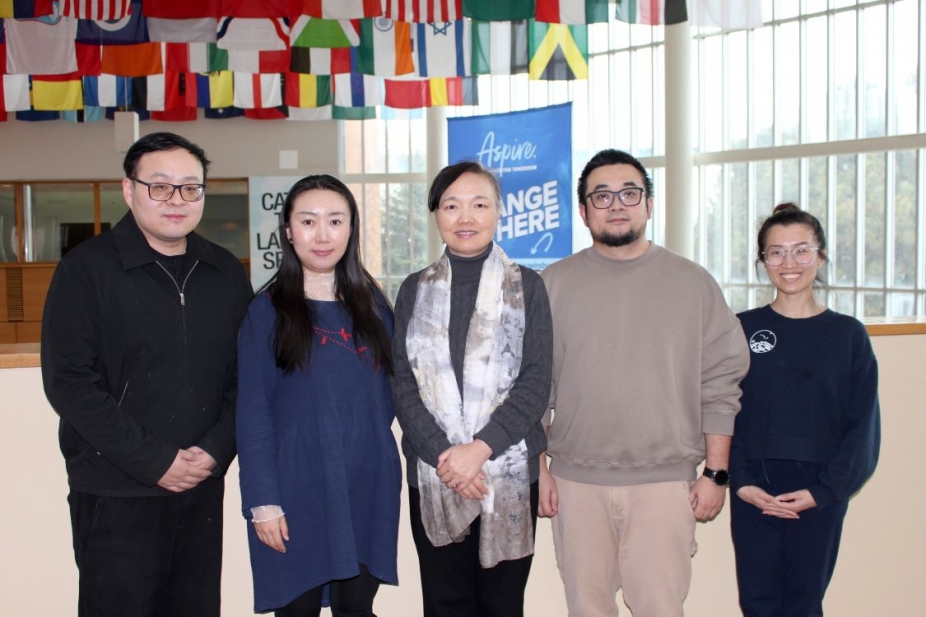 Conference chair Dr. Shijing Xu (centre) with the CSE planning committee (ANGELA KHARBOUTLI/University of Windsor)
By Kate Hargreaves
This August, educational researchers from around the world will share their perspectives as the University of Windsor's Faculty of Education hosts the 3rd Chinese Society for Education (CSE) Annual International Conference.
Taking place Aug. 10 to 12 at UWindsor, the conference’s theme is “West-East Reciprocal Learning for a More Inclusive World: Global Perspectives, Local Practices.”
— Published on Mar 4th, 2026
 Dr. Nicole Markotić is one of the organizers of an upcoming colloquium on precarity in children's literature (left: K.HARGREAVES/University of Windsor; right: CANVA STOCK/University of Windsor)
By Kate Hargreaves
With children’s literature becoming a flashpoint for controversy in both the United States and Canada, the question of who is represented in stories for kids and how those stories are told appears more urgent than ever.
An upcoming colloquium hosted by the University of Windsor department of English will focus on precarity in children’s literature, examining the ways in which marginalized identities are represented in texts for children.
— Published on Feb 27th, 2026
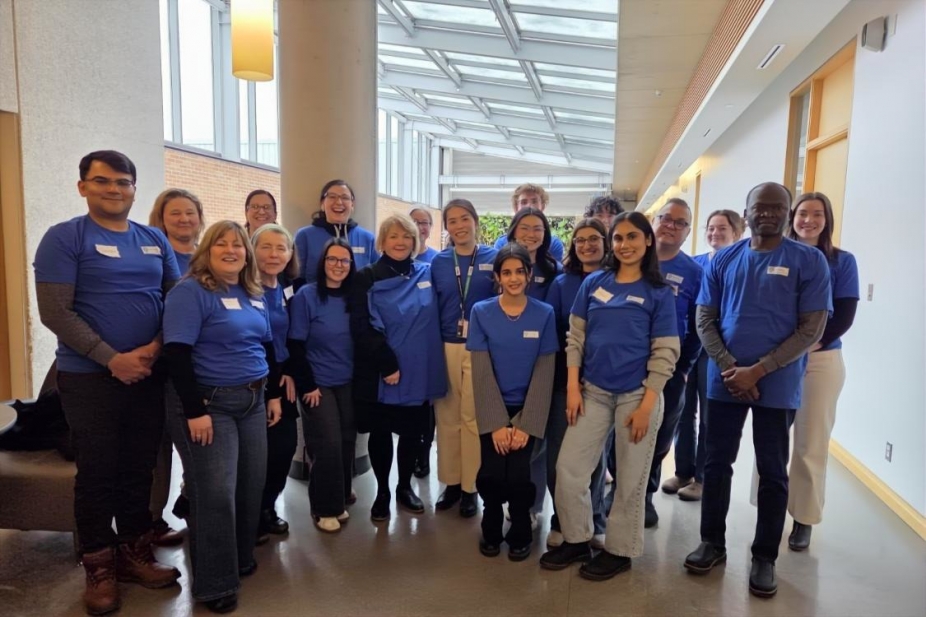 Nursing Faculty, students and Dean gather in celebration of the Faculty of Nursing’s Research Collaborative, highlighting a shared commitment to advancing nursing scholarship and strengthening a culture of research at the University of Windsor. (SARA MEIKLE/University of Windsor)
By Sara Meikle
The University of Windsor’s Faculty of Nursing is advancing its research ecosystem through the launch of the Nursing Research Collaborative.
The new Collaborative marks a significant milestone in the Faculty’s strategic plan. It formalizes three core research pillars while creating intentional space to grow research capacity, foster collaboration and enhance impact across programs and communities.
— Published on Feb 26th, 2026

 The Odette Job Fair held on March 4, 2026, brought students and industry leaders together, sparking conversations that could shape tomorrow’s success stories. (ANGELA KHARBOUTLI/University of Windsor)
